New year means – trying once again to restart 52Frames, and hope that it sticks, and if it doesn’t stick, well, it will have lasted for as long as it will have had, and hopefully I’ll get a few reasonable pictures out of it.
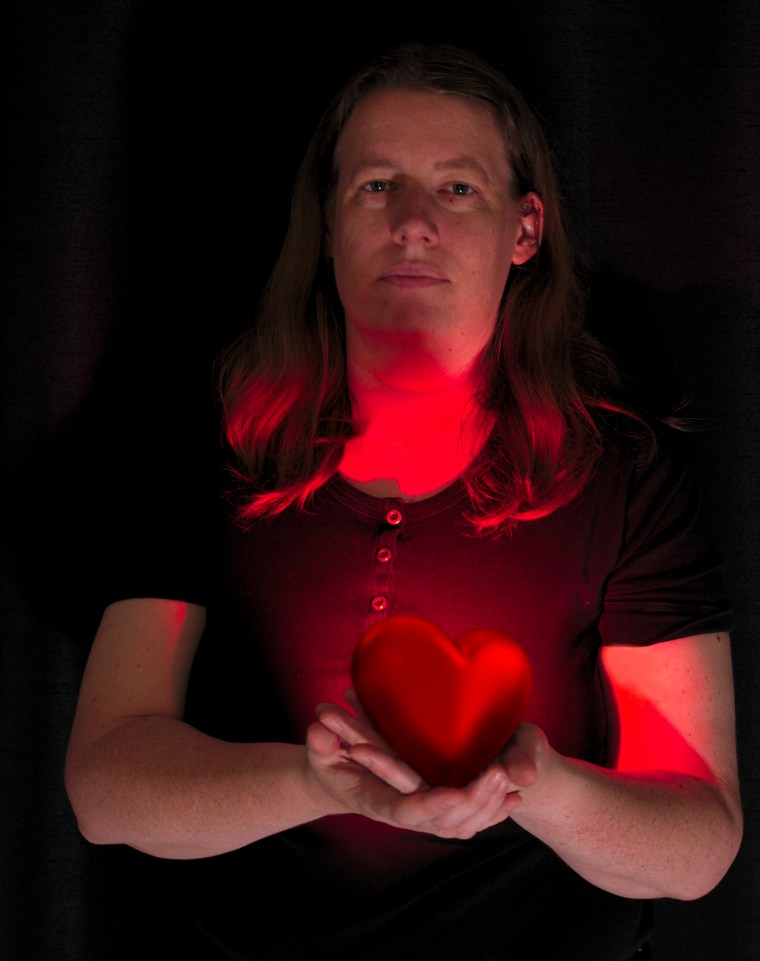
Traditionally, the first 52Frames theme of the year is the self-portrait – it’s actually a pretty good idea to kick-off the year, I think 🙂
Last year, Pierre bought a few Yongnuo 300-III LED panels with which I hadn’t yet taken the time to play. So this self-portrait is my first foray into “proper” portrait photography with a three-point lighting – main light left and above, secondary light right and a bit lower, and light behind to separate the subject (err, me) from the backdrop (err, my black curtain in the TV room.)
I then ran a few edits on Darktable – fixing the exposition and whatnot, removing a couple of really major skin blotches (considering what’s left, I’ll let you imagine what I removed 😉 ), and SHIP IT!
And I decided I was happy enough with it to change my 7+-year old Facebook profile photo – so you may have seen that picture already, but now you get a tiny bit of behind the scenes too 🙂
All right. It seems pretty obvious that even trying to get one #balisebooks a month actually doesn’t work, since I haven’t written one for all of the last trimester of 2019. Giving some more thought about it, I’m thinking that maybe it isn’t the frequency that’s a problem, but the fact that I try to be exhaustive here – and hence ending up procrastinating because there are books that I just don’t have much to say about. So let’s try the “non-exhaustive” approach, where I’m only going to talk about the books I really want to talk about, possibly keep a few books for a stand-alone post if I feel like it (because so far I’ve been avoiding that since I’ve grouped my book reviews in larger posts, and that’s not what I want to do anymore), and if you’re reaaaally interested about everything that I put in my hands, you can have a look at my GoodReads profile. Okay?
How To: Absurd Scientific Advice for Common Real-World Problems – Randall Munroe
The books of Randall Munroe (of xkcd fame) are pretty much an auto-buy for me, and actually usually a paper buy – because there’s enough graphical content that it’s awkward on Kindle. Which puts me in the awkward position of having a book, wanting to read a book, and then not necessarily read it fast because it’s in a format in which I don’t read much. First world problems, I tell you.
The subtitle of the book is a pretty good description of the book – the chapters are named “how to move”, “how to take a selfie”, “how to make friends”, but also “how to build a lava moat” and “how to make an emergency landing” which, admittedly, may be less “common” problems than others. And for each of these chapters, Munroe goes into his version of a “stand-up sketch With Science!”, going into tangents, weird corner cases, and ways to look at the problem that are… pretty uniquely his. To see what I mean, you can read How to Send a File, and have a few giggles. And all in all, it was a brilliantly entertaining holiday read 🙂
Recommended to: fans of xkcd who like Munroe’s absurd approach to things; people who like their pop science with a (large) dash of fun.
The Ten Thousand Doors of January – Alix E. Harrow
I love an intriguing and poetic title, and this one definitely did it for me – definitely an instance of “see title, put book on ‘to read’ list”. The title loses a bit of its mystery when you realize that the main character is called January, and we’re not talking about the month; but the “ten thousand doors” keep their appeal. This novel is the interleaved stories of a girl who finds a Door to another world, and of a scholar of said Doors. The prose is beautiful, I liked the story – which was fairly memorable too. The rhythm feels somewhat slow, especially at the beginning; and for me to say so may mean a lot, because I usually enjoy slow rhythms more than fast-paced plots that explode everywhere 🙂 I almost gave up after the first third, but in the end I’m happy I didn’t, because I did enjoy the story of January.
Recommended to: people who enjoy a beautiful story set in a well-described environment, a slow rhythm and multi-voice narration.
A Ticket for Life – Marzia Mura
This one is maybe a bit of an outlier, because it may not be the most memorable book per se, but it IS a very pleasant read, and since it’s self-published, there’s a fair chance it’s not necessarily on many people’s radar.
It’s the story of Theresa and Andrew – they have a perfect life in a perfectly balanced utopia, part of a closed community that’s shut down from the rest of the world, and who have a very large probability of being able to live forever. But to keep the utopia sustainable, choices had to be made – and the hardest one for Theresa is the strict population control that’s applied to all the community inhabitants. The only way for her to have a child is to win a lottery, which does not happen often in the first place – and Theresa is very decided to skew the odds in her favor.
All in all, it’s a good thriller, and the dystopian world-building is interesting and well done – if you’re in the mood for that kind of story, there’s worse choices out there 🙂
Recommended to: people who enjoy thrillers and dystopian settings.
The City Born Great – N.K. Jemisin
A short story, available here: The City Born Great. The premise is that when a city gets big enough, old enough – it gets a conscience and life of its own. And this time, it’s New York City’s time, and we follow the story of its reluctant midwife.
It’s frankly quite weird. Aaaaand super good. Which is pretty much what I can say about everything I read from Jemisin so far – it’s DEFINITELY more original and more demanding than a lot of things I read, and it’s ALWAYS worth it. There’s a book, due in March, called The City We Became, and that starts where this short story ends – I’m very much looking forward to it.
Recommended to: people who enjoy beautiful prose, engaged writing, and who like their fantasy reading to be challenging and original. Also, everyone, because it’s so short you may as well read it anyway.
Open Borders – The Science and Ethics of Immigration – Brian Caplan and Zach Weinersmith
Like Munroe’s, I tend to pick up most of the things that Zach Weinersmith (of SMBC fame) does. For this one, he’s been very clear that it’s somewhat removed from his usual body of works – Open Borders IS a comic book, but it is a comic book about immigration policy, which may not be the easiest topic (and definitely not the most consensual topic either 🙂 ). In it, Caplan argues in favor of just opening the borders and let anyone who wants to immigrate in any country (well, specifically the US) do so. He goes through the commonly-heard (and less commonly-heard) arguments against it, and proposes solutions/measures to assuage most fears, without being dismissive of them. I learnt some stuff, and it gave me a lot of food for thought on some specific points. I wouldn’t expect that people who are absolutely opposed to the whole concept would change their minds about it, but it does present (at least seemingly) solid and pragmatic arguments.
Recommended to: people interested in political and social questions, who feel they could do with a bit more context and arguments about the immigration topic, and who are not afraid to get their opinions challenged.
Polaris Rising / Aurora Blazing – Jessie Mihalik
A lighter read: if you get a mix of space opera and romance where the space opera is entertaining and the romance is more than decent (hrm. Bad choice of words there. Decency called and is not happy.), I call that a win. Polaris Rising and Aurora Blazing are two novels set in the same universe, where the respective main characters of the novels are two sisters from one of the three High Houses that essentially rule the universe. There is quite a lot of action – , to be honest, sometimes a bit too fast-paced for my taste, likable characters, very good world-building on top of a neat universe. Plus, you know, kick-ass princesses, essentially. All in all, super-enjoyable fluff – and I’m all about super-enjoyable fluff.
Recommended to: lovers of fluff, space opera, and kick-ass princesses.
Comme un roman – Daniel Pennac
(translated to English asReads like a Novel, Better than Life and The Rights of the Reader) I saw Comme un roman in my husband’s mother’s bookshelf, went “ooh, a Pennac I haven’t read”, and read it over Christmas. It’s a collection of four essays – or a single long one – about reading and readers. It starts with kids learning how to read, continue with teenagers learning about literature, teachers teaching and transmitting their love of reading, and ends with a general reader manifesto.
I absolutely loved everything about it – Pennac is one of my favorite French authors, his writing is consistently hitting just the right spot and the right turn of phrase, and his Comme un roman reads like reader candy.
Recommended to: everyone who likes the “meta” aspect of reading.
Everything I Never Told You – Celeste Ng
I started the year with one of the most depressing reads in the past few months, possibly years. Everything I Never Told You starts with the death of Lydia, 16 – and moves around in everything that happened before and the aftermath of that tragic event in her family: her dad, her mom, her brother, her sister… and herself. As we learn more about the family dynamic, we also get some explanation about that night where everything changed. Tragic probably applies to the whole set of circumstances – which is probably what makes that novel so tough. There would be enough flaws in the characters to make them hard to understand, but I found myself empathizing with every single one of them, which makes Everything I Never Told You a fast emotional roller coaster. It’s consequently pretty hard for me to say if I even liked that book. It’s objectively superb, but I don’t see myself ever be able to re-read ever again. I think I want to read more of what Celeste Ng has written, though, so that’s probably a sign I did like it 🙂
Recommended to: emotion-seekers, people who like tragedies and/or family stories.
2019 was the fifth year of Advent of Code – and I consequently spent December waking up at 6AM and spending a lot of brain cycles solving puzzles to bring back Santa from the other side of the solar system, where he was stranded.
Let me quote myself to describe the whole thing to the people who are not familiar with it. Advent of Code is an advent calendar with puzzles that can mostly be solved by programming: the input is a problem description and a user-specific input (as far as I know, there’s a set of a “few” pre-validated/pre-tested inputs), and you have to compute a number or a short string, and provide that as a result. If you have the correct result, you unlock a star and the second part of the puzzle, which allows to unlock a second star. Over the course of the 25 first days of December, you consequently get to collect 50 stars.
When I wrote my Advent of Code 2018 blog post last year, it was December 26th, and I had solved everything – this year it took me until yesterday (so, December 31th) before I got the 50th star. I don’t know if the problems were harder or if I got worse at solving them (maybe a mix of both?), but I still made it before the end of 2019, so I’ll count that as a win 🙂
This year, I worked in Kotlin, a JVM-based language designed by JetBrains, and that I enjoy quite a lot – it is fully compatible with Java, and allows for a much terser syntax, and requires to do things explicitly when it comes to mutability of variables and collections. I like it. My solution repository is on GitHub – beware, here be dragons… and spoilers!
And, like last year, let me give a few impressions of the different puzzles for this year. I WILL spoil the problems and at least hint at their solutions – if you want to start solving the problems with no preconception at all, you may want to stop reading here 🙂
darktable 3.0.0 [text] has been released last week. I’ve been using it for all my photography processing for the past few years, and I’m thoroughly impressed by what it can do and by the people behind it.
We Learned to Write the Way We Talk [text] – I thoroughly enjoyed Gretchen McCulloch’s Because Internet this year, where she looks at Internet communication from a linguistics perspective – this article is a nice taste of what’s in the book, and an interesting view on writing styles.
Copperplate Study Session [text, images] – I’ve been playing with Copperplate calligraphy a bit last year, and it’s in my objectives for next year to master that, and I think this series of Reddit posts on the topic may just be what I was looking for 🙂
I’ve recently learnt about figurate numbers [text, images] by way of learning about heptagonal numbers [text, images] (via some middle school math homework), and I spent enough time on Wikipedia to warrant their entry in coolstuff 🙂
Quanta Magazine has run a few articles about what happened this year: The Year in Math and Computer Science [text], The Year in Biology [text] and The Year in Physics [text]. I had seen almost everything in the “math” article, so it was a nice trip down “memory lane” on things I thought were cool at the time (and a few that I had missed); the “biology” and “physics” ones were nice entry points to stuff I had mostly missed.
My problem with metric recipes [short video] – the title of the video let me fear the most trollful content, but that would be selling Adam Ragusea short – it’s actually quite insightful, and he’s making great points about recipe translation.
Micro chess / DIY [video, mid-length] – a video of someone making a tiny chess set. It’s super impressive, adorable (because TINY) and generally exquisite.
Markus Reugels on 500px [images] – someone doing (among others) very cool pictures of drops and splashes.
It’s Way Too Easy to Get a .gov Domain Name [text] – there IS a quote in there that says “I never said it was legal, just that it was easy”, but I still found it an interesting read 🙂
Fraktur and the psychology of type [text] – an article about the fraktur typeface and its association, in particular in Germany, with the Nazis – and the impact of that association in today’s print and calligraphy practice.
Making chocolate colourful – apparently there’s a way to make chocolate shimmer with structural properties. That’s pretty cool 😀
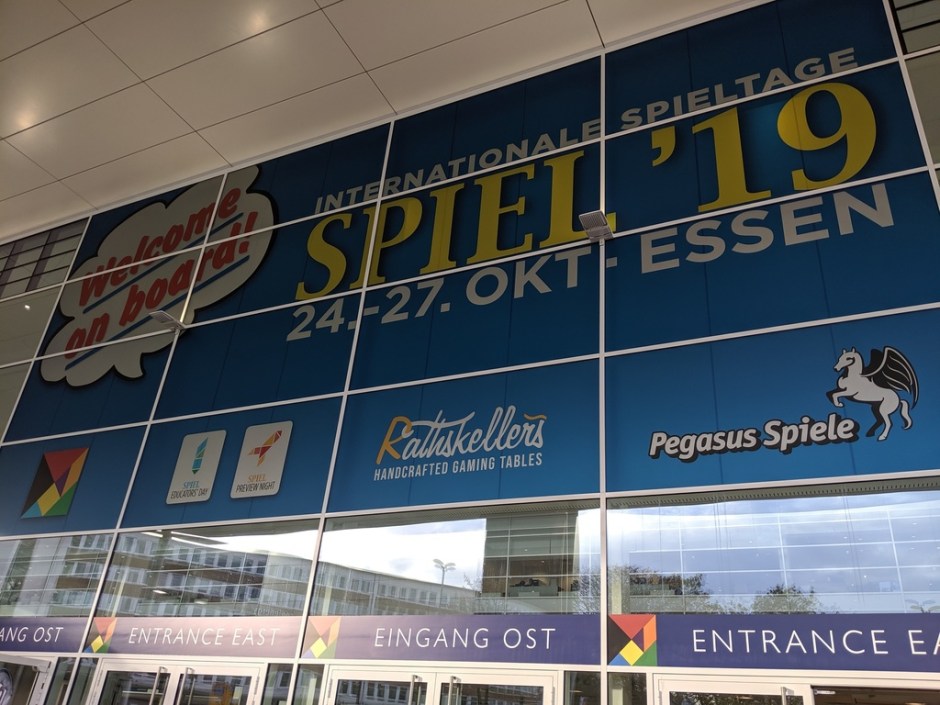
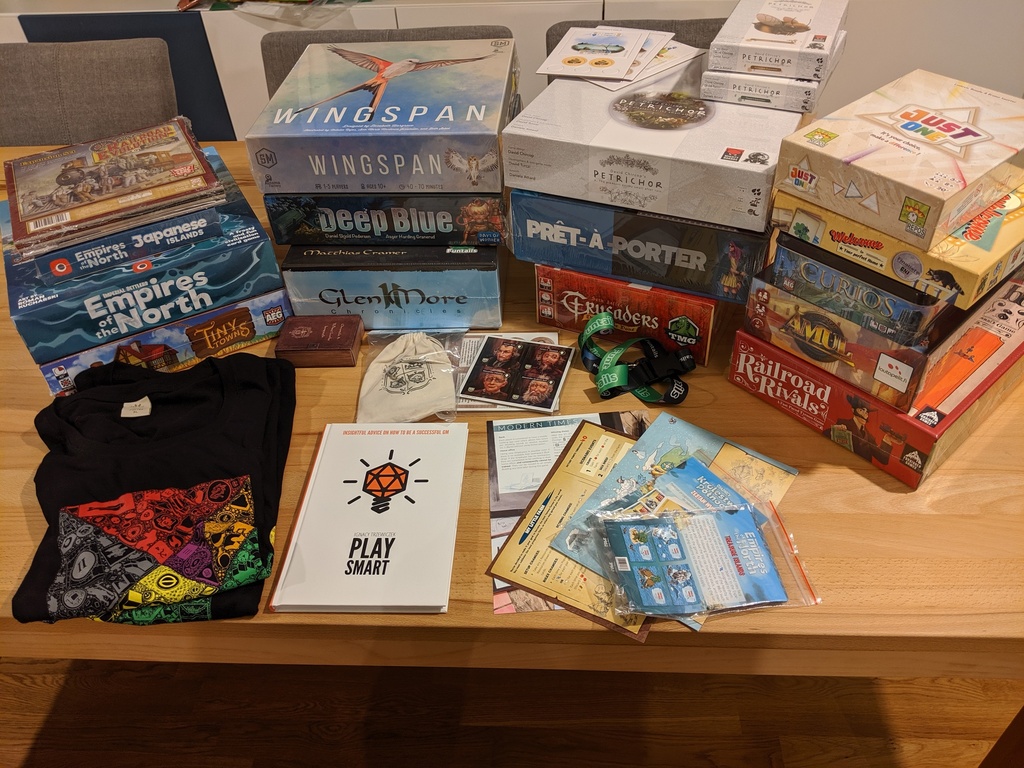
For the fifth year in a row, we went last week to Essen for the SPIEL board game fair. Four days of wandering in the halls, of playing a fair amount of games, of shopping… and a few very nice restaurants and cocktails in the evening, because why not 😉
This year felt somewhat less crowded than the previous years, to the point that I got slightly worried – but they did announce a 10% increase in visitors compared to last year (reaching 209K visitors); I guess the increase in surface compensated for that. But let’s talk games!
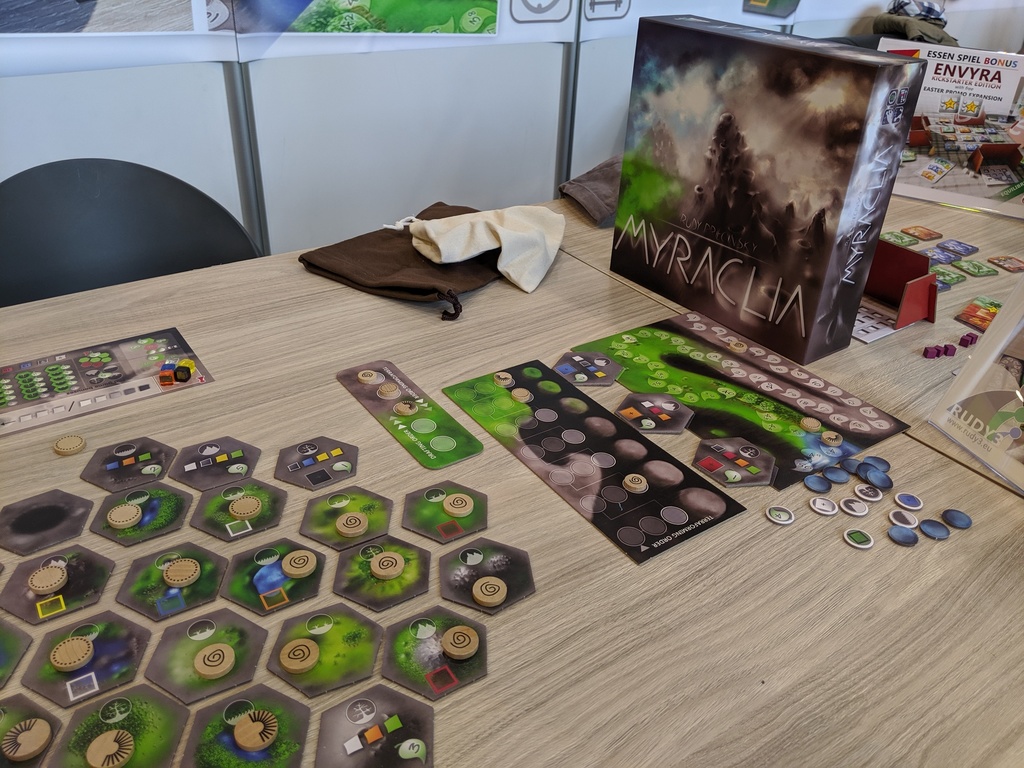
Myraclia, Rudy3 – a game where players draft cube ressources from a randomly-chosen pool, and use these cubes to terraform tiles that may give bonuses for the following turns. Very pretty and interesting mechanics; the game is on late pledge/pre-order on Kickstarter, and we ordered it.
Myraclia, Rudy3
Copenhagen, Queen Games – I liked the box art, and that’s probably the main reason why this game ended up on my list of “things I’d like to have a look at”. It’s a game where players gather cards to buy polyomino tiles to build a building facade and gather victory points as they go. It’s not a bad game, but it didn’t really click with any of us.
Imperial Settlers Roll&Write, Portal Games – a common dice roll is used as number of actions and resources to build a civilization over 10 rounds. I quite liked it, and I think I would like the solo/adventure mode, but as it is it’s a bit annoying to remember how many actions you did (and you can probably end up going to do 6 or 7 on one turn, depending on bonuses) and the resources you’ve used. Not convinced enough.
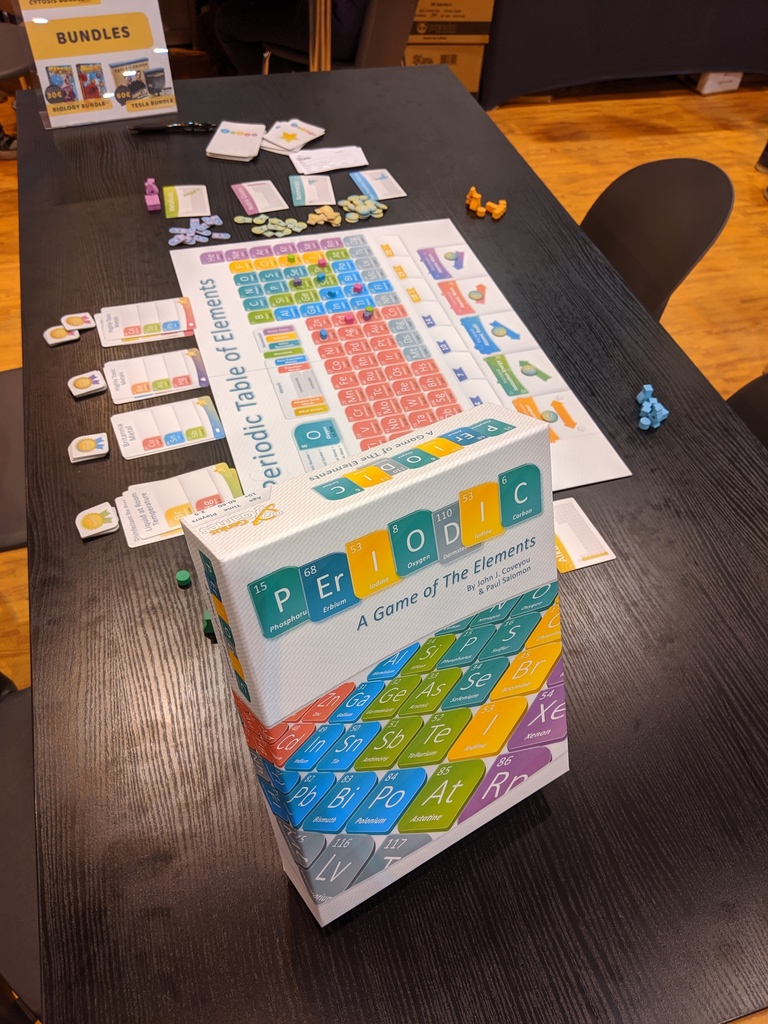
Periodic, Genius Games – I think we both really wanted to like that one, because how cool/nerdy is a game where you move around the periodic table? And where, when you ask if there’s a way to get more energy to move around the periodic table, the person at the demo explains to you that “well, no, because energy is never created or destroyed, duh”? And it is indeed pretty cool to zoom around the periodic table, but the mechanics themselves felt pretty flat. Let’s put it that way – as an educational game, it’s probably a good one; as a themed game, it was a bit disappointing.
Periodic, Genius Games
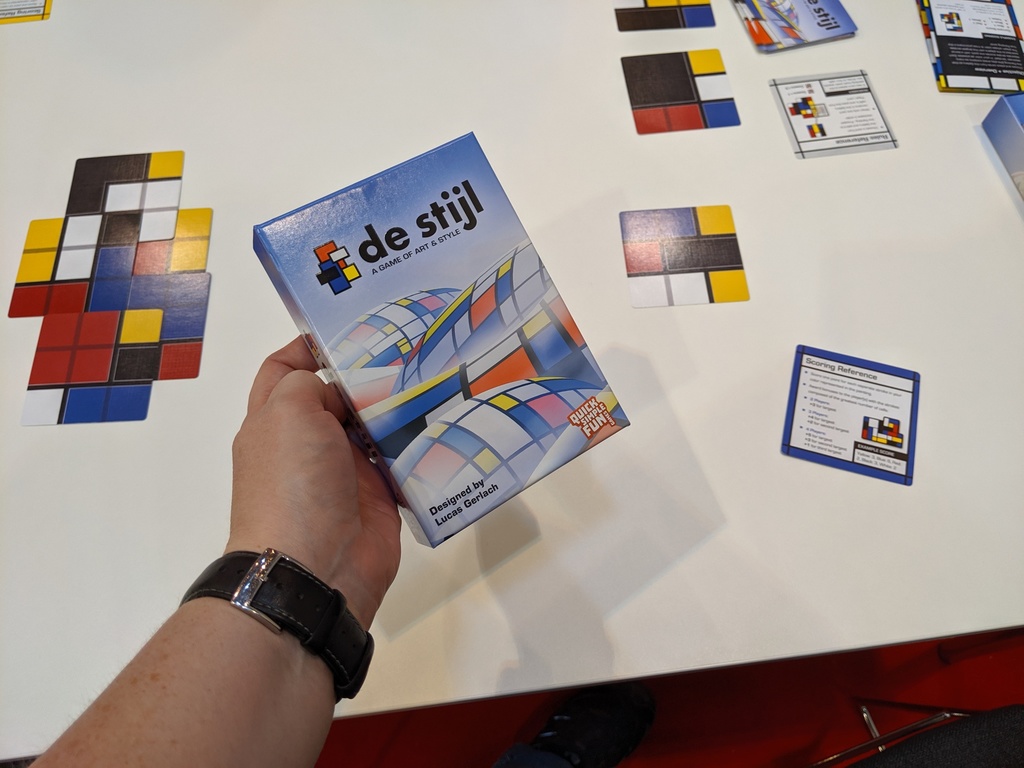
De Stijl, Quick Simple Fun Games – this one caught my eye because of its Mondrian aesthetics. Players add cards displaying 9 colored squares to the game, covering between 2 and 5 existing squares; at the end of the game, the score is computed both on the number of distinct areas and on the size of the largest area. Quite pretty, and probably takes a few games to master, but not necessarily our type of game.
De Stijl, Quick Simple Fun Games
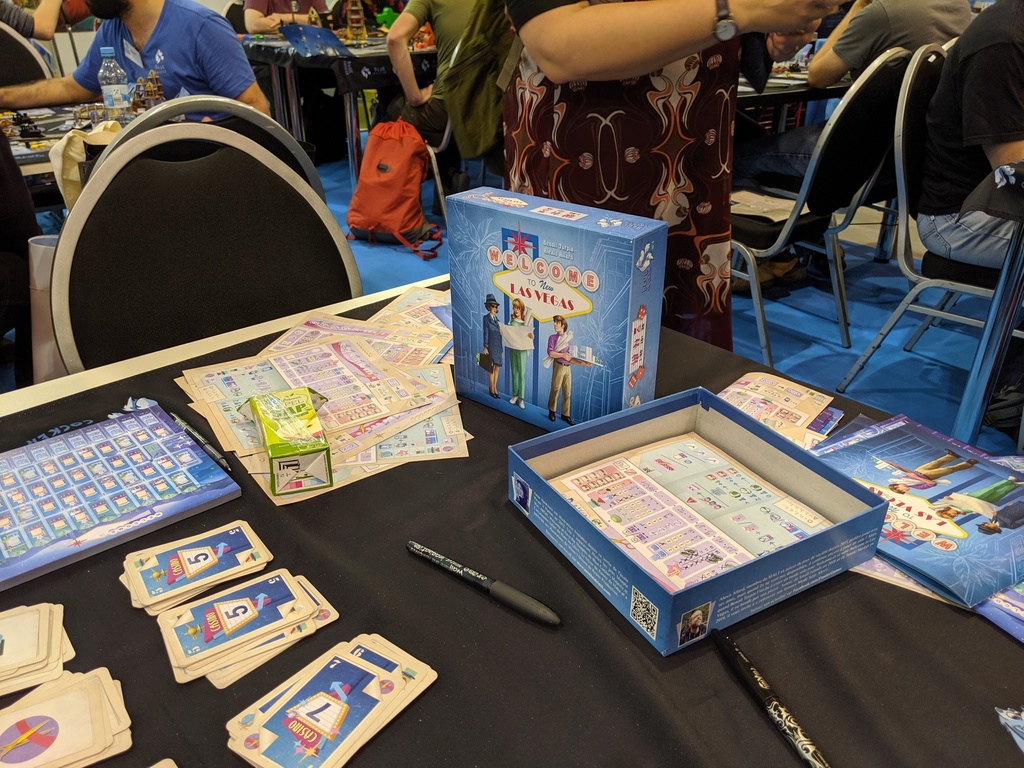
Welcome to New Las Vegas, Blue Cocker – a roll&write without dice 🙂 Players need to build casinos on their sheet, and to achieve that there is three decks of cards that give a number (that yields constraints on its placement on the sheet) and actions (that allows to eventually win points). Actually quite fun, although we messed up a rule that made our scores explode compared to the typical score 😉 However, it’s not available yet! Buuut it’s a new take on another game, Welcome to Your Perfect Home, where players build houses instead of casinos – so we got that one instead. The “Las Vegas” version is slightly more complex, but Perfect Home has another interesting set of constraints and goals – where most of the player interaction happens, since there’s a race to reach these goals first.
Welcome to New Las Vegas, Blue Cocker
Empire of the North, Portal Games – a close cousin of Imperial Settlers, which I like a lot. Players also get to build their civilization and engine by adding cards to their board, and there’s a few additional mechanics, such as the possibility to go explore distant islands that yield extra bonuses. The food tokens still look like tomatoes (although they’re officially apples), and there’s also get fish as well in this version 😉 Pierre says it’s the game Imperial Settlers should have been; I might agree. We bought it as well as the Japanese Islands expansion.
Paranormal Detectives, Lucky Duck – we didn’t play that one, we only watched the explanation and the beginning of the game. Someone has been killed, and their ghost is haunting the detectives in charge of the case in order to make them understand what/where/how everything happened. And for that, they have a number of means at their disposal, that go from miming to a ouija board or even trying to assemble a hangman rope to give clues. That actually looked pretty fun, but probably not a good fit for us 🙂
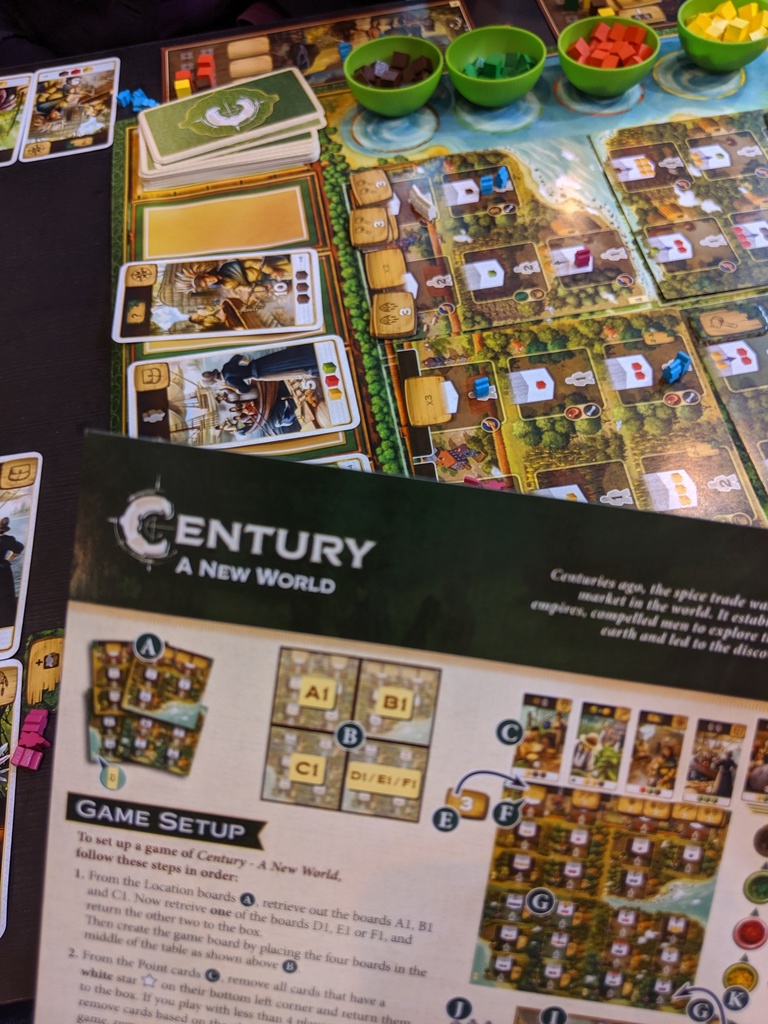
Century: A New World, Plan B Games – the third game of the Century set of games, which can all be played individually or combined. The base mechanics is the same for all three: players can gather resources that they can upgrade via different actions. In the first game, the actions are given by cards that can be bought; in the second game, the actions involve moving on a map; in the third game, we get worker placement mechanics. We both like the first game and its simplicity – it has the same feeling as Splendor, and a bit more complexity, and the Golem edition is very pretty; New World is kind of nice, but not necessarily the one we’d buy in this collection.
Century: A New World, Plan B Games
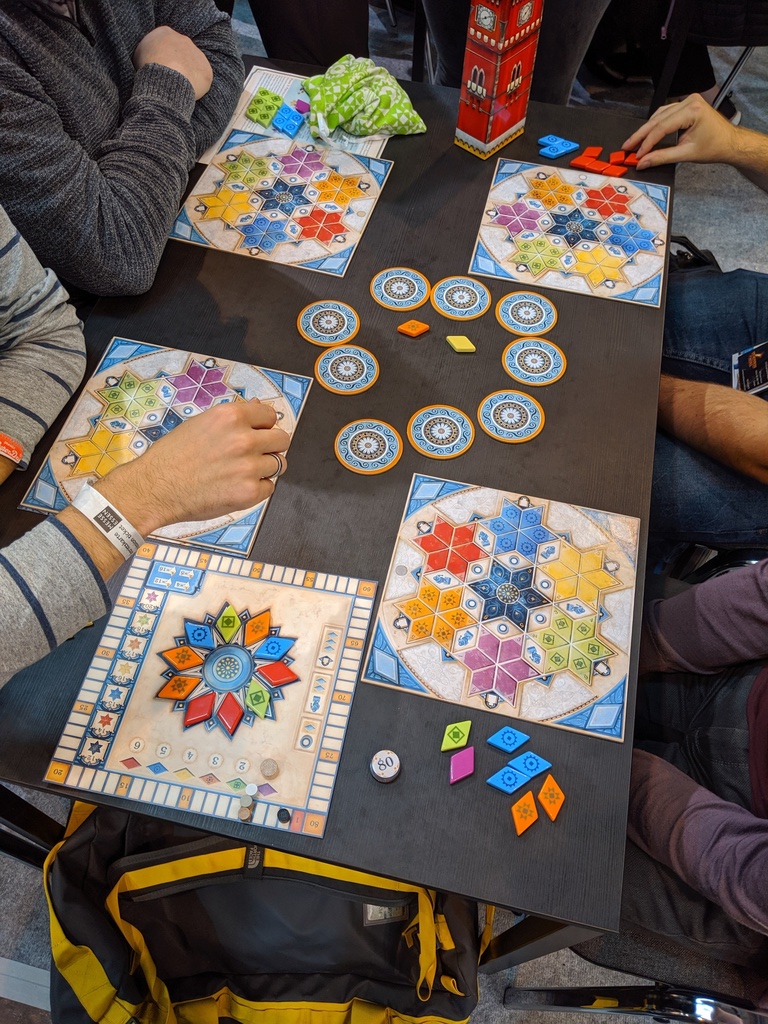
Azul: Summer Pavilion, Next Move Games – we also didn’t play this one, only got a vague idea by watching people play for a few minutes. It’s the third Azul game, with the same mechanics of picking tiles as the first two (except now there’s also wildcard tiles). Here, the tiles are put on stars, where each branch of the star needs a different number of tiles. The mechanics of placement are slightly different from the other two Azul, but not necessarily enough of a different game to justify a buy, considering we already have (and enjoy) the Stained Glass version. It still looks very pretty, though.
Azul: Summer Pavilion, Next Move Games
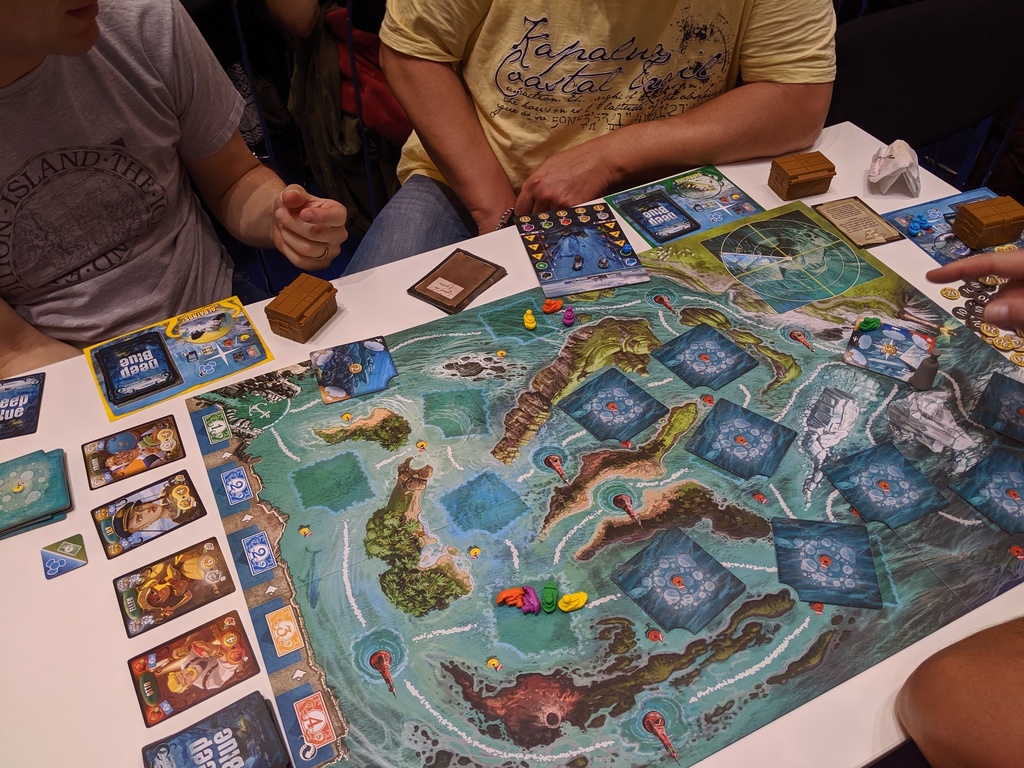
Deep Blue, Days of Wonder – the Days of Wonder of the year. This time it’s a push-your-luck game, with a diving theme, where players try to get the largest amount of treasures (and hence monies, and hence points) without getting hit by the lack of oxygen or harpoons. They start with a hand of cards that allows different actions and, to help them, they can recruit more people (get more cards) that will get them bonuses or additional actions. I liked it way more than I thought I would (it’s fun!), the production quality is at the usual very high Days of Wonder standards, it plays up to 5, and we ended up grabbing a copy (finding a non-German copy in the Asmodee shops ended up being a fail; we ended up finding a French copy directly at Days of Wonder where they had a few French boxes behind the desk.)
Deep Blue, Days of Wonder
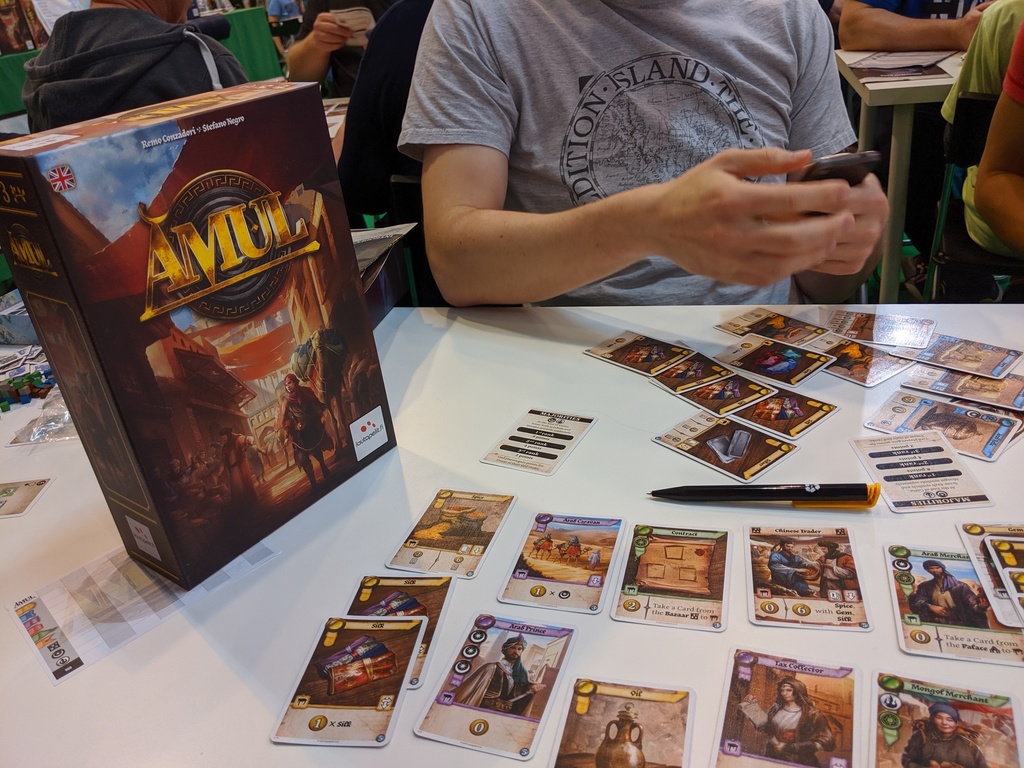
Amul, Lautapelit – we had played a prototype of that one last year under the name Silk Road, and it was a pleasure to see the final version and to play it again (with a group of people coming from Singapore!) At every turn, players get a new card, choose a card to put on the common market, pick a card from said common market, and play a card on their board, trying to gather sets and get actions that will eventually build points for the end of the game. The extra twist is that some cards only score when they are kept them in hand, and some cards only score when they are put on the table, yielding agonizing decision-making about what to do since it IS mandatory to put a card on the table 😀 Really liked it, and it plays up to 8 with mostly simultaneous playing; we grabbed a copy, and I’m looking forward to play it again.
Amul, Lautapelit
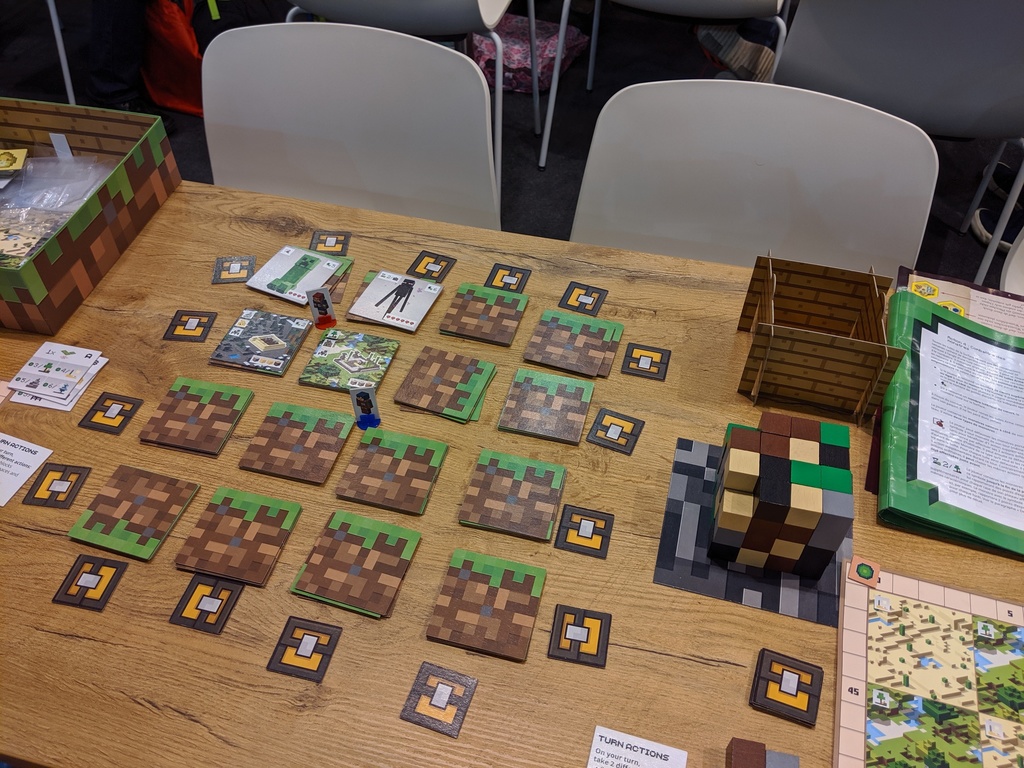
Minecraft: Builders and Biomes, Ravensburger – a board game adaptation of, well, Minecraft. Players can gather resources by mining them in a cube of resources, discover tiles, reconfigure their board, fight monsters, and score points doing all that. It is actually a very good adaptation of the video game, it’s not very deep but I could see that one working well in a family with kids – both simple enough and strategic enough for everyone to have fun. It’s a bit sad that the cardboard bits feel very flimsy (and that the scoring markers are larger than the scoring tracks! Infuriating 😉 ) Not a buy for us, but I’m keeping it in mind as a gift idea for that kind of situation 🙂
Minecraft: Builders and Biomes, Ravensburger
Glenmore Chronicles, Funtalis – a game full of Scotsmen and Scotland places and whisky, where players build their settlements by getting tiles on a track, producing resources, using resources, and trying to optimize the placement of their tiles to be able to activate them at all. One of the twists is that players get negative points at the end depending on the size of their settlements (the more tiles, the less points), so they need to get “as large as necessary, but not larger”. I lost that game SUPER BADLY, but I still enjoyed it a lot, and we came home with a box. On top of that, there’s 8 mini-expansions within the game, that all come with their little box that looks like a book, and that’s completely adorable (and no, I don’t have a picture, but believe me, it’s adorable.)
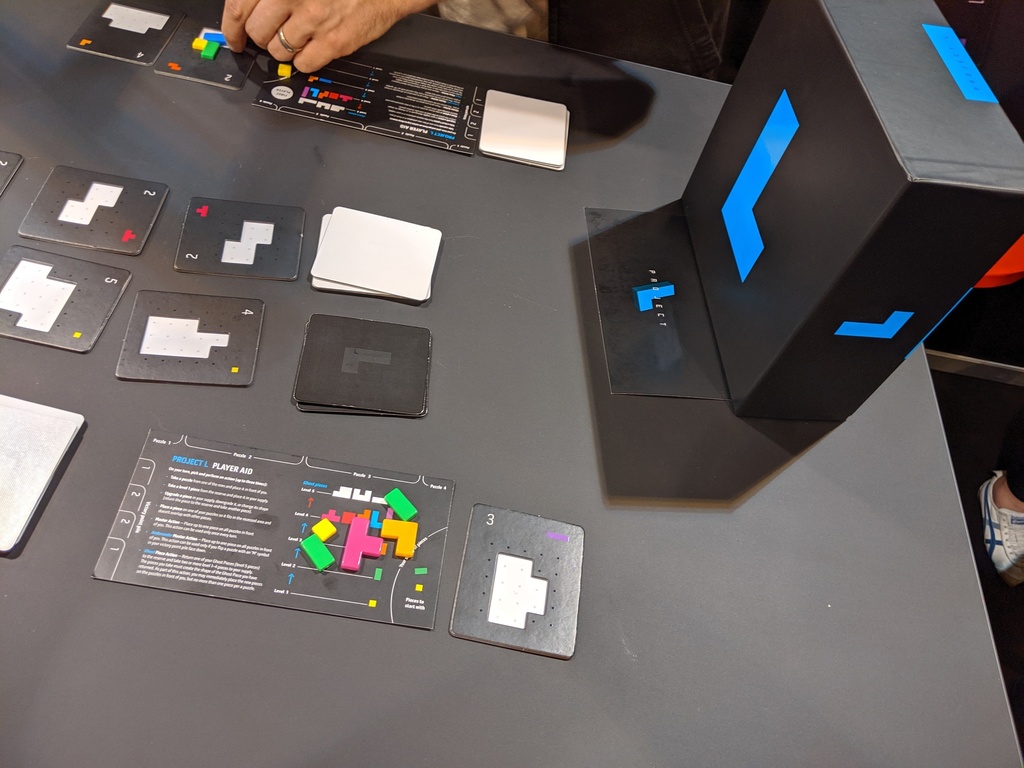
Project L, Boardcubator – players start with small polyomino pieces that they can upgrade, downgrade or change to other ones, and objective cards for which they need to gather a set of polyominos making the shape of the card (a bit like a tangram). They keep their polyominos and typically get new ones, which allows them to build more and more complex objective cards – and hopefully get more and more victory points. It’s quite pleasant and the material is really nice; I think it might have been a buy if it had been available on the booth (but it’s not out yet).
Project L, Boardcubator
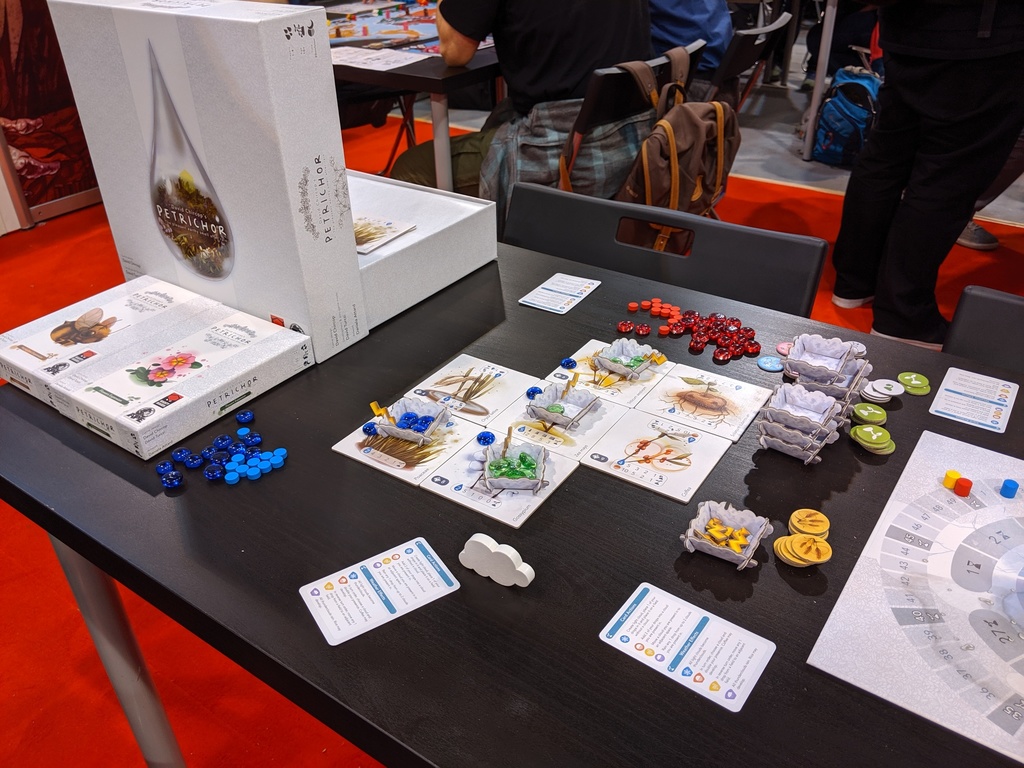
Petrichor, Mighty Boards – a wonderful theme, since players get to play CLOUDS! They need to move around and strategize to rain at the right time on the right crops to get victory points. It’s quite brain-intensive because most of the actions have a delayed effect, but it looks really interesting, although I’ll definitely get an extra game or two to really get the feel for the game. We were on the fence for a while about getting it, but we ended up grabbing a copy at the end of the fair.
Petrichor, Mighty Boards
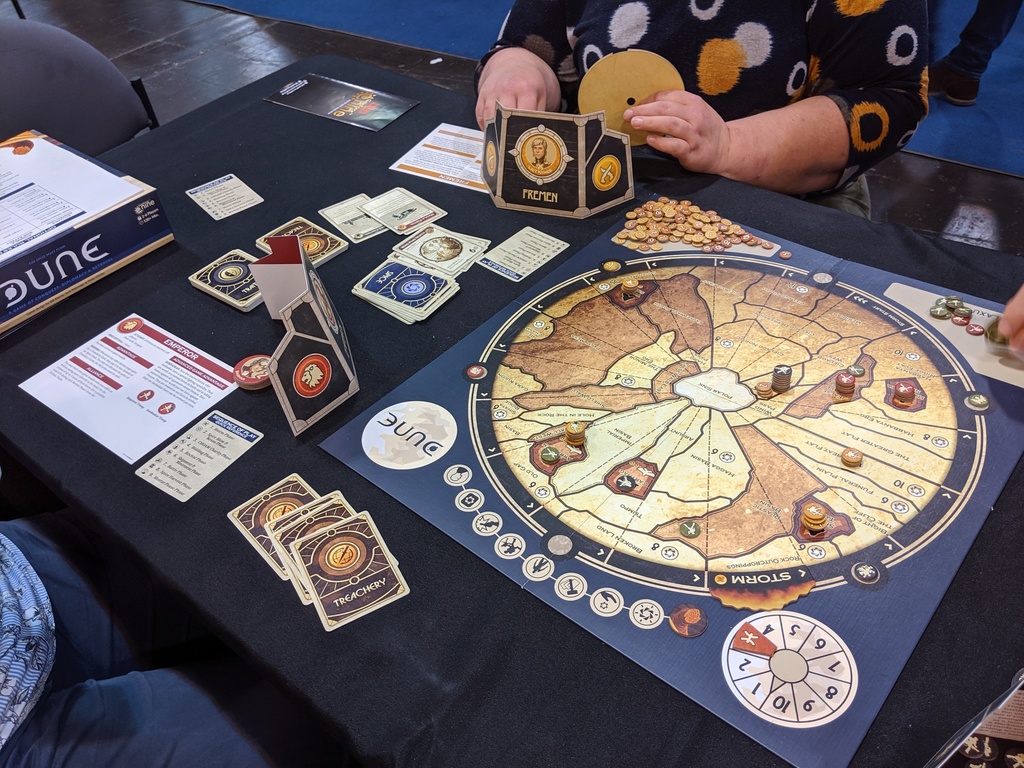
Dune, Gale Force Nine – yes, THAT Dune. I think this was the largest surprise for me this year. I tend to shy away from that kind of game that has diplomacy and alliances and mind games as a selling point. But we had a short talk with someone at the booth one of the evenings who was actually quite enthusiastic and selling it very well, so we ended up grabbing a demo game when we saw a table was getting free (while we were mulling over the Petrichor decision at the next booth). I was very, VERY lost at the beginning of the game because the explanations were somewhat confusing (to a very unpleasant point), but I finally got somewhat of a feel for the game and I ended up liking it a lot. The theme is strong, I played Harkonnen and I really enjoyed it, and it ended up being a game I reaaaally wanted to play again. They were out of stock on site, but they apparently had a bit of stock in an external warehouse; we ordered a copy, and it will hopefully arrive in our shelves soon.
Dune, Gale Force Nine
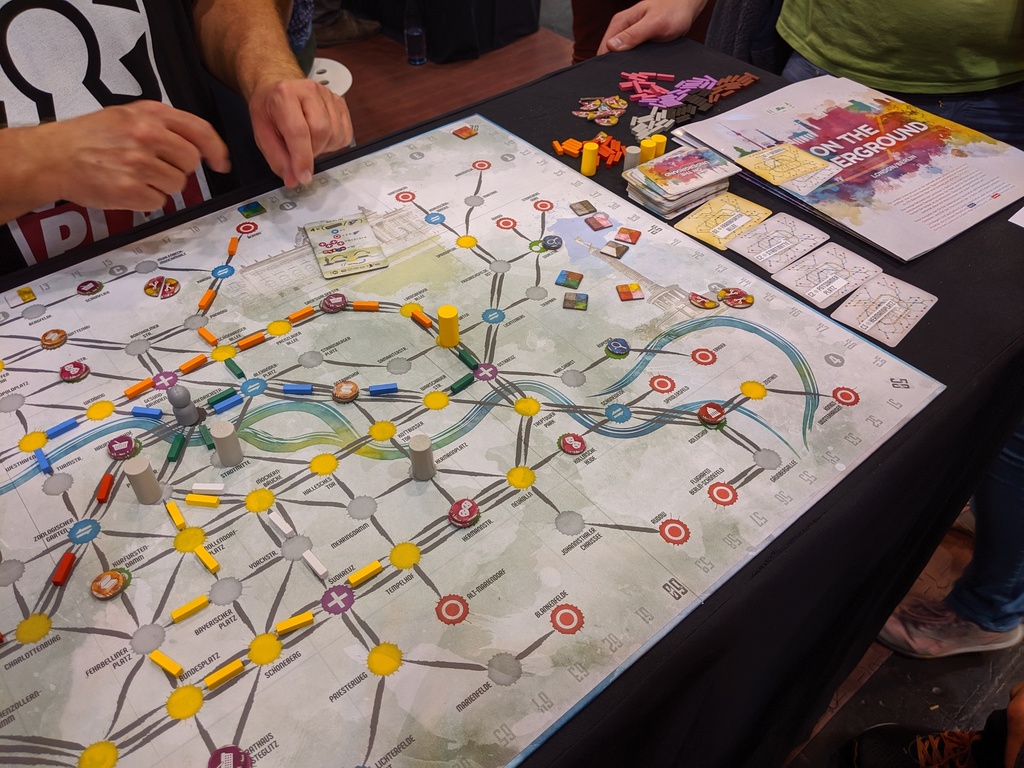
On the Underground: London/Berlin, LudiCreations – a transport network construction game where players try to have passengers move to their destinations in an optimal way. We only got the 3-minute explanation, no demo game, and I must admit I phased out for most of it (I probably got tired at that moment), so… I kind of don’t know 🙂
On the Underground: London/Berlin, LudiCreations
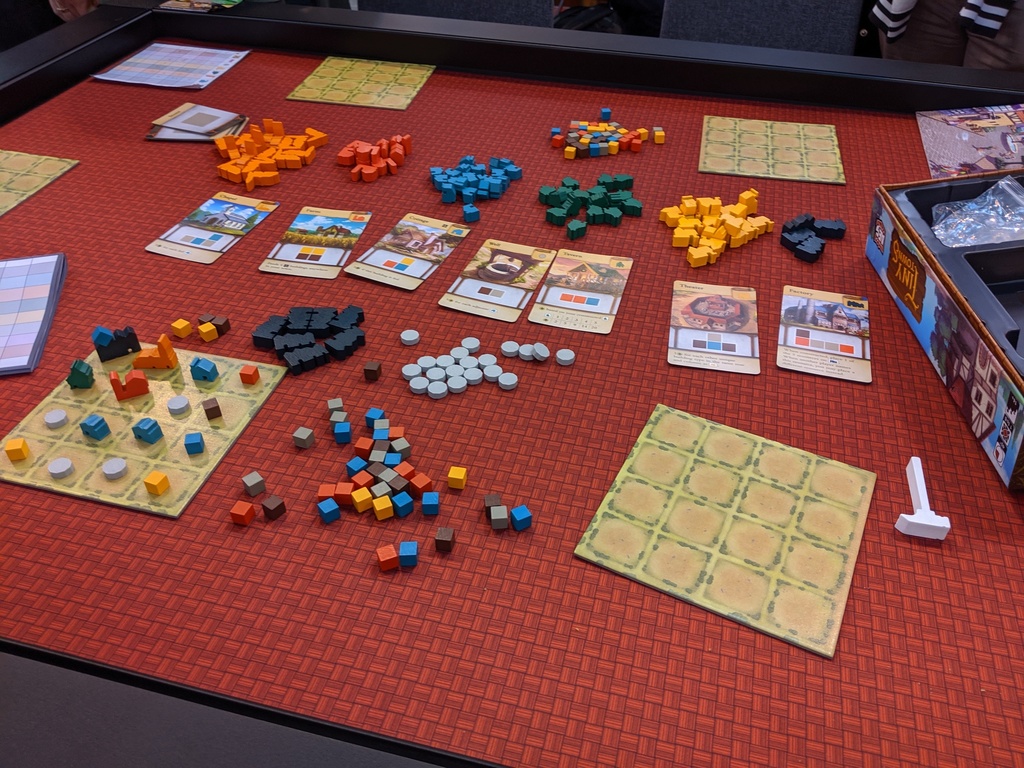
Tiny Towns, AEG – a game where players gather resource cubes (via a common card mechanism) to build buildings on their own board using geometric constraints. I liked it a lot – we got a copy, which also unlocked THE GIGANTIC AEG BAG (people who ever went to Essen know what I’m talking about 😉 ). I don’t THINK it had anything to do with the fact that I nuked the rest of the table, score-wise, but it sure didn’t harm 😉
Tiny Towns, AEG
Curios, AEG – we usually don’t spend that much time on the AEG booth, and it may be a good thing, since we ended up buying this year the two games we tested by them! Curios is a game where players are trying to get the most value from artifacts that they can gather; the twist is that they do not know the exact value of said artifacts, they only have a few clues. It ends up being fun on a game theory level, and generally speaking quite enjoyable, short, and playing up to 5. We got a copy.
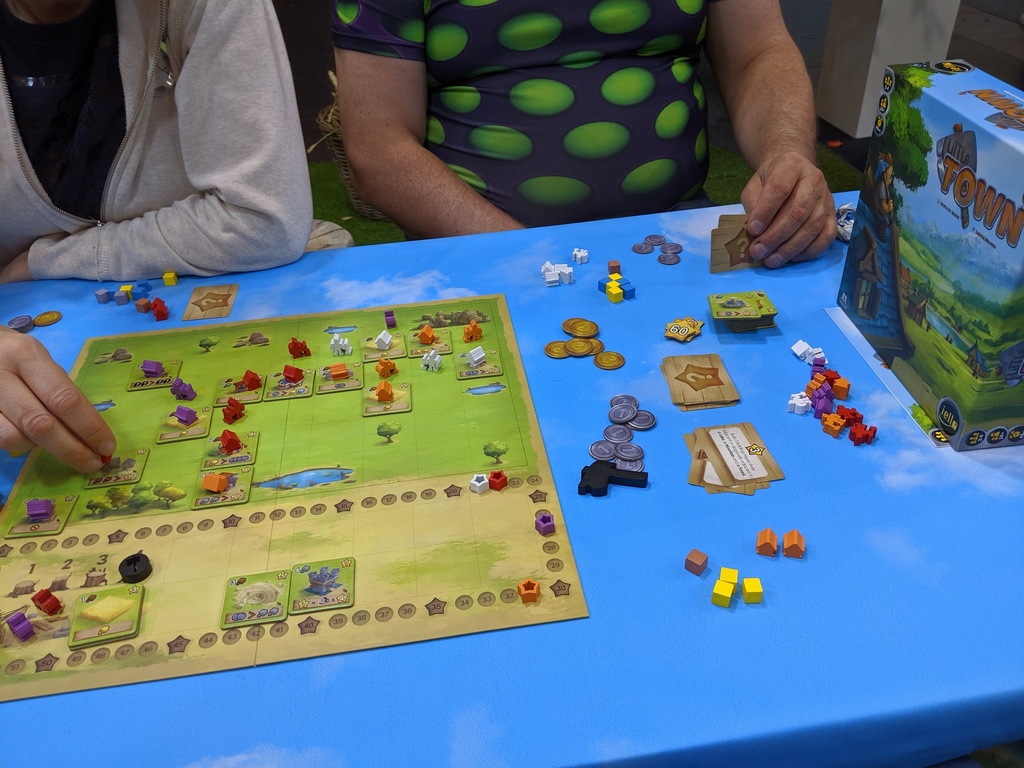
Little Town, Iello – players build a common city by adding tiles to a board and activating tiles around their player marker to gather resources (allowing to add more tiles). There’s nothing wrong with it, and it’s even a pretty good game I think, but it just didn’t click for me. I might have enjoyed it more at another moment, or, or, or (we’ll never know!)
Little Town, Iello
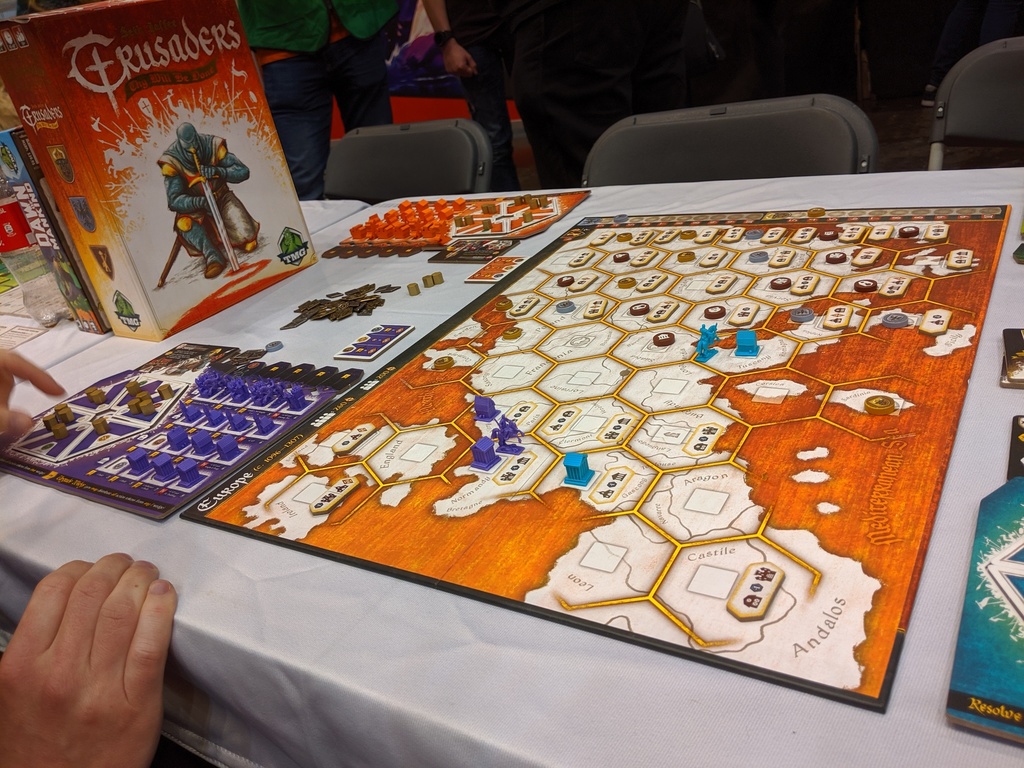
Crusaders, TMG – I must admit the theme is not necessarily something that appeals to me, but I really liked that game. Players get to move, build or attack according to a wheel around which they move tokens to get actions that are more or less strong, and the building that they build make these actions stronger. The wheel mechanic is a mix between the one from Finca and the meeple handling of Five Tribes; the whole game does have a bit of a Terra Mystica feel, and we ended up getting a copy. And since they were out of the regular box, we got the Deluxe edition – which has metallic victory points and very cool minis 😉 (And a metal sword as a first player token!)
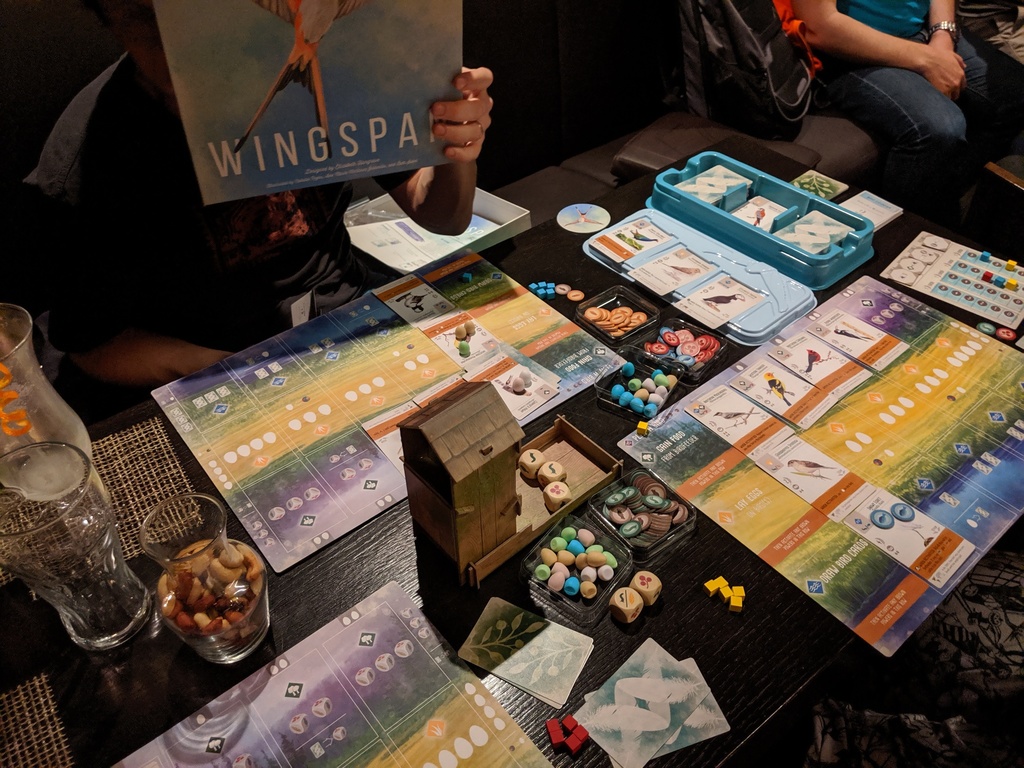
Wingspan, Stonemaier Games – I had been looking for an English demo of Wingspan to no avail on the fair – but thankfully a friend with whom we had shared a few cocktails in the evening found an English copy and we got to play it at the hotel bar in front of a couple of drinks 🙂 It’s a bird collection and engine building game, it’s gorgeous (THE EGGS!), it’s the Kennerspiel des Jahres for this year, and it’s absolutely deserved. We found another English copy by chance at one of the store booths, and we didn’t hesitate much before buying it.
Wingspan, Stonemaier Games
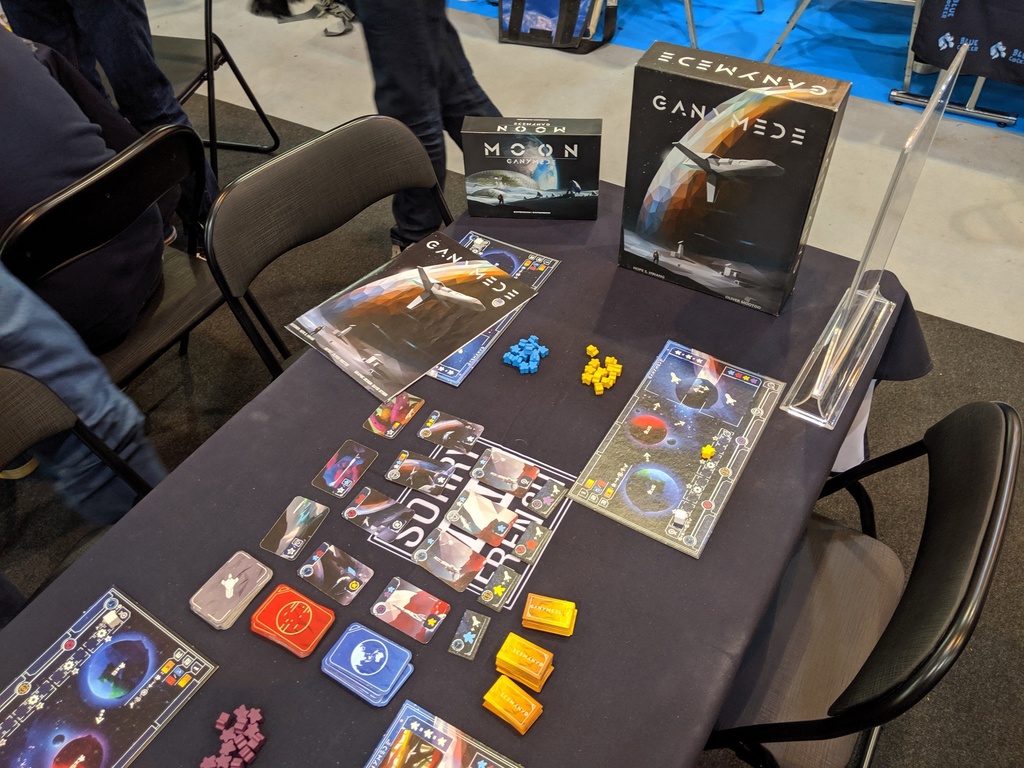
Ganymede, Sorry We Are French – a racing game where players want to get their meeples from Earth to Mars to Ganymede, so that they can fly to galaxies far far away on their rocket ships. Quite pleasant, cool mechanics, but it apparently didn’t click enough to be a buy.
Ganymede, Sorry We Are French
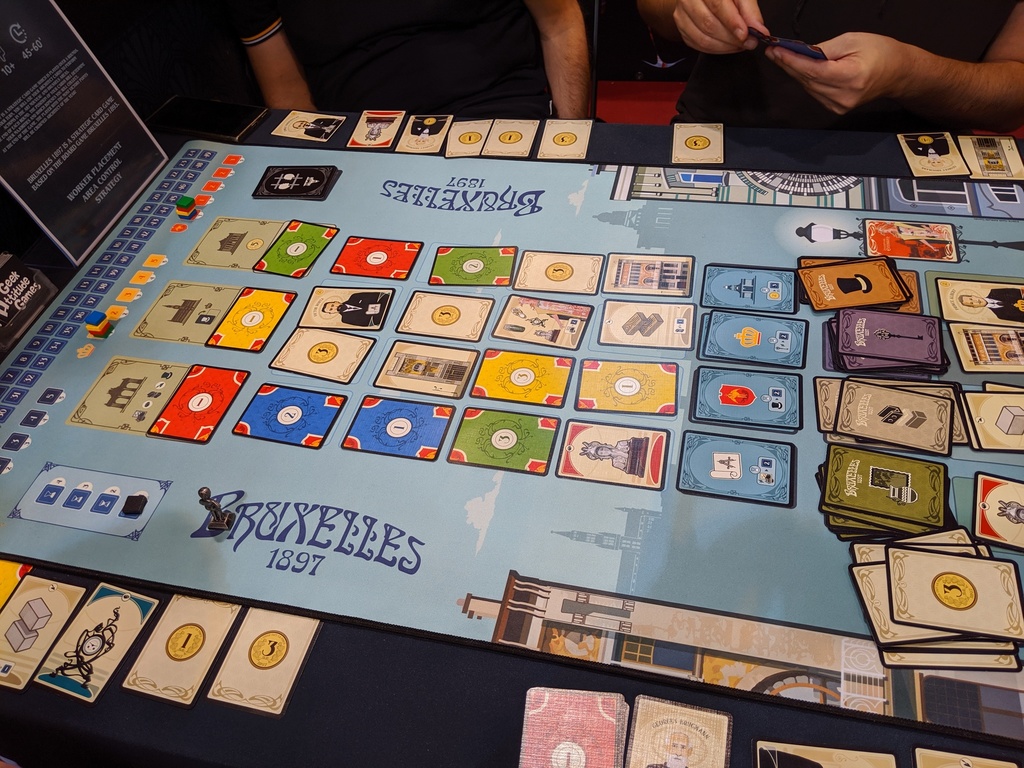
Bruxelles 1897, Geek Attitude Games – I was intrigued by the Art Nouveau art, so I was happy when we found a table. Players get cards on a grid that give them different advantages; the twist is that the scoring also depends on the placement on said grid, and more specifically on the majority of money spent by players in each scoring track (column of cards). I’m not sure why I didn’t like it more, because it had potential to tick a lot of boxes, and it’s objectively well made, but it really didn’t click for me.
Bruxelles 1897, Geek Attitude Games
Just One, Repos Production – the Spiel des Jahres for this year. As far as we could tell, there was only one English table (and a lot of German ones) – and, definitely, for a word game, English is better for us 🙂 It’s a light cooperative party game, somewhat akin to Concept (by the same publisher) – one player try to find words that the other players are trying to make them guess. All players get to write a clue, but if a clue is given by more than one player, it gets eliminated before the guesser has a chance to look at it! So clues need to be helpful but not obvious, and it’s generally speaking a lot of fun (and sometimes downright impressive). We got a box, because why not – it can be a nice change from Codenames 😉
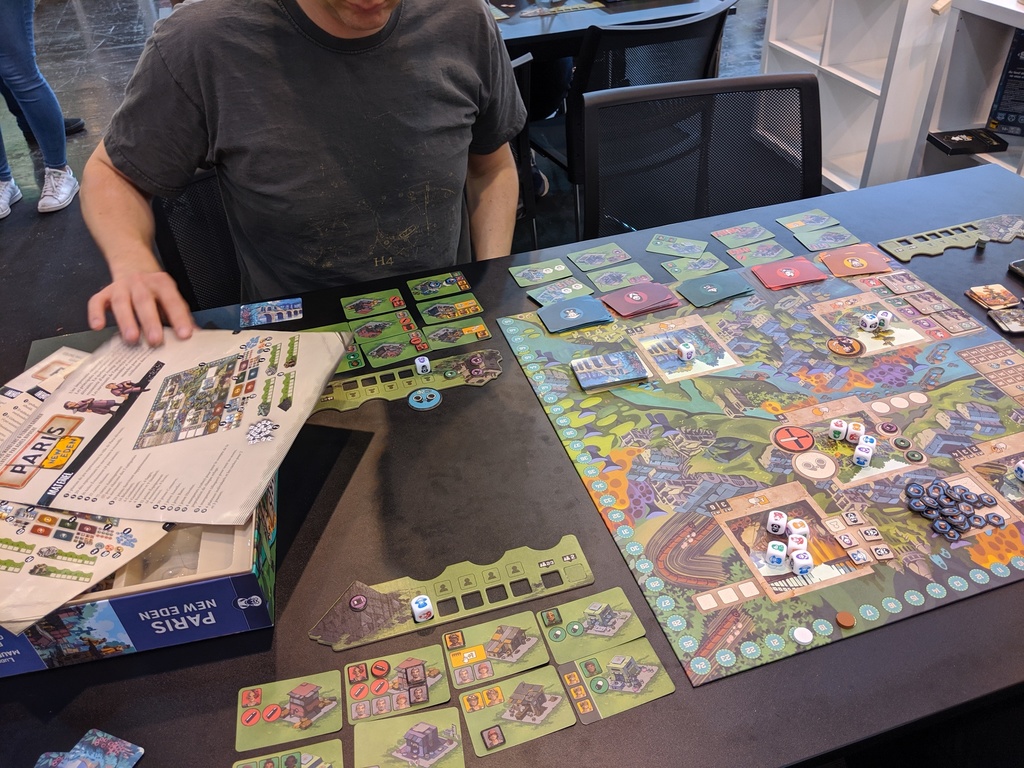
Paris: New Eden, Matagot – in a post-apocalyptic Paris, players try to re-build settlements by finding a good mix of people to populate them. To do that, they get to choose actions associated to dice that help get said people – so they need to optimize the choice and order of the actions to get what they want. I liked it quite a lot, but Pierre wasn’t convinced, so we didn’t get a copy.
Paris: New Eden, Matagot
And for the other buys…
A copy of Prêt-à-Porter, at Portal Games – I had bought the Kickstarter on “theme + strong euro + Portal Games” and I got my copy delivered in Essen
Railroad Evolution, the expansion for Railroad Revolution, a game that we quite like – it seems to add a few mechanics, to “fix” what’s generally considered an overpowered track, and to be playable without much hassle on top of the original game.
Play Smart, a small book by Ignacy Trzewiczek (of Portal Games) about role-playing – I had enjoyed his previous two books, they’re funny (the guy knows how to tell an entertaining story – we went to see his seminar during the fair and it was both hilarious and touching) and that’s probably worth the read
Railroad Rivals – it was an Almost Buy last year, and it was on sale this year, so I didn’t resist 🙂
A couple of SPIEL t-shirts, because they had a design contest (based on their logo) and the result is actually quite nice 🙂
The Round 26 of the Photography Scavenger Hunt took place in the past couple of months, and the reveals are all done. We had 10 words for this Hunt, all related to the Wizard of Oz… which I haven’t seen! But oh well, the words could be interpreted in any way, as usual, so that was not a big issue. I only submitted 4 this round – lack of inspiration conspired with lack of time… or more precisely with time used in other ways. To compensate, someone in the Scavenger community gave me the idea of doing a “behind the scenes” type of post, with “this is the original picture, this is the picture I submitted”, so here we go!
Selective Color
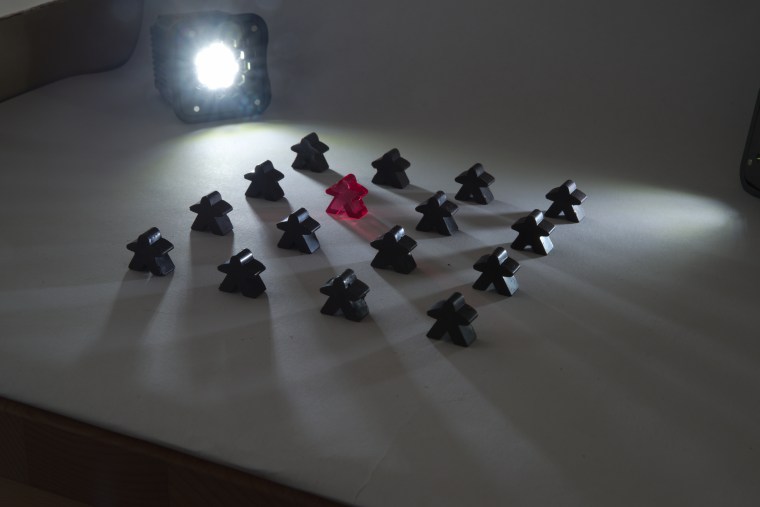
The first word that was revealed was the first one I shot, coincidentally 🙂 Here’s the picture I submitted:
The idea came by chance – Pierre made some chocolate meeples to start experimenting with making his own chocolate molds (with ComposiMold), and he had put a red plastic one in the bowl as a joke. I played with a lot different configurations and structures before settling on this – which I took quite some time setting up in my lightbox with a ruler and everything! And then I spent quite some time experimenting with the lights and the different angles and so on, until I ended up with this in camera (that’s the RAW exported in Darktable as JPG without any extra processing):
The physical setup was my lightbox with my seamless background paper and a couple of LumeCubes to illuminate the scene. Post-processing was essentially cropping, fixing the light levels, and quite a lot of detail clean-up (turns out, chocolate on paper tends to leave some traces…).
Courage
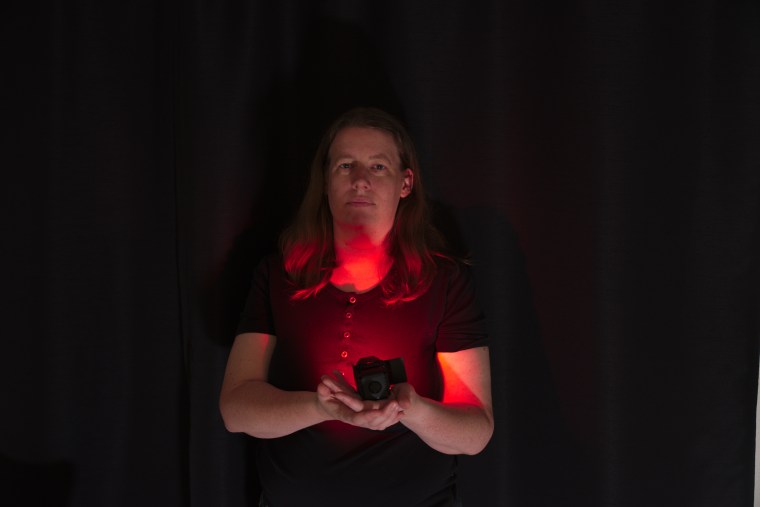
For this one, I had a very clear image in my head of what I wanted, which is VERY rare, and I actually managed to pull it off, which I’m very proud of. This is what I submitted:
This is one of the most personal images I ever made, especially associated to that word – I wanted to convey the courage that comes with showing vulnerability and offering/opening one’s heart to another person.
And this is the main part of the image:
The photography setup was, well, me, a tripod, a remote (I don’t remember what I did there, I’m assuming I put a delay and put it back in my pocket before posing, or something), and a LumeCube with a red filter and a barn door to orient the light where I wanted it. One of my fellow Scavengers had made a talk during the Meetup about his Ghostrider image (you can see a speed edit here) and I definitely had that talk in mind when I got the idea of using the cube as a placeholder for the heart to give it a glowing aspect. I got the heart from PixelSquid, another resource I heard of during the Meetup. And then the final image was essentially finding the right image in the gazillion I took with that light, editing it to my liking in Darktable (crop, levels, that sort of things), adding the heart in GIMP, and adding a bit of shadows on the heart so that it looked reasonable – which is ALSO something I learnt about during the Meetup. All in all, I find it funny and kind of wonderful that I call this one of my most personal pictures ever, and it’s all assembling things that I learnt/saw during that meetup 😀 (Oh, the LumeCubes were also a post-meetup addition to my collection :D)
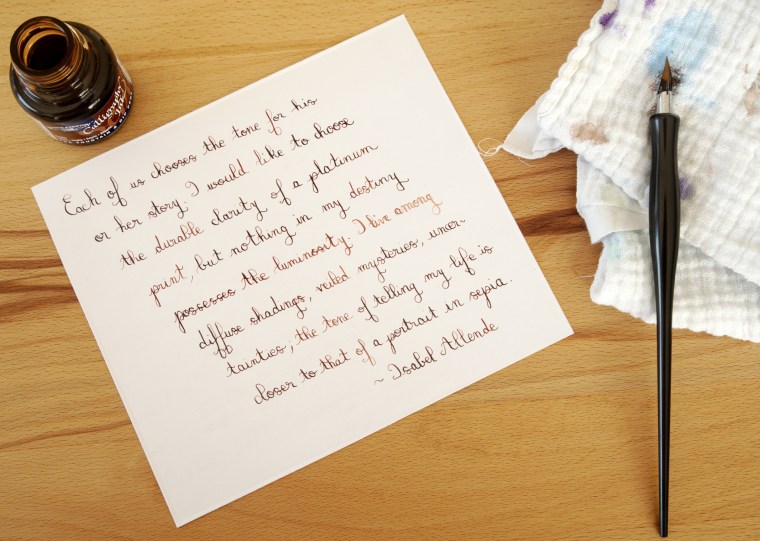
Sepia
I believe my Sepia submission is the weakest of the four I submitted, but eh, better a weak submission than no submission, so THERE.
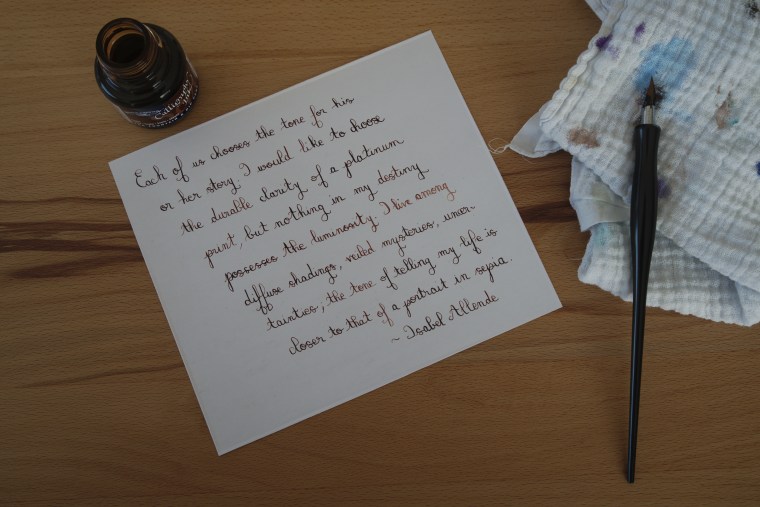
I started playing around with calligraphy recently, and I do own a bottle of sepia ink, so that kind of felt like a natural fit (and it suited me better than trying to do a sepia post-processing of something else). And then I also looked for inspiration on what to write, I looked for quotes, and I quite liked this one (which also has the advantage of ending with the word sepia, which I liked for “making things obvious” reasons). The longest part of making this image was to write the quote – I made multiple drafts on lined paper before I felt confident on this one – and still ended up hyphenating a word, which I would have preferred avoiding, but oh well. I also ended up needing to thicken my ink before I was able to do something reasonable with it (note: arabic gum works really well 🙂 ). And it’s a Nikko G nib and Rhodia white paper, if you’re wondering. And that’s the picture out of camera:
As you can see, pretty minimal edits on this.
Rainbow
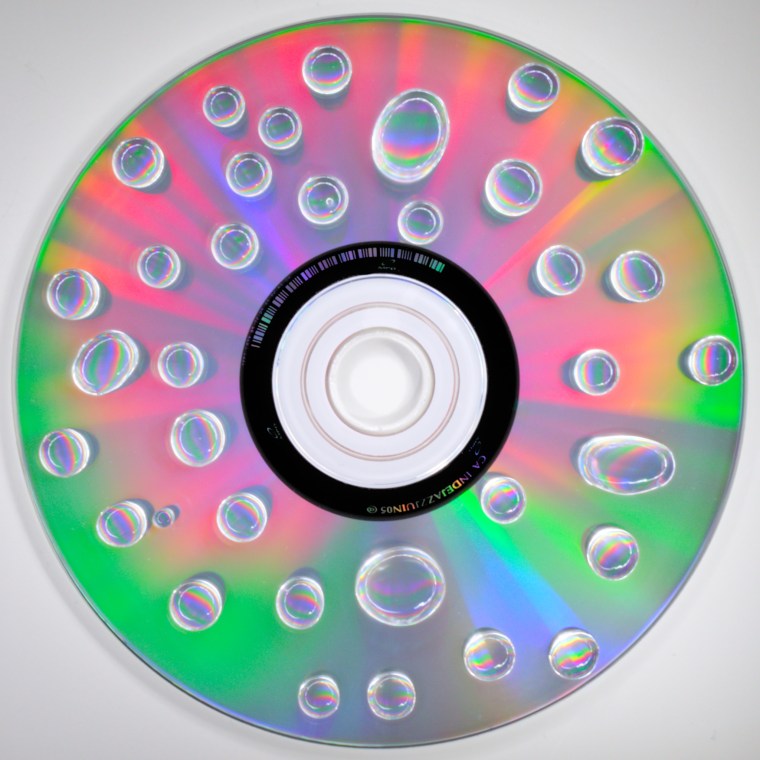
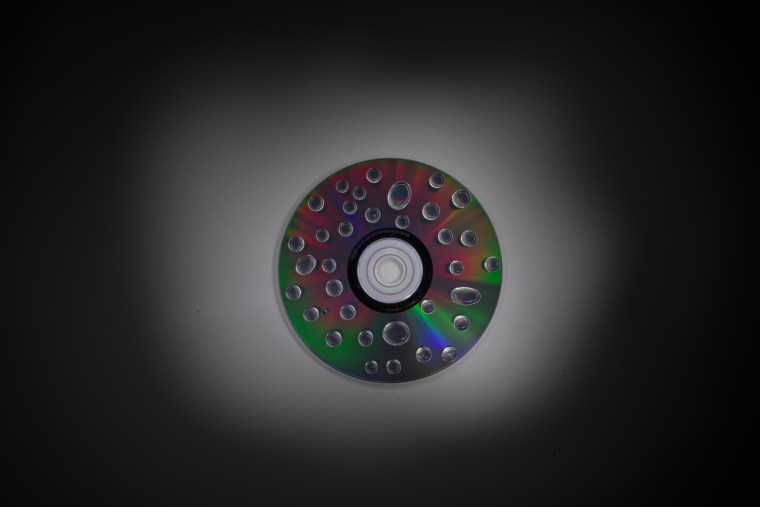
Rainbow is probably the picture that took me the most time for this Hunt. Here’s what I submitted:
I was first thinking along the lines of playing with a prism, or doing SOME variation of the well-known Pink Floyd album cover, until I got a flash of “ooooooh, I know how to get rainbows!”. I started playing around without much success, until I called The Internet to the rescue and read this: How to Make and Photograph Rainbow Water Droplets on a CD.
And here’s the “out of camera” RAW-to-JPG conversion:
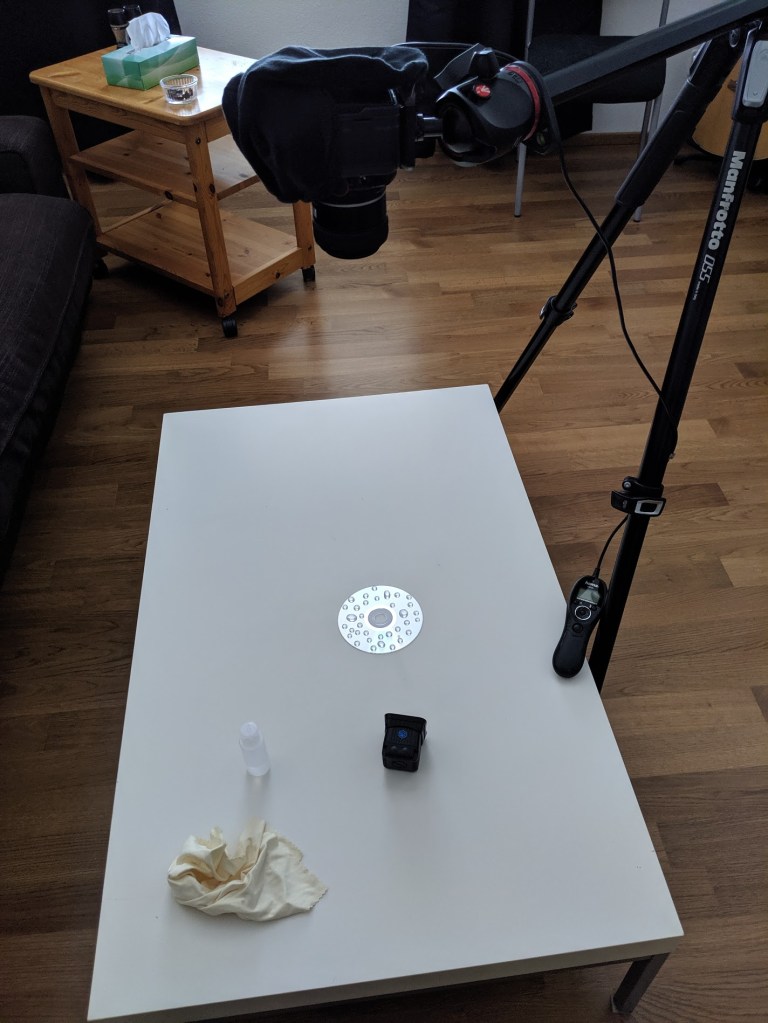
For this one, I have an extra picture, which is the “studio setup”:
So: CD, white table, room that can be darkened, tripod with a tilting center column (<3 Manfrotto), a way to make water drops and to remove dust, and a LumeCube. Also to be noted: there is a SOCK on top of my camera, because the very white PENTAX logo was reflecting in the CD on my first attempts (which sucked). The idea for the rainbow CD picture is to have a fairly long exposition (I had 20 seconds there), and to move around the CD with a light to create the rainbow effect. It took me A LOT of experimentation and A LOT of shots to get the one I finally decided for. And then it took me A LOT of time to get a clean image. It turns out that CDs tend to be slightly scratchy, slightly dusty, and even if you don’t see it on naked eye, that’s ALL YOU CAN SEE when you have an enlarged picture of them on your screen. So I spent a lot of time in Darktable to clean up the image.
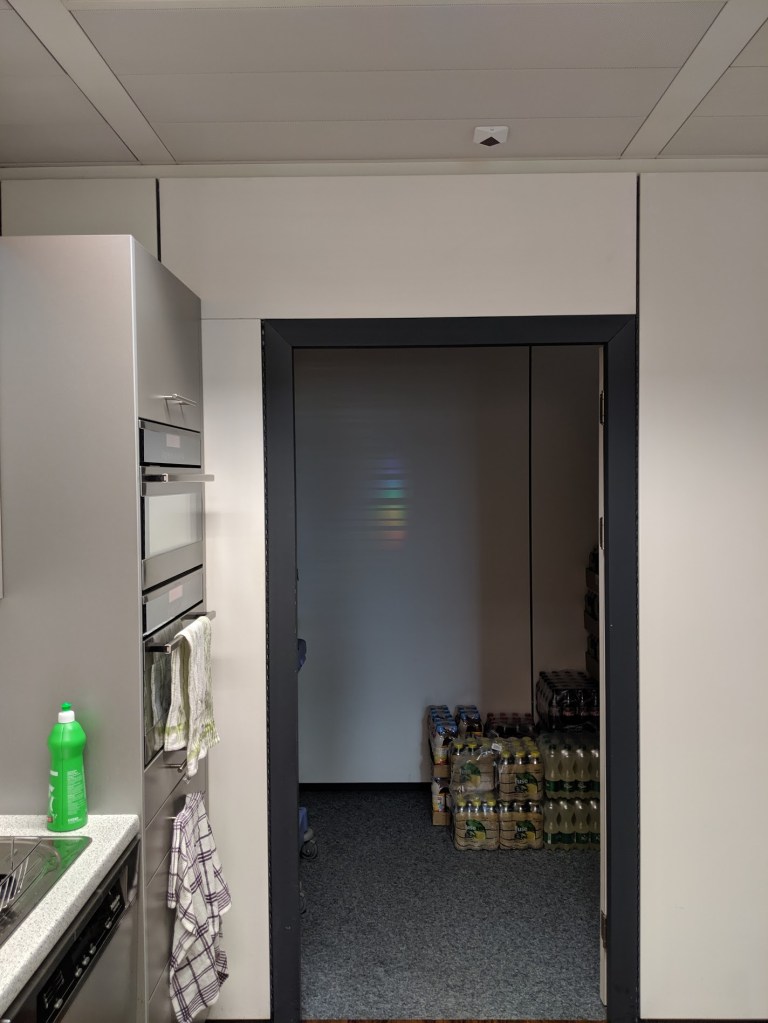
All in all, it’s nothing much more than a very “technical” image – I’m still quite happy with it, and I feel it was worth the effort, because I quite like it 🙂 Funny coincidence, though: the day after the deadline for the Hunt, I took a double take on that wall in the office:
I must admit it made me smile (and then hunt down HOW that rainbow actually appeared – I think the bottom of one of the glass doors was hit by the sun in just the right way at the right time 🙂
The other words!
As mentioned, we did have ten words, although I only submitted four – but here’s the full list, with links to the albums of pictures submitted by my fellow Scavengers!
How Cameras and Light LIE About Food [medium-length video] – a neat video about the impact of light temperature on food aspect (and the impact on food photography).
Scott’s Supreme Quantum Supremacy FAQ! – Aaronson is my primary source of information when it comes to quantum computing – and this might be the first time I see him carefully optimistic (with a lot of “hypothetically” :P) about something that went into the general press, so there’s that.
23rd September 2019: Making the Mandelbrot prettier – Alun is back to his Mandelbrot generator, which means I’m probably going to go back to mine Soon™ (but right now my pet project is a Kotlin ray tracer)
How to Send a File – Randall Munroe (the guy from XKCD) is publishing a new book, How To: Absurd Scientific Advice for Common Real-World Problems. How to Send a File is a sample chapter, and it made me giggle more than once.
Microsoft Flight Simulator – E3 2019 – Announce Trailer – Microsoft is releasing a new Flight Simulator. I’ve never played it much, and I probably won’t play this one because of time, patience, and platform. But it’s SO PRETTY.
Le Creuset x Star Wars – now THAT’S a mashup I was NOT expecting. That’s also a mashup I didn’t know I NEEDED until now. Dammit.
Well look at that, summer went and came and it’s been a while since I wrote a #balisebooks post… let’s fix that, shall we? The good thing is that I didn’t read that much during these past three months, so it’s still a reasonable-sized #balisebooks 🙂 I do have, like, four longer/more time consuming books still in progress in parallel, so the next one may also either be short or delayed 🙂
The Gown: A Novel of the Royal Wedding – Jennifer Robson
A historical novel that follows the story of embroiderers working for Norman Hartnell, designer of the wedding gown of (future) Queen Elizabeth II. I reaaaaally wanted to love everything about that book, and I almost did, except for a particularly unpleasant plot point that felt… avoidable. And it is a pity, really, because if not for that plot point, that book would probably have ended up in the (tiny) list of “to re-read when I need something comforting” books. I still really liked a lot of things about that book, and in particular all the details about the embroidery work!
Persepolis Rising / Tiamat’s Wrath – James S.A. Corey
Those are the books #7 and #8 of The Expanse, and they happen after a 30-ish-year leap after the end of #6. And there is not much more than I can say without the context of the first six books, soooo… I was a bit afraid at the “ah. 30 years later. Okayyyyy” bit, because I was afraid of “losing” something, in a way. But this was still very enjoyable, very emotional at times, and I cannot wait for book #9, planned for next year. And in the meantime, I have a few short stories/novellas from the universe that I haven’t read yet, which I’m looking forward to.
Beyond Addiction – Kit Rocha
Book #5 of the Beyond post-apo romance series. Finn and Trix knew each other when they both lived in Sector Five and were both addicts; Trix got out (and ended up with the O’Kanes in Sector Four), Finn thinks she’s dead… until she get kidnapped back to Sector Five. The backstory is still great, I liked the couple of this book, the steamy scenes are, well, exactly that (although I have some reservations about a specific one, but eh), what more do you want? 🙂
Radicalized – Cory Doctorow
These are four novellas set in societies that are juuuust different enough from ours to call them dystopias, and definitely close enough that they’re scary. In Unauthorized Bread, Salima, who’s a refugee, finds ends up needing to hack her toaster oven, because the company that makes it gets bankrupt. Trouble ensue. Model Minority is a re-take on Superman (vs police racism and brutality) – I must say I don’t remember much of that story, actually. In Radicalized, the lack of universal health care leads to people organizing and planning terrorist attacks. And The Masque of the Red Death is a story about a post-apocalyptic bunker community. All in all, four very solid stories – with enough humor that they are not thoroughly depressing. The politics are Not Subtle, but then you don’t read Doctorow if you have something against Not Subtle Politics 😉
The Headspace Guide to Meditation & Mindfulness – Andy Puddicombe
Headspace is one of the meditation apps I use (less often than I want to these days, but oh well), and Andy Puddicombe is the face (and voice) of that app. That book explains the approach and sprinkles it with a number of anecdotes, making it very approachable and funny. I probably would have benefited from this book more if not after hours of Headspace-the-app. Still – good reminders, pleasantry written, some funny anecdotes 🙂
To Be Taught, If Fortunate – Becky Chambers
A chronicle about a long-term space mission – 4 people on a starship, exploring 4 very different planets. It has a solid, competent crew, and science, and feels, and it feels so much longer (in a good way!!) than the small amount of pages, and it’s lovely, and am I fangirling a little bit too hard here? naaaahhh…
The Long Way to a Small, Angry Planet – Becky Chambers
That one is a (re-)re-read; Becky Chambers got a Hugo for the Wayfarers series, so I re-read that one for celebration. This is the third time I read it in less than three years (which is very rare in these days of book abundance), and I still love it a little bit more every time. I expect I’ll re-read the two others of the series before the end of the year.
And since apparently I haven’t talked about this book here yet, and it’s one of my favorite books of all times, let’s fix that! This is the story of the crew of the Wayfarer, a tunneling ship: they punch holes in space-time to make space travel shorter. And they get hired to go punch in a place that doesn’t have a tunnel yet, for a trip that’s roughly a year long. The whole thing reads like a VERY wholesome Firefly, and is my personal own equivalent of a cup of thick, hot chocolate in a pillow fort.
Lake Silence – Anne Bishop
I discovered Anne Bishop with her Others series – a urban fantasy series with shapeshifters and vampires and the like, but where the “usual” dynamics is flipped: the Others own the lands, the humans are barely tolerated, and they’d better not misbehave, unless they really want to end up Deceased, Location Unknown.
Lake Silence’s world is the same as the one from The Others, which I quite liked, but in a different community and with a different set of characters. And… I was not convinced. I still like the idea of the world, but I didn’t manage to get enthusiastic about that installment – I was actually quite bored (it felt repetitive), considered several times to not finish it, and all in all that was a disappointment.
Because Internet: Understanding the New Rules of Language – Gretchen McCulloch
A very neat book about the internet, as viewed by a linguist. It has chapters about the tone of writing, punctuation, emojis, memes, conversations… and it’s generally delightful, I learnt a ton of things, it made me giggle more than a few times, and it was all in all a great, informative read.
Raytracing – in Excel!! [short video] – someone made a raytracer in Excel, and that just made me laugh in delight 😀
New Proof Settles How to Approximate Numbers Like Pi [text] – a cool result in number theory, explained in a way that makes sense to non-number theorists. I probably would have liked a tiny bit more detail about the graph theory tools involved, but still, the writing is neat.
Kerbal Space Program 2 has been announced – to be honest, KSP is one of “those games that sound so very cool but that I just can’t manage to play”, whether it’s a matter of interest or of general skill or learning curve; I’m definitely curious about what they’ll do with KSP2.


 Balise's Blog