SPIEL 2025 in Essen

It has become a tradition: in October, we go to Essen in Germany for SPIEL. We have our habits, we know how things work, and we have a grand, if exhausting time. And it’s a great way to test a lot of things and to make opinions and quick reviews! And to come back with, well, a bunch of loot to enjoy between two editions of SPIEL 😉

A bunch of board games and associated misc elements - Ink, Bohemians, Railroad Tiles, Wispwood, a book "Boardgames that tell stories", expansions for Pixies and Sea Salt & Paper, RAVEL, Furchtloss, Kingdom Legacy expansions, A Carnivore Did it, Les Derniers Droïdes, Weave, Kingdom Crossing, Just 3 folds, Floral and Similo are set on a table.

The loot doesn’t reflect everything we played (and there’s a few things in there that are not a direct consequence of what we played in this edition), so here’s everything we saw!

Azul Duel

A two-player game; two boards with slots and tokens, a score board in the middle of the table, and 5 circles (four small, one large) with various colored tokens on them.

Azul is a classic, declined in many versions, and this version goes back to the idea of the first game, but in a 2-player version. The original Azul already plays pretty well with two players, but I still appreciated the adjustments to the rules that make it more tactical – a bit more choices that depend on the exact timing (and not only on the opportunity to deny something to your opponent), and I liked the idea of building your grid as you go. We’re not really on the market for 2-player games these days, but if we had been, it would have been under consideration for a buy (especially since we don’t own the original version).

Take Time

A round abstract clock face with white and dark blue numbered cards around it in six piles. The sum of the piles is ascending clockwise starting from 1.

A cooperative game where players try to solve constraints of a round clock with the cards that they are given – but they can only discuss strategy before looking at said cards. Pretty neat, probably has the potential to get very difficult challenges – but it felt like, for us, it would fit the same niche as The Crew (which we both preferred). Very pretty, though, and probably shorter games than The Crew too.

Locus

A sheet of paper divided into multiple colored areas with grids and a few boxes of the grid crossed. There are also a few cards with colored polyominos, and a stack of LOCUS boxes in the background.

Locus has a very clear (and acknowledged) inspiration from Ganz Schön Clever, except that instead of dice, you get cards with polyominoes – players take turn choosing one and crossing the corresponding patterns in the different grids, with a significant chance to have combos that yield more crossings on the sheet (and hence more points). I liked it well enough, I think it’s also less fiddly than Ganz Schön Clever, which has a few iffy corner cases that require going back to the rules a bit too often, but it wasn’t enough of a wow factor to get a copy.

Bohemians

A lot of colorful cards that evoke artistry and Paris

Bohemians is a deck building game where the currency that you have to get new cards depends on the half-symbols that you manage to combine into full symbols when you get your cards, with additional actions on the better cards (and bad things happening to you if you forget to work to support your artist ways). Cool mechanics (I had previously enjoyed the symbol combination mechanic in After Us), pretty theme, and made by Portal Games, for which I have a personal fondness – we got a box. And with the box I also got the third book of Ignacy Trzewiczek “Boardgames that tell stories” (I had enjoyed the first two) and got it signed since he was around when I got it 🙂

Postcards

A large map of France with interest points and some postcards on the side, as well as a large pile of red stamps.

I liked the theme of Postcards – traveling through France and sending postcards – that sounded nice; and the first random postcard that I started the game with depicted Carbonnade Flamande (a personal favorite); but the mechanics of the game (filling in a few tasks, getting the opportunistic bonus and some set collection) fell a bit flat for us.

A Carnivore Did It!

Five animal cards associated with statements cards reading "Panther and Peacock did it", "A Carnivore did it", "Shark did it" "Shark and Iguana are lying" and "Horse didn't do it".

A Carnivore Dit It! is a cooperative deduction game where you try to solve series of puzzles where you get cards with animals, some statements where you know that a number of them are true (and the rest are false) and try to deduct as a group who’s the culprit. Fun times, a lot of scenarios to go through, and my love of logical puzzles made me grab a copy.

Railroad Tiles

Tiles with railroads and streets, in a common market and placed in front of players as the start of a transport network.

I enjoyed Railroad Ink (a series of roll&writes where you make a rail and road network), so I was very curious about the tile version of it. Players get a set of tiles to add to their network. During the game, they also get to add trains, cars and commuters to their network and score points accordingly; a few bonus tiles and the largest rectangular area of the board round up the final score. This sort of things tickles my brain exactly right, so we got a copy, even if Pierre was less convinced than I was (but then: it has a solo mode!)

Sanibel

A market of tiles representing seashells on a beach, and two player boards showing said shells organized on a hex-and-diamonds grid.

Sanibel is a set collection game with a placement on a board and a seashell theme. I liked the theme and the different shapes of the tiles (diamonds and hexagons made of three diamonds), but again not enthusiastically so. And the table was a bit too small, which led to an incident of board flipping that was not very pleasant 😛 (Not the fault of the game, though 🙂 )

Wispwood

A wheel with square tiles representing firs on the back and various colorful wisps/spirits on the front side, with polyominos on the wheel between each pair of tiles. Players assemble these tiles in front of them in a grid.

Wispwood is a tile laying game where, at each turn, players choose a colored tile from a common reserve and one of the polyominoes next to it to build an increasingly large grid that eventually gets scored along multiple axes. We didn’t get to play it, only got the explanation, but I’m curious about the feel of the game and we’ll try to find an open table in the next few days.

EDIT and we did find a table, and it was indeed delightful, and we bought a box.

7 Wonders Dice

In the 7 Wonders Extended Universe, we know have: the dice game! This is a roll and write – at every round, a set of dice is rolled, of which each player chooses one (at the same time) and adds it to their player board for various effects. We could only play for a few numbers of rounds since it was the very end of the day, but again the overall feeling wasn’t enthusiastic.

The Hanging Gardens

A market with tiles containing arched windows, and a player tableau showing a line of 4 of these tiles and a line of 2 above it. Other tokens and coins on the table too.

The Hanging Gardens is a tile laying game where you try to make gardens irrigated in the same way as your objective card while adding animals, plants, humans, and try to optimize the associated points. Pretty neat, but lacked a bit of a “wow” factor.

Castle Combo

Two tableaux of 3x3 cards with cartoon characters, with gold coins on top of them, and a market from which players would pick said cards.

Castle Combo is a tableau-building game where players build a 3×3 grid of characters that interact in various ways to yield points. It was released last year, but there was an extension this year, which gave us the opportunity to play it; the publisher wasn’t selling the base box today, but it’s going to get on my next shopping list because I really enjoyed it – it’s fast, every decision matters, and it’s tight and well made.

City Tour

A colorful and very curvy road being built with tiles containing roads, markers and traveler. On the road, there's a plastic bus with two blue passengers in it.

City Tour may well have been designed as “what if Tsuro, but cooperative” – all the players are driving the same bus by adding tiles at the end of its path, gathering passengers and dropping them at various points. Cute, and the box seems to have more options than the basic version we played, but not much more than that for us.

Ladybugs

A green board with squares, and fields of daisies taking over some of the squares. There's a bunch of ladybugs tokens with varying numbers of dots on their back in various places on the board.

Ladybugs was the unexpected territory control game of the day – you play as a colony of ladybugs that try to control fields of daisies. When putting a ladybug on the field, you get to place it at a distance equal to the numbers of dots on one of the previous ladybugs you have placed, orthogonally; this yields a nice puzzle to be able to place your bugs while planning your next moves. Pretty cool, not a buy.

Restart

Colored plastic tiles numbered from 1 to 16, in ascending order.

Restart was the most puzzling game we played on Friday. It presents itself as a riff between Rummikub and Uno;   players place numbered tiles in increasing rows, with a few special tiles allowing them to manipulate the board a bit. Whether it was because we were only two players or because we weren’t playing aggressively enough, neither of us got the point of the game (which doesn’t happen often!)

INK

Tiles with multiple colors (purple / cyan / dark blue / yellow / red), installed in front of players; a lot of small tokens in the shape of adorable ink bottles.

In INK, players try to get rid of their ink bottles by placing them on a tiled board that they build during the game – when an area is large enough, you get to place ink bottles on the few places in that area that welcome them. Larger areas yield bonuses that can create small combos. It was a very pleasant game and the ink bottles were adorable and I’m looking forward to playing it again with the box we bought.

Cosmolancer

A 6x5 grid filled with colorful tiles with numbers on them, as well as yellow and blue camera tokens.

Cosmolancer is the new edition of a 1994 game (something we learnt after playing it 🙂 ). Players take turns placing score tiles and scoring tokens on a board to maximize their own score and minimize their opponent’s. Good design, tight game, a couple of things that we didn’t necessarily fully understand/score correctly during our game. But also not something we’d expect to put on the table.

Dying Message

Abstract cards trying to represent a crime scene, and a set of cards with faces and text associated to letters.

The accidental social game of the day. In Dying Message, one player plays the murder victim and the others the detectives. The murder victim has a set of abstract cards to communicate who killed them from beyond the grave, and the detectives must decide, given a list of suspects, who the victim may be talking about. I took the role of the murder victim, and all my detectives failed at understanding me 😦 This might be fun with the right group, but we don’t think we’re necessarily part of that type of group 🙂

TRND

8 cards around a deck and a discard, representing chairs of three different shapes and three different colors.

Trnd is a game where you try to collect the largest possible set of a certain type of chairs while discarding the rest. And you can only discard identical cards that have a common characteristic (color or shape) with the current discard. Intriguing, but not quite enough to make us get a box.

Knitting Circle

Boards with buttons and yarn, a wheel with two cat tokens and yarn samples around them, and knitting pattern-describing cards.

In Knitting Circle, players create clothes from squares of wool that their cats bring them. There’s two phases in each round: moving cats around a wheel to get wool pieces, and assembling said wool pieces to clothes, with various bonuses for specific colors, patterns or shape. Cute, and the switch between player-interaction phases to get materials and more solitaire puzzle during assembly is pleasant. Didn’t click quite enough to get a box though.

Scribble City

Cards with polyominos and sheets of paper with a lot of roads and polyominos drawn on them. There's a set of colored pencils next to the sheet of paper.

Scribble City is a game where you draft cards to add roads and polyomino buildings to a map. A few objectives and additional bonuses make it a bit more strategic, and overall this would have been a buy… if their shipment had arrived in time for Essen! As it is, I’ll probably try to get a copy at some point still.

R.A.V.E.L.

A grid of 8 colored dice (3x3 without a center) with cards with various dice-symbols on each side of the square.

Ravel is a solo (or “two people working the problem together”) game where you have a set of dice, constraints on how you can move/change them, and objective to fill. It’s a very nice puzzle, it has a few ways to adjust the difficulty (we were either very lucky or very good at it today), and it’s delightful. I got a box.

Hues and Cues

A board containing a large amount of colors going from brown to green vertically and from brown to purple horizontally (and then some), with a bunch of conic tokens all in the same area around red/orange hues.

Hues and Cues is a party game where someone tries to give clues for the other players to guess a color. The closer people are from the color to be guessed, the more points the clue giver and the guessers get. We had a few laughs in the couple of rounds that we played – including with someone who was very colorblind but evidently surprisingly good at color games 😀 Fun to play, but not a fit for our usual games.

Just 3 Folds

Round cards with colorful patterns, a 90° mirror, and some heavily folded yellow, pink and blue origami paper.

Just 3 Folds is an origami game. You get a picture and a piece of colored paper, and you have to re-create the picture by folding the piece of paper only three times. The additional twist is that you’re actually creating only a quarter of the image, and check your work by putting it against an angle mirror. Cute concept, and we got a copy – it may work for us under some circumstances.

Flip 7

A shiny box of Flip 7 Deluxe, and a bunch of luxurious-looking foiled numbered cards.

We hadn’t played Flip 7 yet, which is now fixed! It’s a push your luck game, described as “a mix of black jack and Uno”. You can continue getting cards as long as you wish, but if you get two identical ones, you lose (and the winner is the one with the largest score). Pretty fun and the Deluxe edition (which we played) is gorgeous, but the game itself doesn’t necessarily warrant the price point of said deluxe edition. That said, might get a deck of the regular edition at some point – looks like an easy filler game.

The Last Droids

A central tray containing two columns of cards, and player boards with resources (oil, cogs, circuits, batteries). There are a lot of colorful cards with robots on the table.

In The Last Droids, you get cards that you can either buy for their effects or recycle to get resources to buy said cards. It’s a post-apocalyptic theme where you try to rebuild houses, and the cards are defunct robots (that you can either repair for actions or recycle). The originality comes from the four-player game, in which players team up in two teams, and draft cards, giving the other one, depending on the turn, to their adversary or to their partner. I really really enjoyed it and I got a box. I’m curious to see how it plays with other numbers of players too!

Vantage

A large box containing a very (very) large number of cards, behind a player mat with dice and tokens.

We only got a table explanation of this game and we have very little chance of getting a table, but it looks quite fascinating. It’s an open world exploration game where players are (in game) physically separated but can communicate to achieve a common mission; there’s a metric ton of cards and it’s NOT a campaign game, just a game with a lot of randomization of the starting conditions. I’m VERY curious and I’d love to give it a try (but it’s also sold out, so even the leap of faith is not an option).

Propolis

A player board with resources an a couple of cards; a bunch of colored cards with bee tokens on them.

Propolis is a game with bees (and you get a bunch of beeples) where you collect resources to build cards that give you discounts for future buys. It is very reminiscent of Splendor, with a few more strategic elements, and it’s really nice, but not distinct enough niche-wise from Splendor to my taste to warrant a buy.

Carnival of Sins

Black, white and gold playing cards showing masks on the back and sin representations on the front, and a set of black and golden dice.

Carnival of Sins looks pretty neat, concept-wise – each player has a hand of 7 cards that they will play entirely to get dice that are rolled at the beginning of the round, with various cards effects (get the highest die, get an odd and even die, that sort of things), with a few backstabby effects too. The cards are also very pretty. But we did run in at least 3 corner cases that were not mentioned in the rulebook during our game, which made it feel a bit incomplete, rule-wise.

Into the Machine

A colorful board with various symbols, a track on top, and multiple colored tokens on the different symbols of the board.

Into the Machine is a very efficient combination of racing game (you want to move your markers as fast as possible to the end) and worker placement (by making actions on a board where space is limited). Very very enjoyable, good iconography – it was a prototype so no copies to buy but it may be in next year’s list.

Skybridge

A central board with cards of different colors, a player board with resources and cards on top; a board representing a large bridge/tower being built.

Table demo only for Skybridge, a game where players try to build a bridge in the sky with the hell of various characters and gods. It did look interesting, but not enough to try to fight for a table on our last, shorter day.

Weave

A 4x4 grid with squared colored tiles and a bunch of gems on the tiles. The colors of the gems are the same as the one from the tiles, but they do not necessarily match where they are.

We played Weave at two players, and we suspect it’s best for two players – but it was very good at two players. You’re both playing on the same grid, trying to make alignments of gems on the correct color of tile with three actions: pick a gem, place a gem, flip a tile (to get another, known color). If you place a gem on a tile of the same color, you get an extra action depending on said color leading to fun combos. First player to three points (which happens when an action creates a line) wins the game. Very pleasant, and we got a copy (and I’ll update the BoardGameGeek link when it’s out of the processing queue 🙂 ).

Five Families

A map of New York split in different colorred areas, an impressive amount of money tokens, some cards and meeples.

In Five Families, players play mafia families trying to control boroughs of New York in the 1930s. They try to claim territory and, if they manage to transform their claim, control it, usually at the cost of people (canonically “injured”) and/or money. Areas are grouped into sets of threes on which majority of control is computed for extra points. I liked it a lot for the first half of the game, and then it felt like it was getting quite long. I suspect that we were not playing the game aggressively enough for it to quite work.

Kingdom Crossing

A board showing islands joined by bridges;  player boards show variousresources. The bridges have little paw tokens on them, and there's a bunch of cards on in piles on the board. The design is very cute.

Kingdom Crossing was high on my list of games I wanted to look at this year, and it almost didn’t work out (but we found a table as the last thing we played this year!). There’s no way I’m going to resist “we took the 7 bridges of Königsberg and made a board game with that”. Add to that cute animals, a solid engine building mechanism and action selection, and you get a box I’m happy to have in my collection 🙂
Essen SPIEL 2024

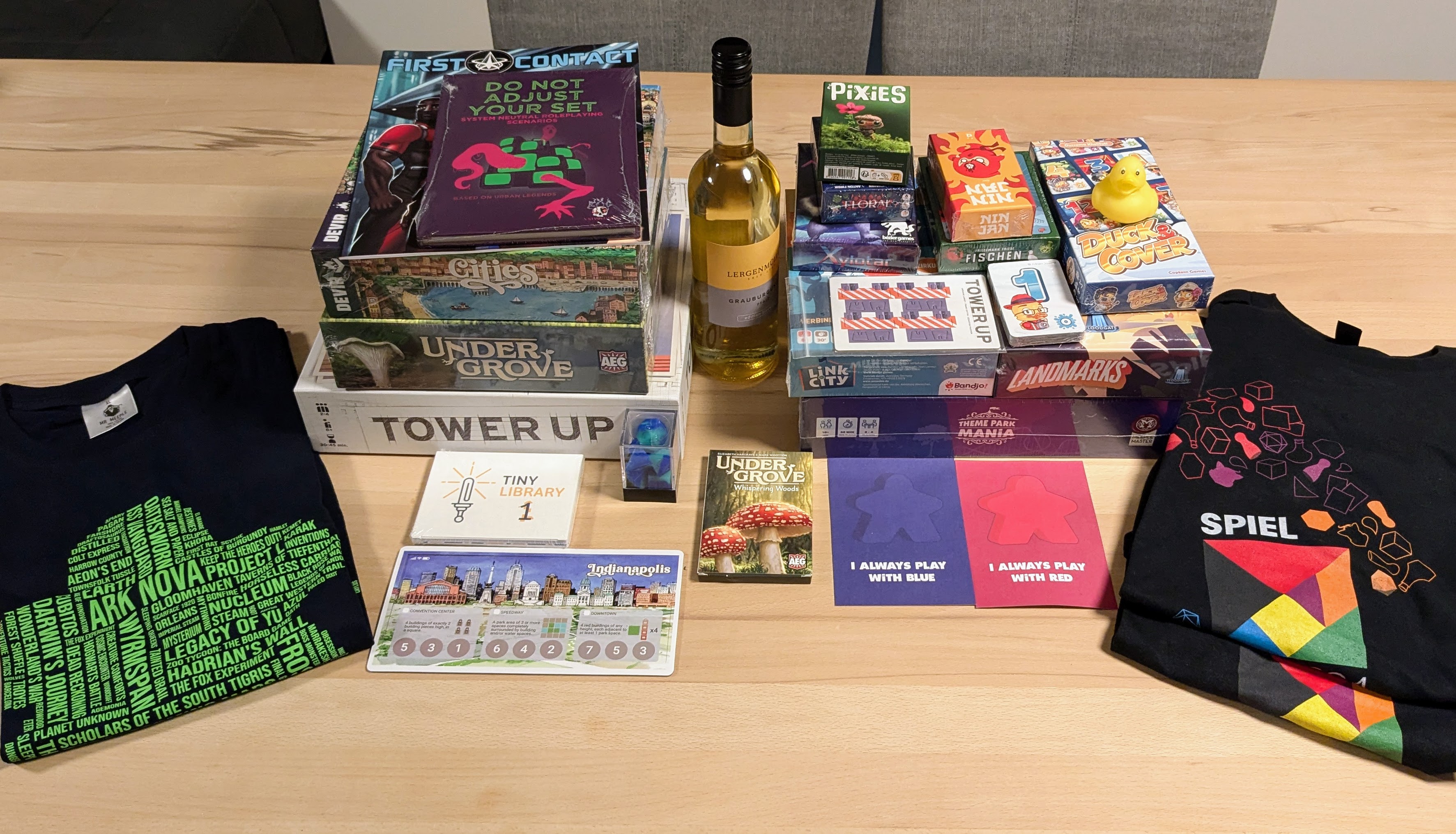
A table with board game boxes, three t-shirts, a bottle of wine and a yellow rubber duck

There, SPIEL Essen 2024 is behind us, and it was another great edition. It was slightly awkward when we saw “by the way, the 4-day tickets are sold out” before we got ours; thankfully we managed to get daily tickets before they ran out as well. This is the first year that they have contingents, and they hit them every day, so it was, well, a busy fair. Anyway, let’s go for the (by now) traditional back-from-Essen post! I counted 37 games in this post, so brace yourselves, it’s a long one 😉

Continue reading “Essen SPIEL 2024”

Essen SPIEL 2023

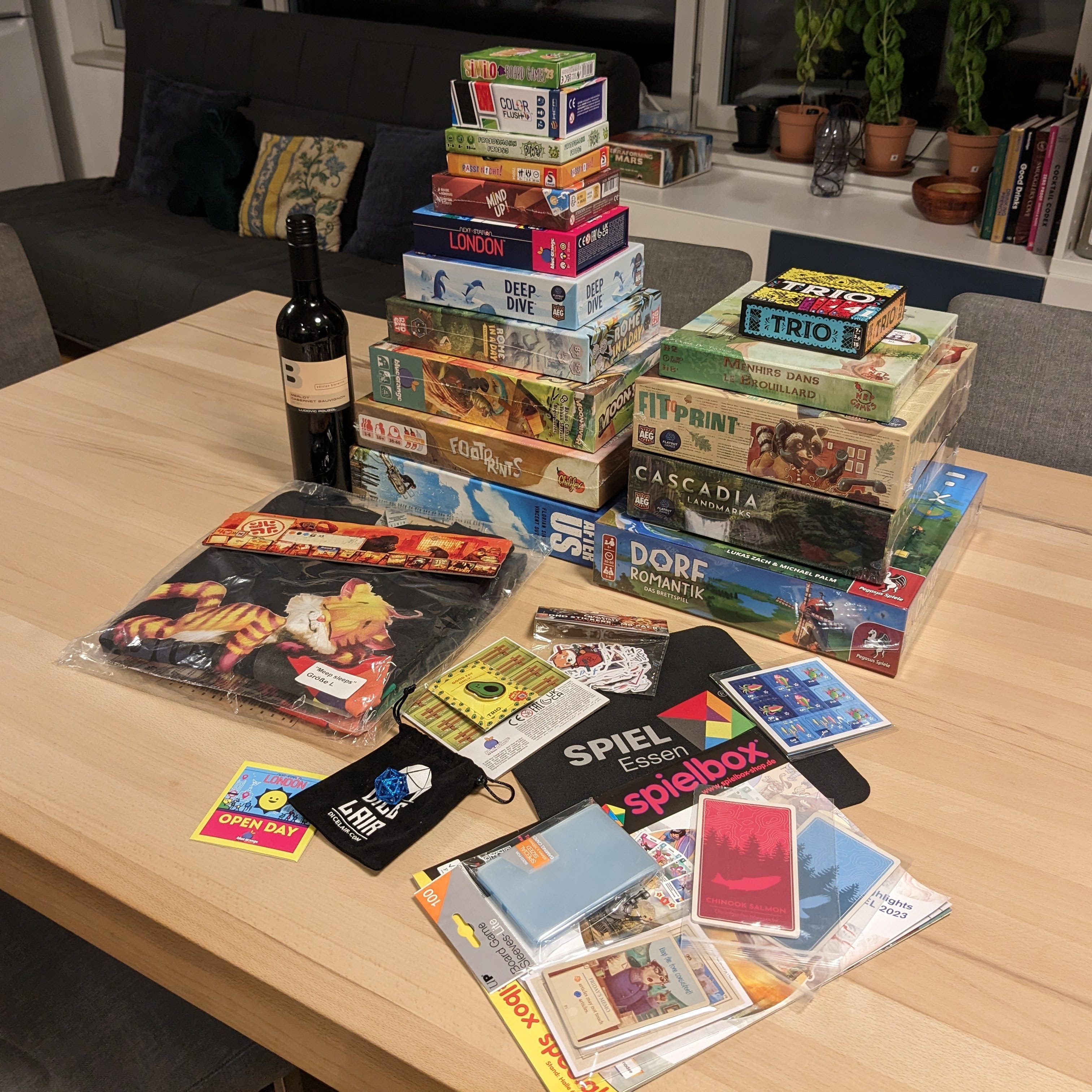
16 game boxes organized int two piles, with miscellaneous goodies in front of it, and a bottle of wine on the right side.

Another year, another SPIEL, and it keeps delivering, as an event. A lot of games played, a lot of games bought, a lot of fun 🙂 And, if you’re wondering about the bottle of wine on the loot: we went to a restaurant (Fischerei) and got their fixed menu with wine pairing, and got treated with a bottle on our way out! (Food was delicious, by the way – highly recommended if you’re in the area. And like fish.)
So, let’s talk about games and, like last year, let’s do that in order of games played, because that’s actually easier to narrate. We’ve tried really hard this year to not buy games we weren’t sure about (“maybe is no”), but we may have failed a few times as the fair went on.

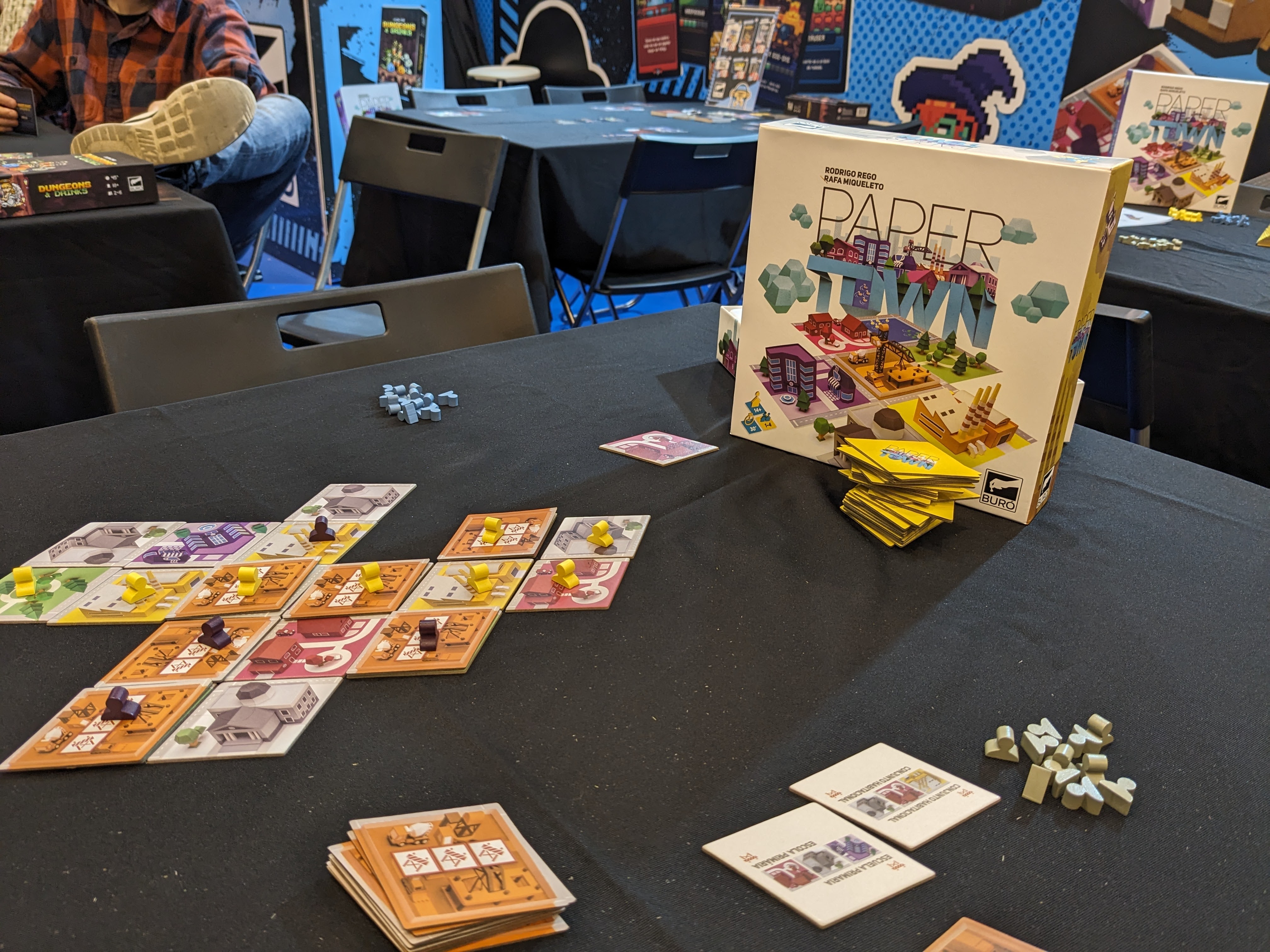
Papertown

Paper Town - lozenge tiles displaying city elements, colored meeples

Papertown is a tile-laying game, where you try to make geometric combinations of tiles to place your buildings/objectives and the corresponding meeples. The twist is that the tiles are in isometric 3D, which makes it a bit harder to fit in one’s head! That twist might have been enough to make it a pick later during the Messe, but we still had enough self-control at that time to not get it.

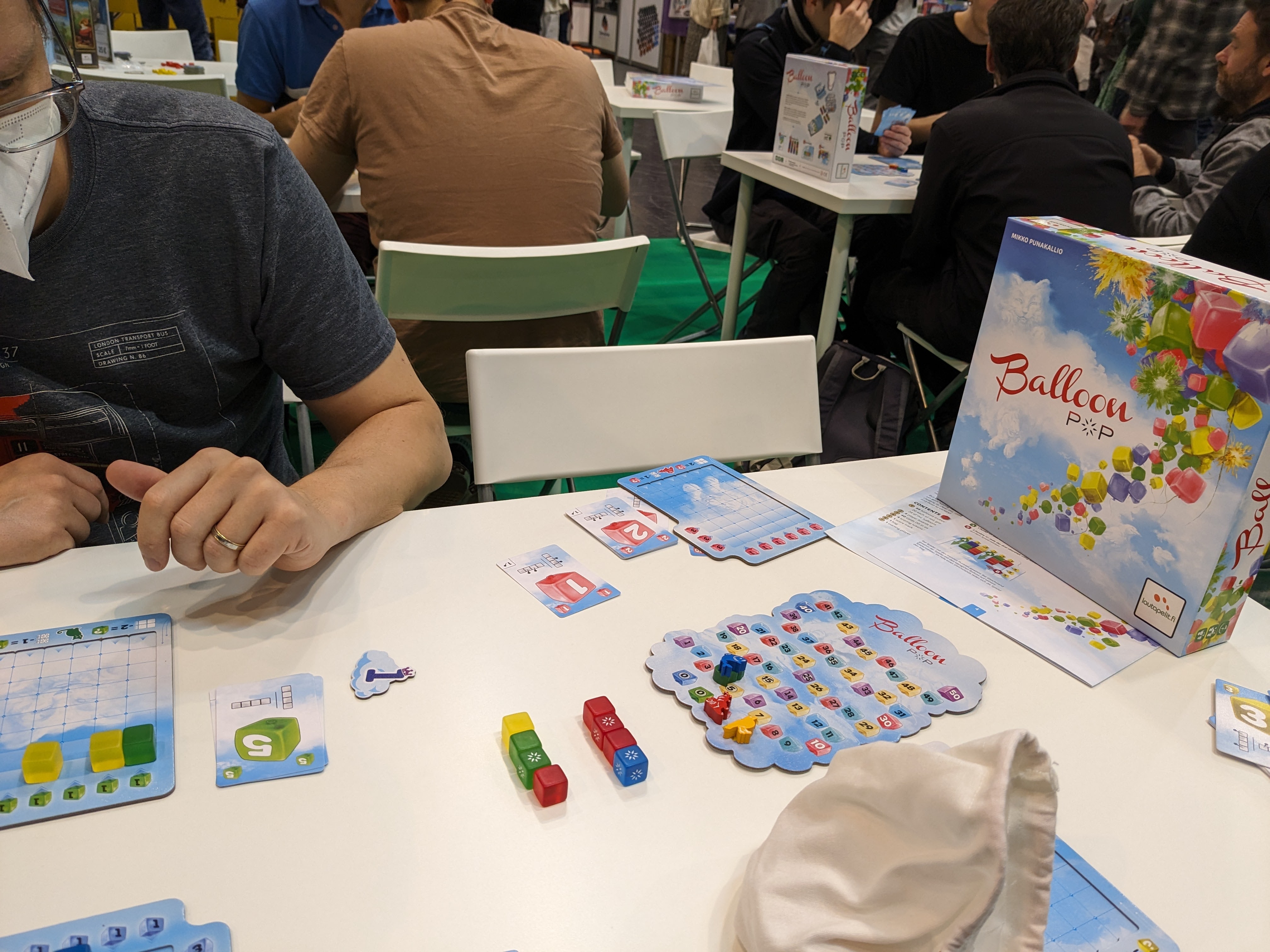
Balloon Pop

Balloon pop: transparent cubes and grid player boards

In Balloon Pop, you get a row of colored cubes, representing balloons, that float on top of your board, and they pop (making points) when they reach a certain threshold. The cards are used to define both the priority order and what you’re allowed to do with the balloons (place them horizontally, vertically, discard some of them). Pretty clever, and that may be the one I’m regretting not getting right now.

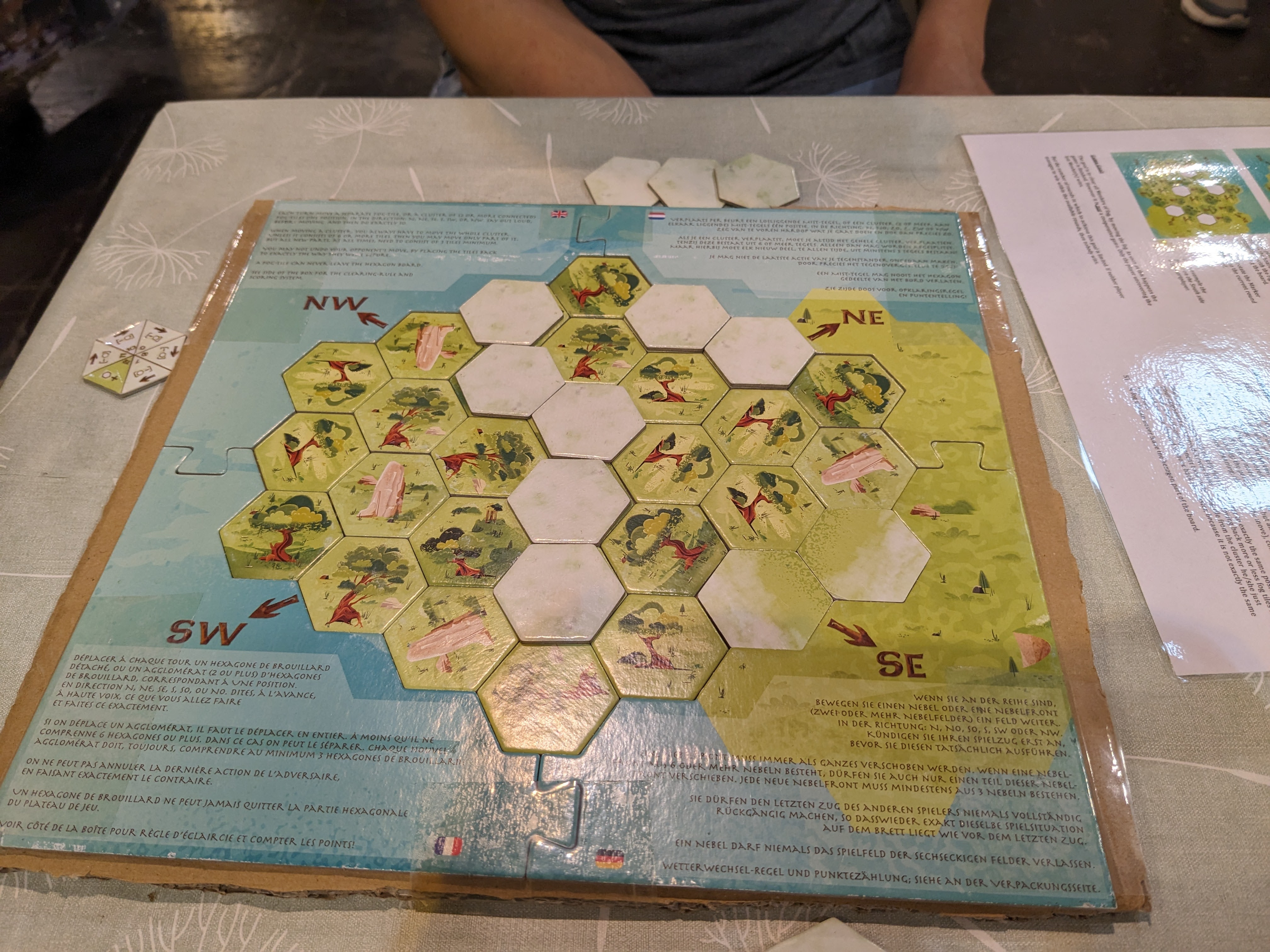
Menhirs dans le brouillard

Menhirs dans le Brouillard : hex tiles showing menhirs, forest, and white fog tiles on top.

“Menhirs dans le brouillard” was a buy, and it was honestly half because of the title (which means “Menhirs in the fog”, which we both found hilarious) and quarter because of the people explaining the game (who were super friendly and passionate). And the game is actually interesting, even if it’s not our typical fare! You have an hex grid of forest tiles, in which a few menhirs are hidden. There’s initially some fog covering them, and there’s a game of adding fog, removing fog and moving fog so that you are the one to uncover the last menhir (or you’re preventing your adversary to uncover the last menhir).

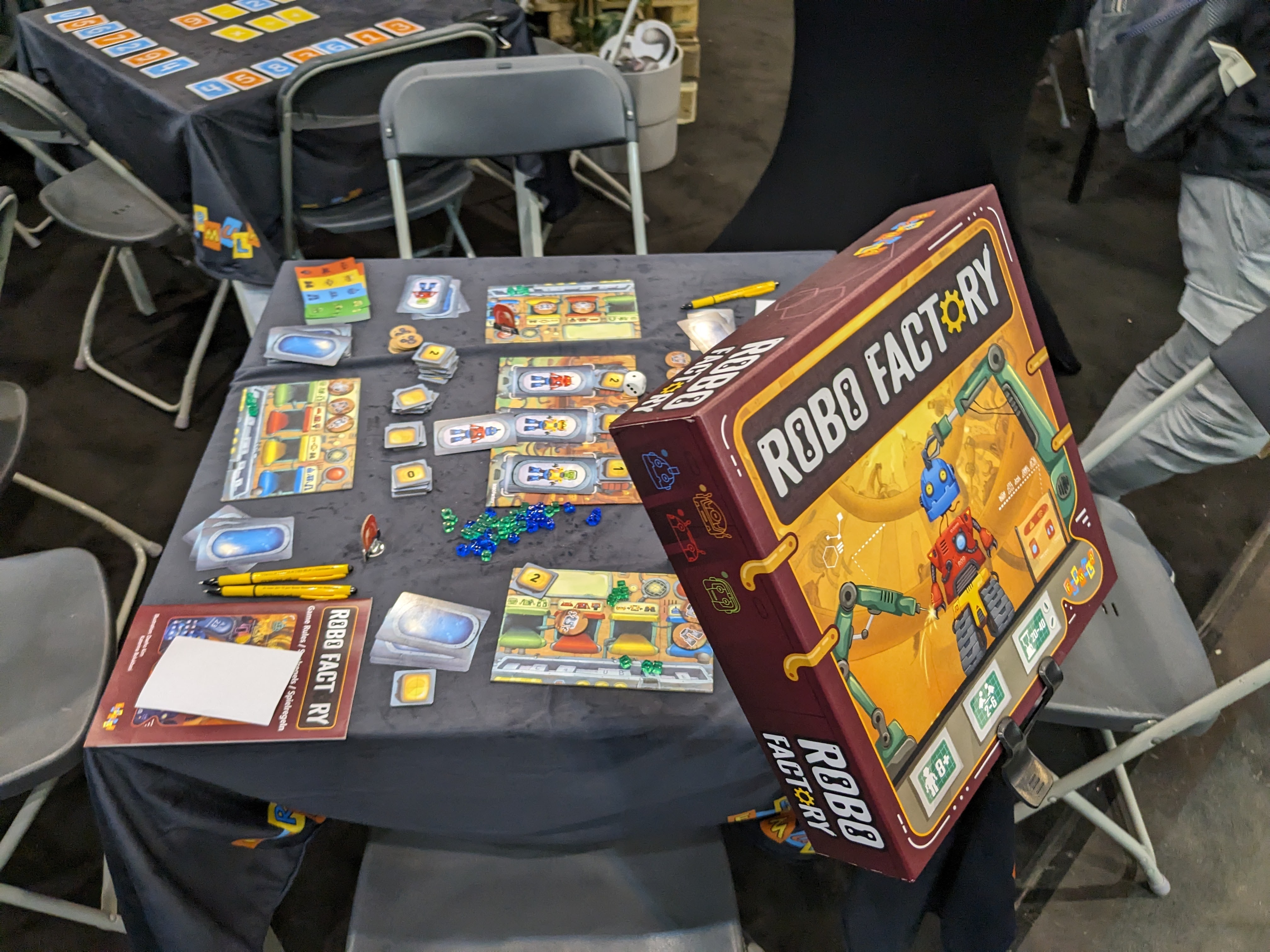
Robo Factory

Robo Factory - colorful tiles with robots, and player boards with factories

Robo factory is a deduction game where players try to match a secret combination of color elements to create a robot. It’s essentially a multi-player, simpler, version of MasterMind, with all the players playing at the same time, and we were not convinced.

Mind Up!

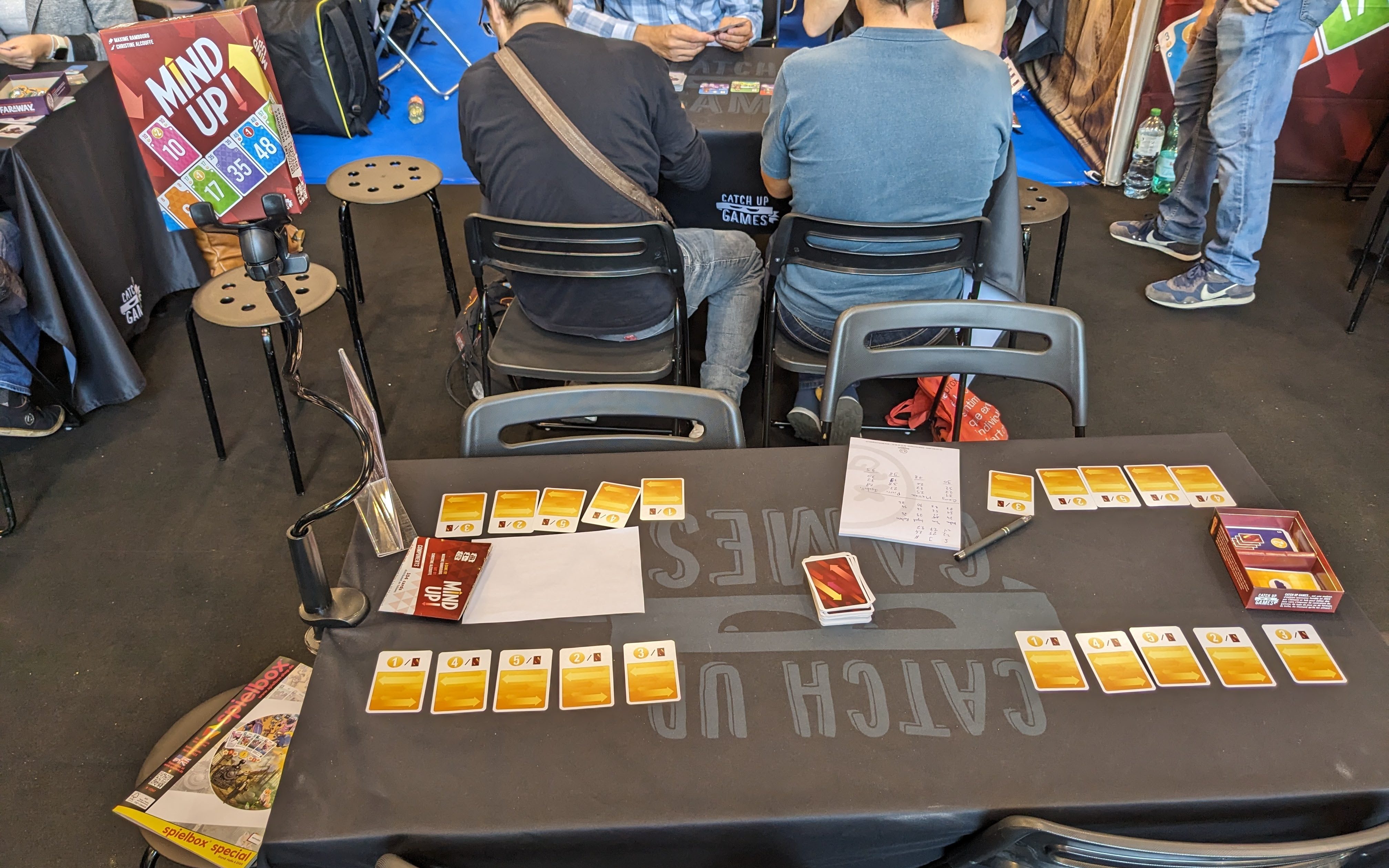
Mind Up!: a deck of card in the middle of the table, and five cards for each of 4 players set in a row.

The explanation for Mind Up! started with “Do you know 6 Nimmt?”. And it is indeed very reminiscent 😉 Players play a card from their hand, which allows them to pick another card, depending on the order of their card in the overall sequence, which they then organize in piles according to the color. It feels like a welcome update to the concept of “trying to get the right position in a sequence of cards”, and we got a copy (the first of multiple “X copies of N colored cards with numbers” games we got this year 😀 ).

Nautilus Island

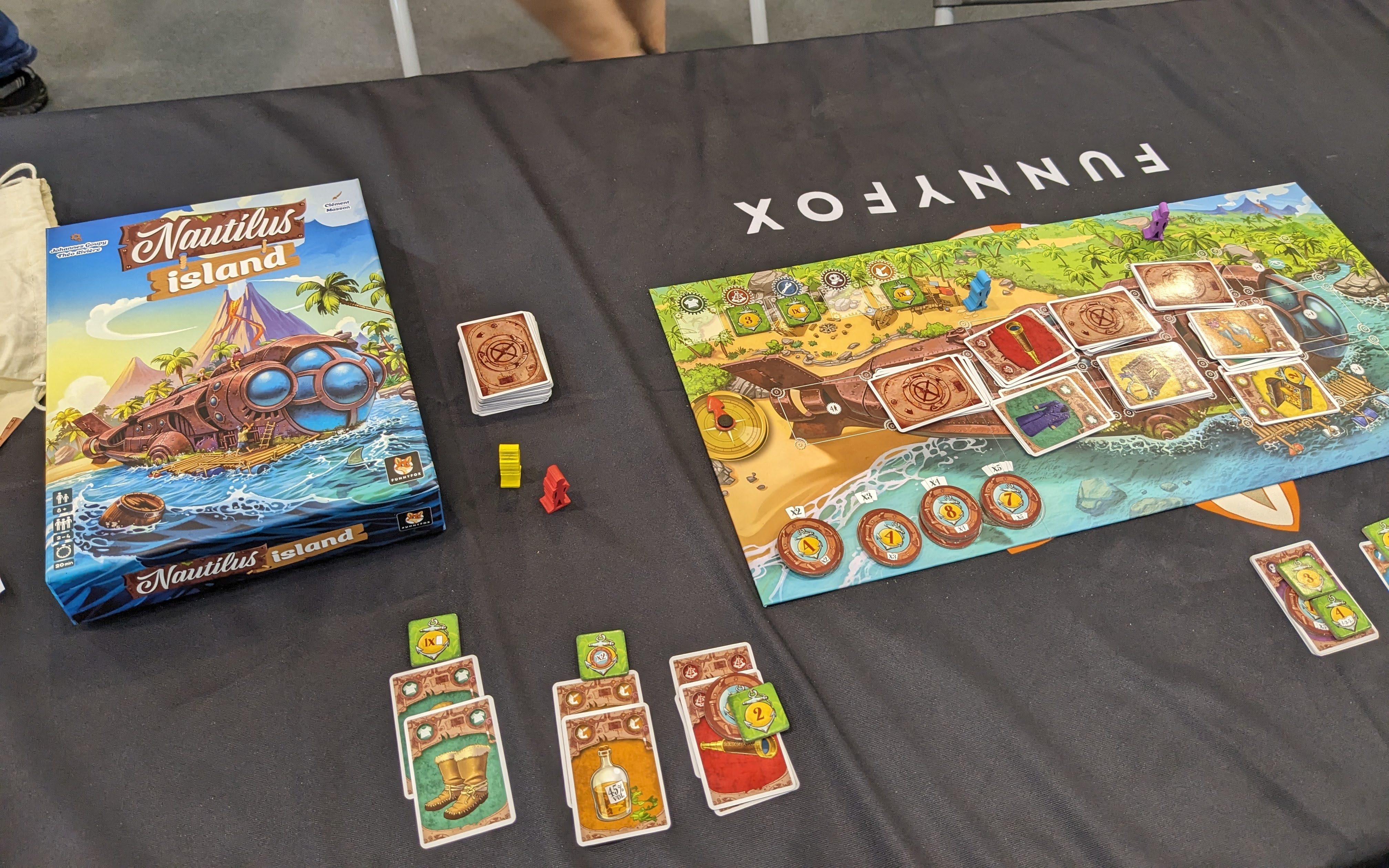
Nautilus Island: a submarine board with cards, and collected sets of cards

Nautilus Island is a set collecting game: you’re on a desert island with a crashed submarine and you’re trying to collect stuff to survive. It’s a pretty neat combination of set collection, race for bonuses, and push your luck, and I’d be happy to re-play it, but it didn’t feel special enough to warrant a buy.

Line It

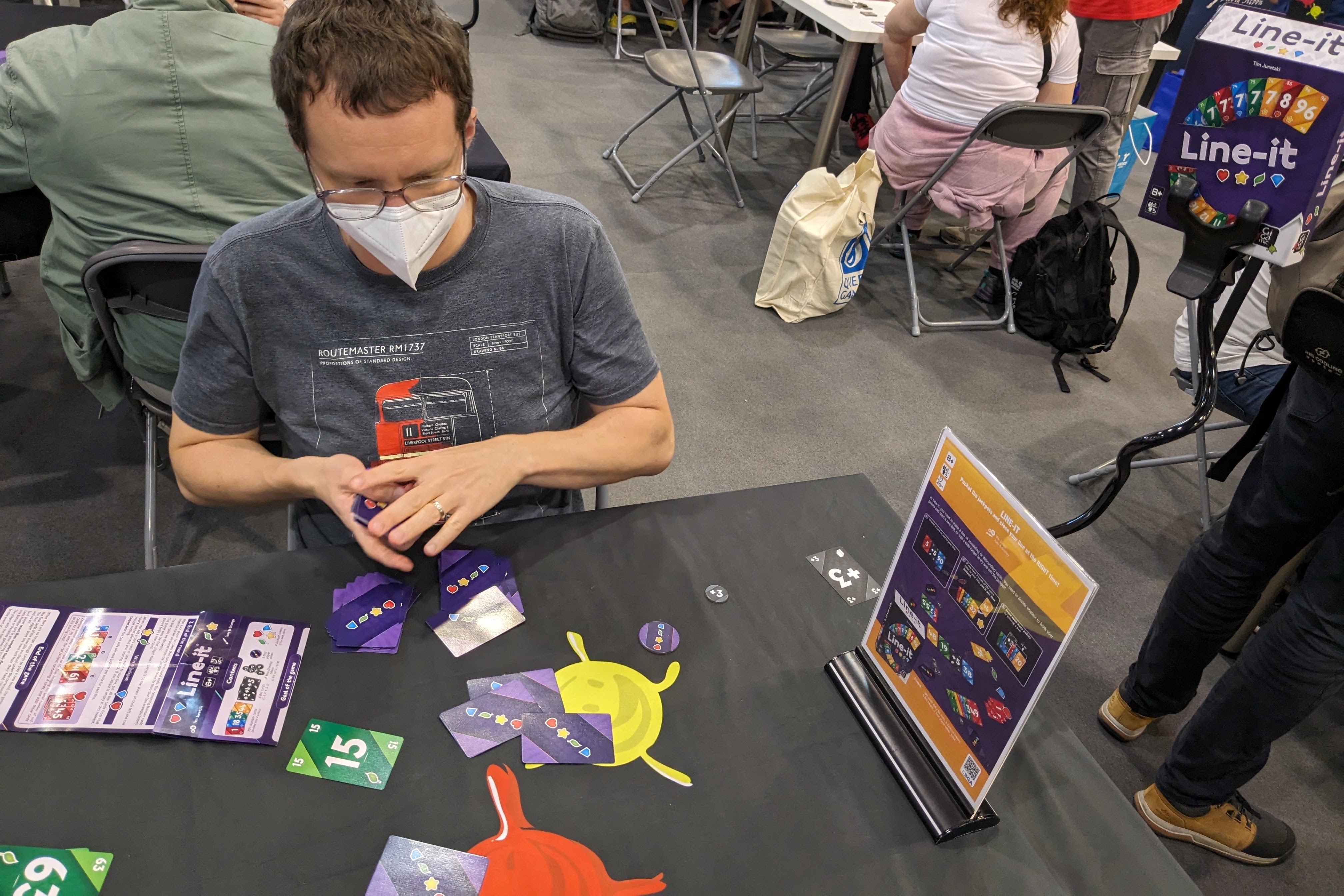
Line-it: Colored cards face up (15 and 63), and cards back showing four colors/symbols (red/yellow/green/blue).

Line It is another “numbered cards with colors” game, where you build a line of value-increasing or value-decreasing cards in front of you, and try to time fetching “jackpots” that build up as a side effect. Considering our other buys, it’s possible that the only reason we didn’t get that one is because we had gotten Mind Up! half an hour before, despite the games not being that similar in the end.

Battle Fries

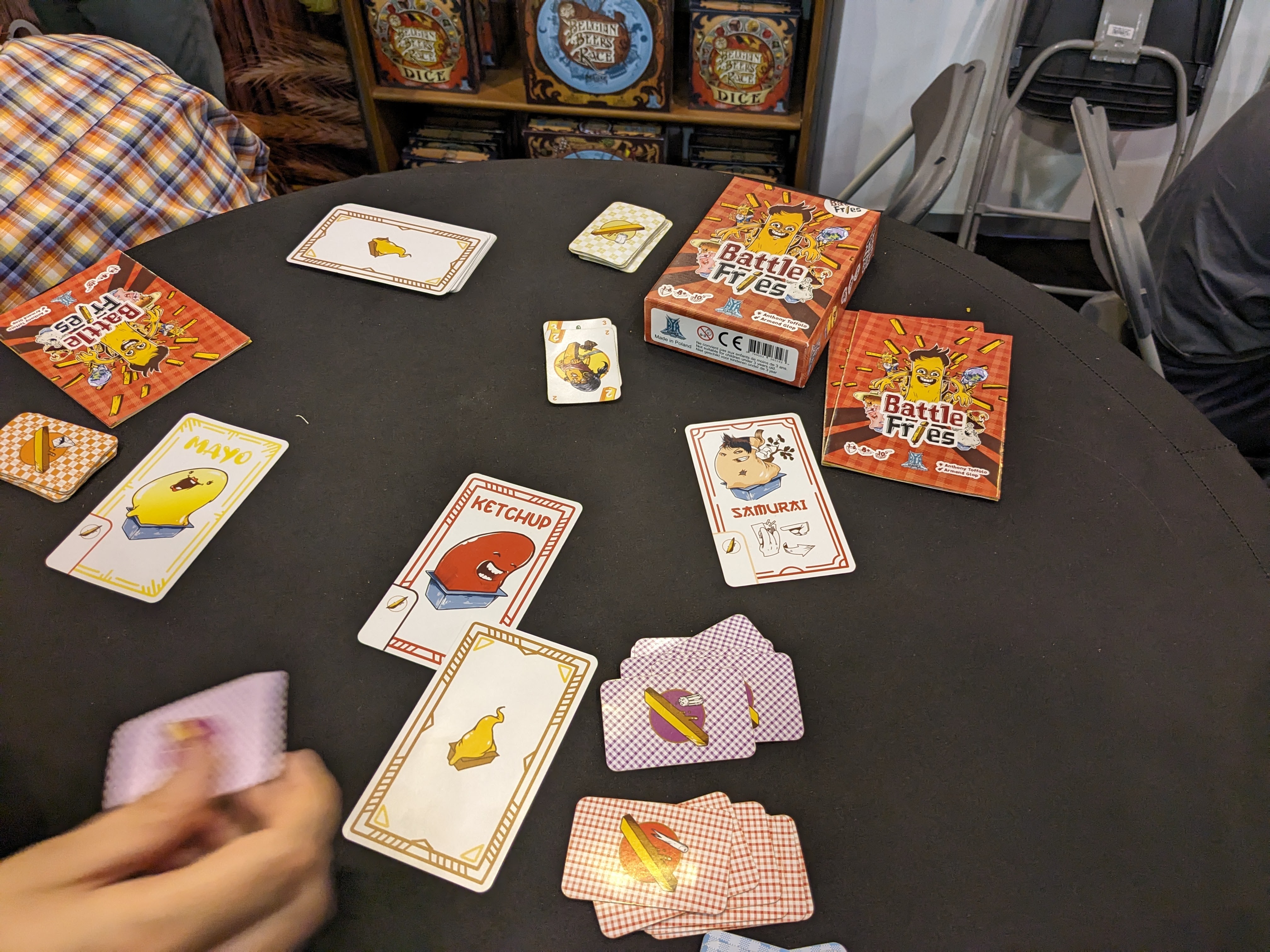
Battle Fries: cards showing sauces and player cards showing fries

Battle Fries is a very silly card game where you try to dip your fries in various sauces… and preferably other sauces than your opponents, by yelling the name of the sauce all at the same time. The theme is hilarious, but we’re not much for yelling games 😀

Black Friday

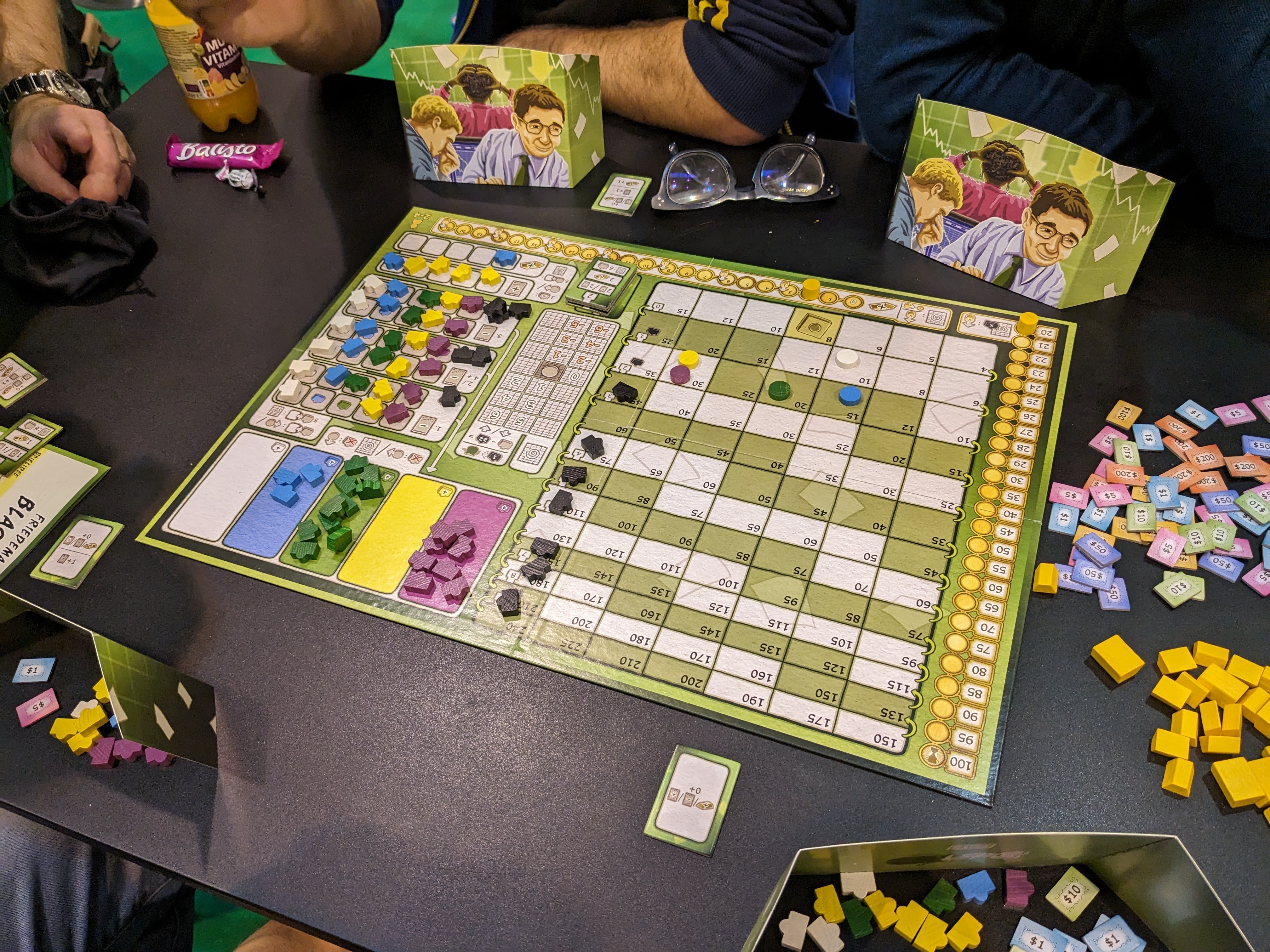
Black Friday: a green board with a price grid and colored tokens.

Black Friday is a market manipulation game: you’re trying to make the most money possible by timing your share buys and sells between the different market crashes. Interesting mechanics that do yield “large tendencies and small variations” around the share prices, but it felt a bit dry to be able to sell it on a game night.

Stamp Collection

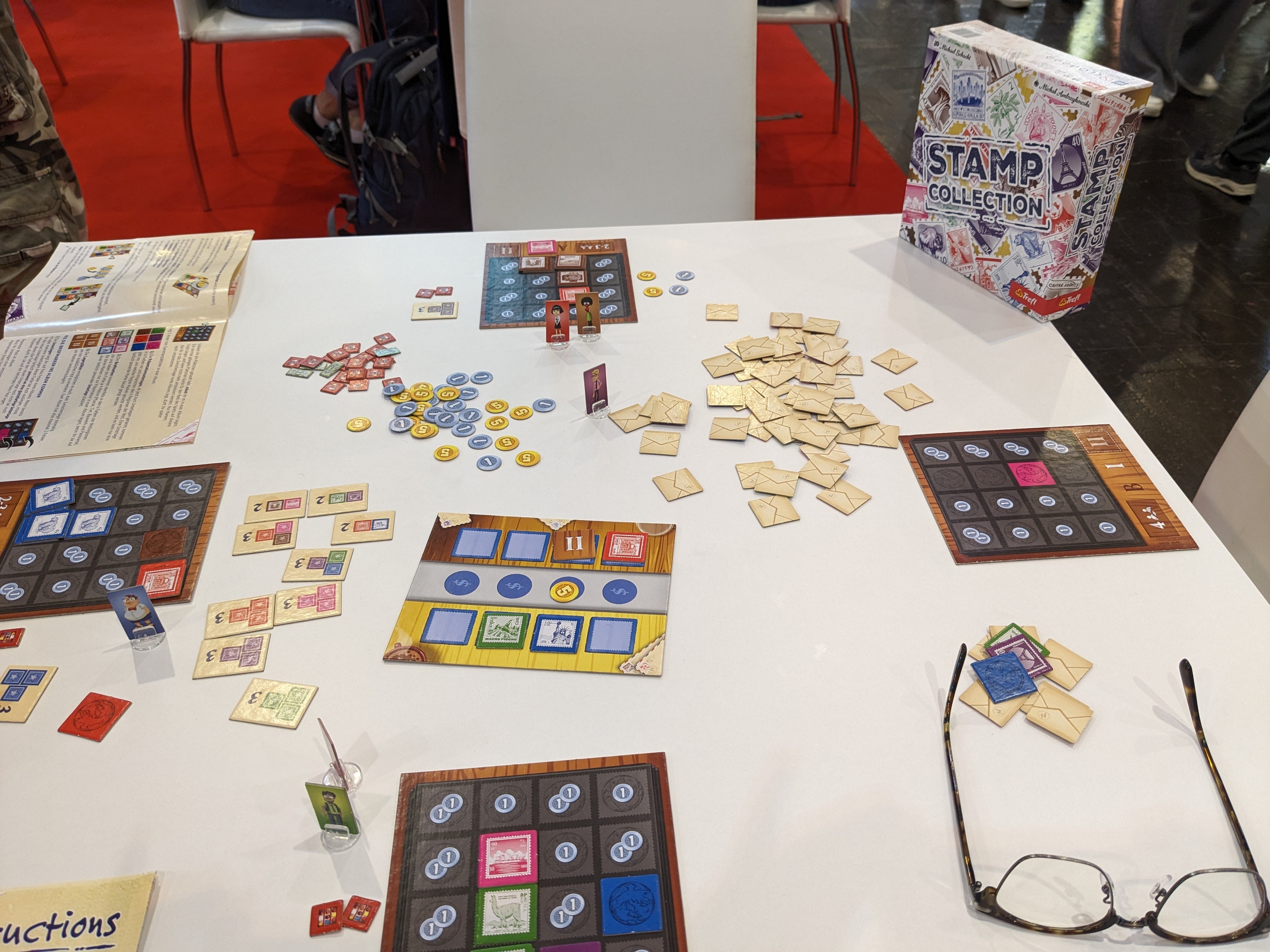
Stamp Collection: a common pile of tiles and money, and player boards with a few stamps on them.

Stamp Collection is a reimplementation/re-theming of an older game called California, where the players try to make pretty stamp collections to attract fans that bring chocolate when they visit/appreciate said collection. I kind of liked it, and the theme was cute, but the component quality felt pretty low compared to modern standards.

Isle of Trains

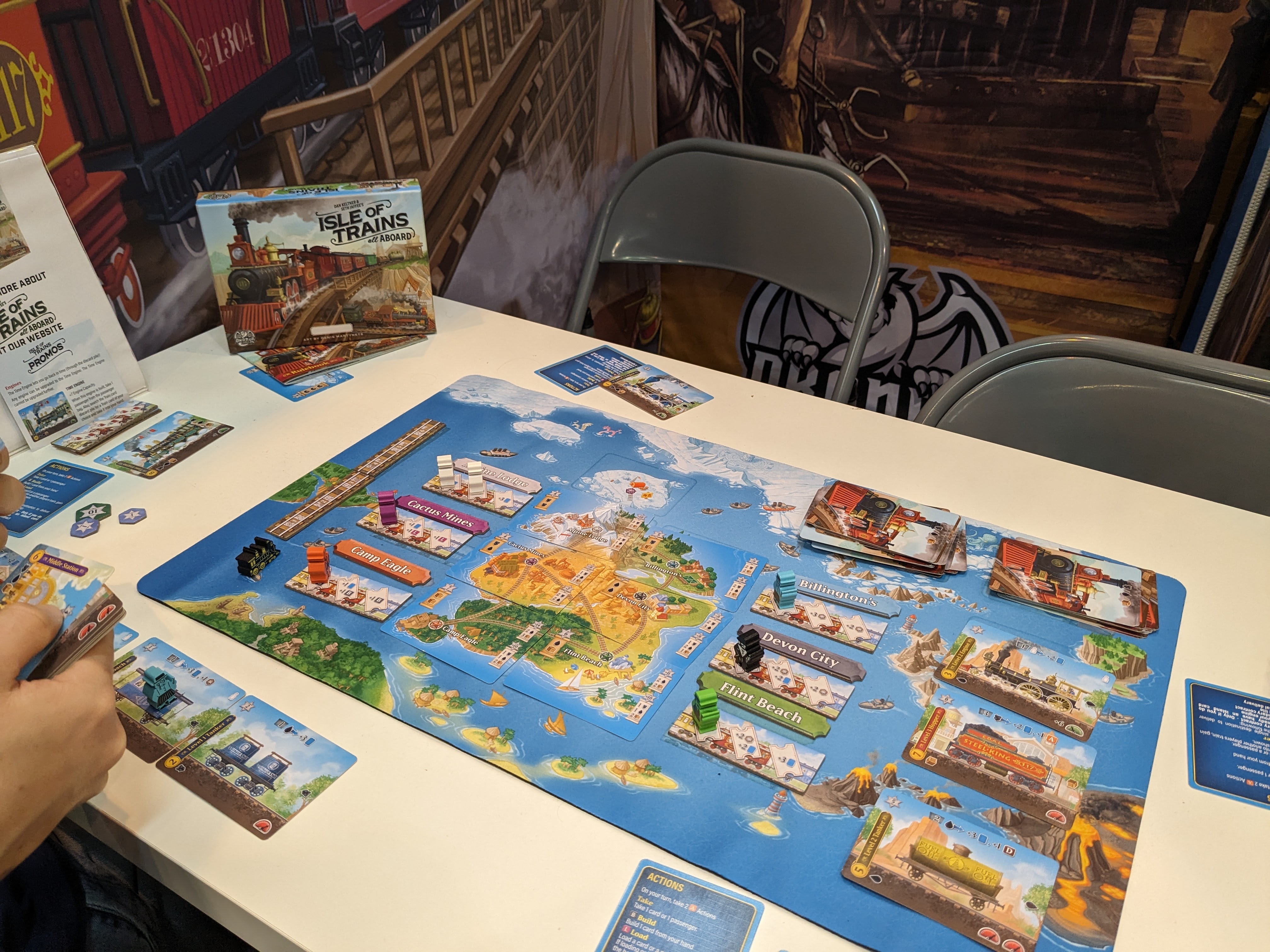
Isle of Trains: an island map with meeples and train cards forming trains on the player boards.

In Isle of Trains, you build a train to deliver goods and people to places. The twist is that the goods and people can be put there by your opponents, because you get bonuses and resources when you add things to your opponent’s train, but not to your own – making your train appealing is consequently a good idea! We both liked the game, which also had excellent iconography, but were a bit worried at having to check other player’s boards from across the table to be able to make decisions (checking what others players are doing are not necessarily our strong suit, and this requires a fairly detailed view of that).

Fit to Print

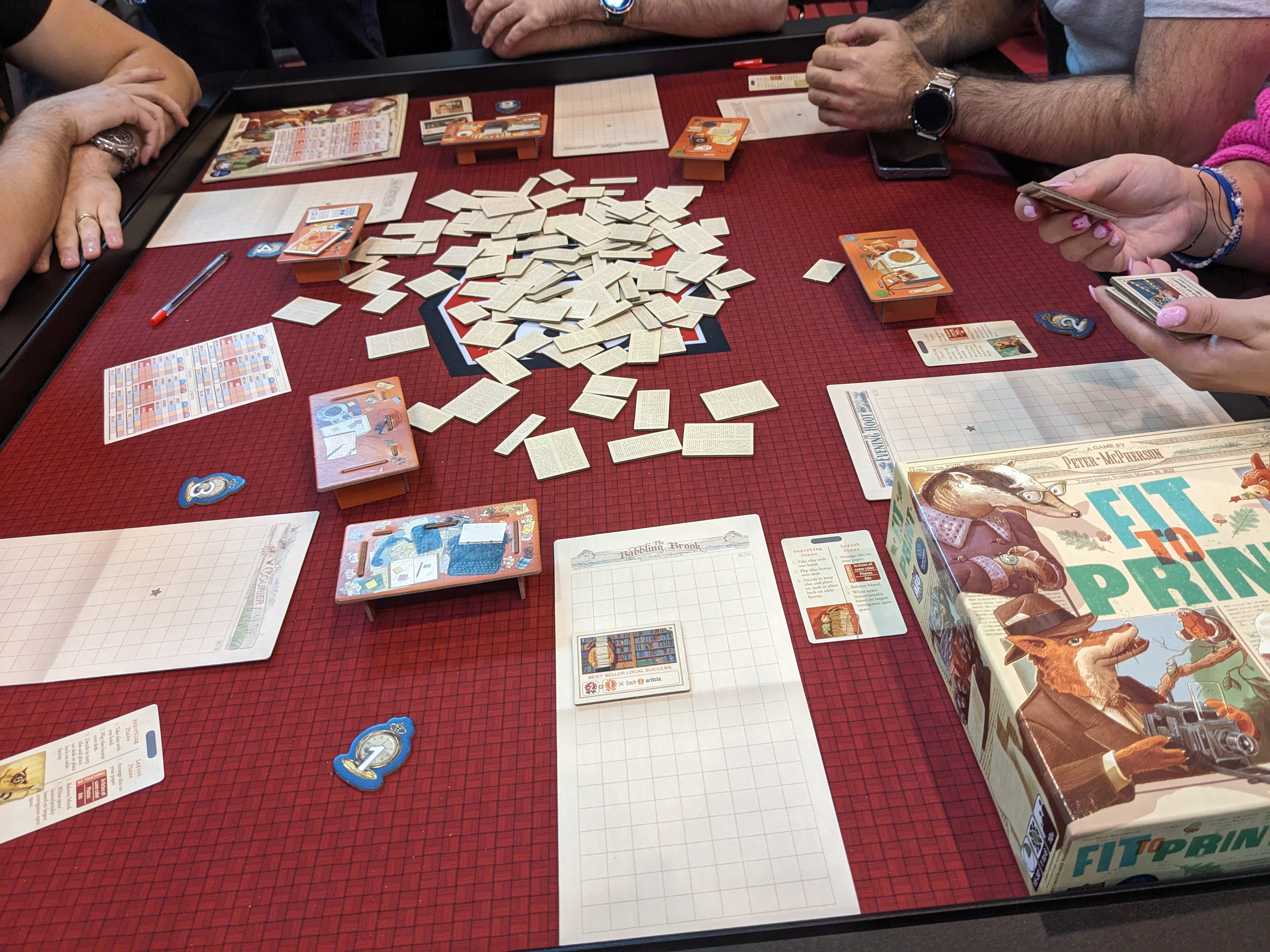
Fit to Print: grid player boards, small desks, and a bunch of "newspaper article" tiles in the middle of the table

Fit to Print is very reminiscent of Galaxy Trucker, but instead of creating a ship, you create a journal layout, with a bunch of constraints. Also, you score directly without making your journal layout explode first. I kind of like the frenzy of ship building in Galaxy Trucker, but I was never convinced by the “race” second half of the game, so Fit to Print plays into that. Add to that an adorable “forest newspaper” theme, and that’s a box that went home with us.

Footprints

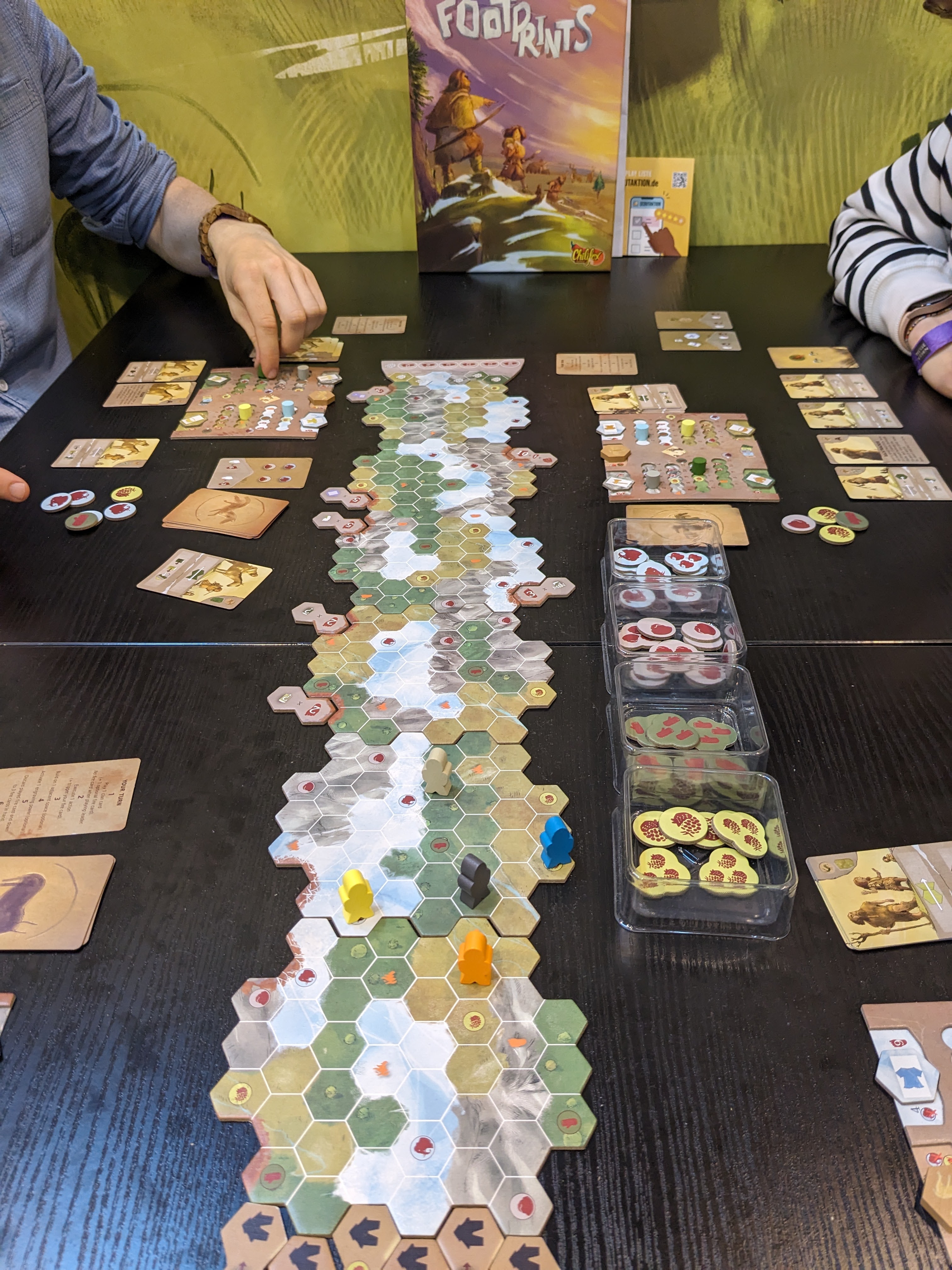
Footprints: a long hexagonal board with different types of terrains, player maps and tokens.

Footprints is probably the game I got most excited about while playing it. You’re playing as a clan of stone age people who move through the terrain, gathering resources and leaving footprints (and cave paintings) around. Each card you have can either move your pawn or increase the amount of movement you get in one or two terrain types, and you unlock more powers as you go. It was really enjoyable and we also got a box for home – good thing that we did, because it did sell out later during the Messe!

Color Flush

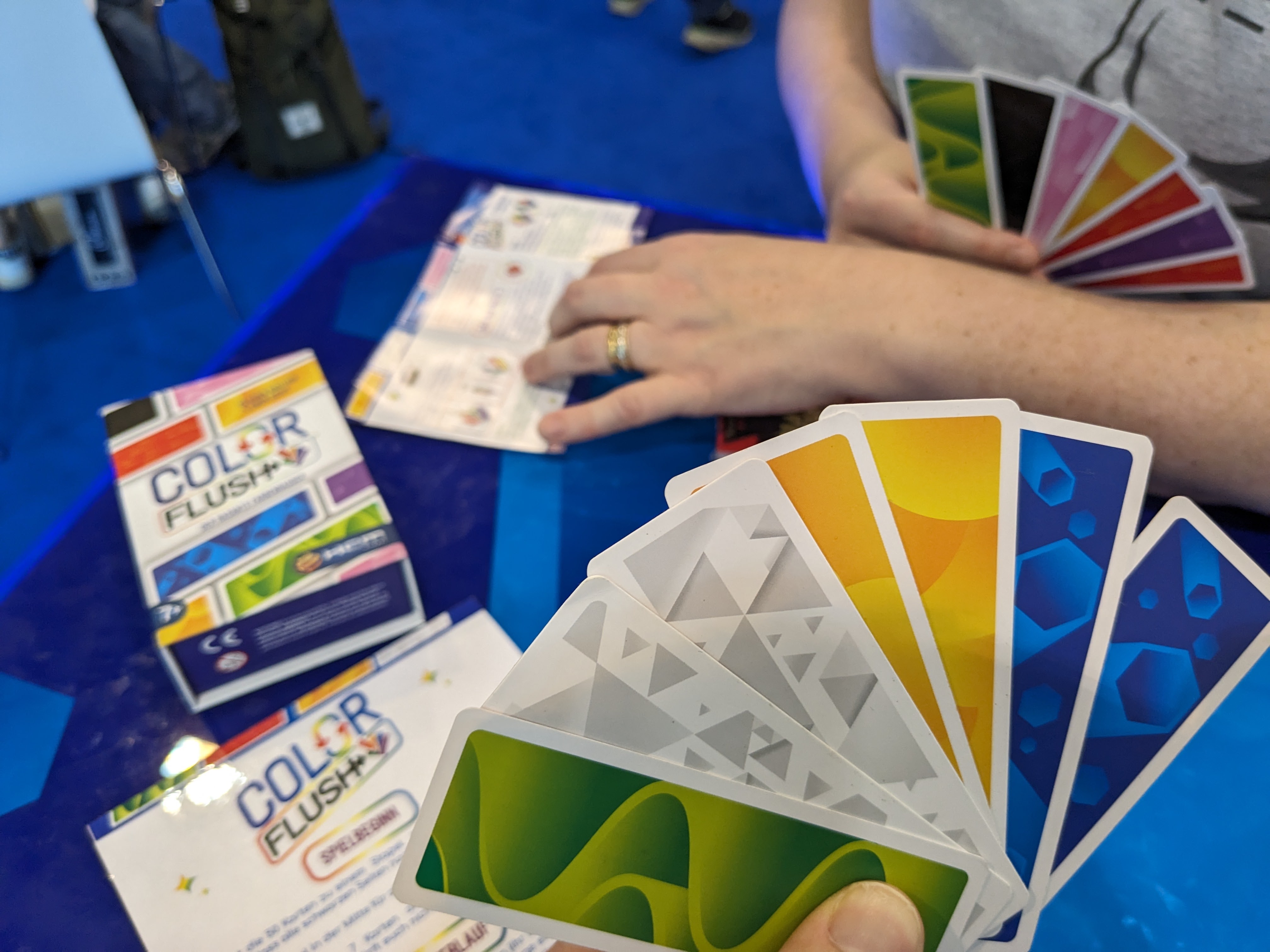
Color Flush: two players with a hand of cards that look like colorful bookmarks

In Color Flush, players have colored cards that may or may not have the same color on both sides. They’re trying to get a hand in front of them that has only one color of cards, and they do that by picking cards, removing cards and turning cards. We explored this 3+-player game on our own with the German rule, and it felt like it could be fun, so we got a box; but a subsequent attempt at play proved disappointing. Possibly the buying mistake for this year :p

Sixto

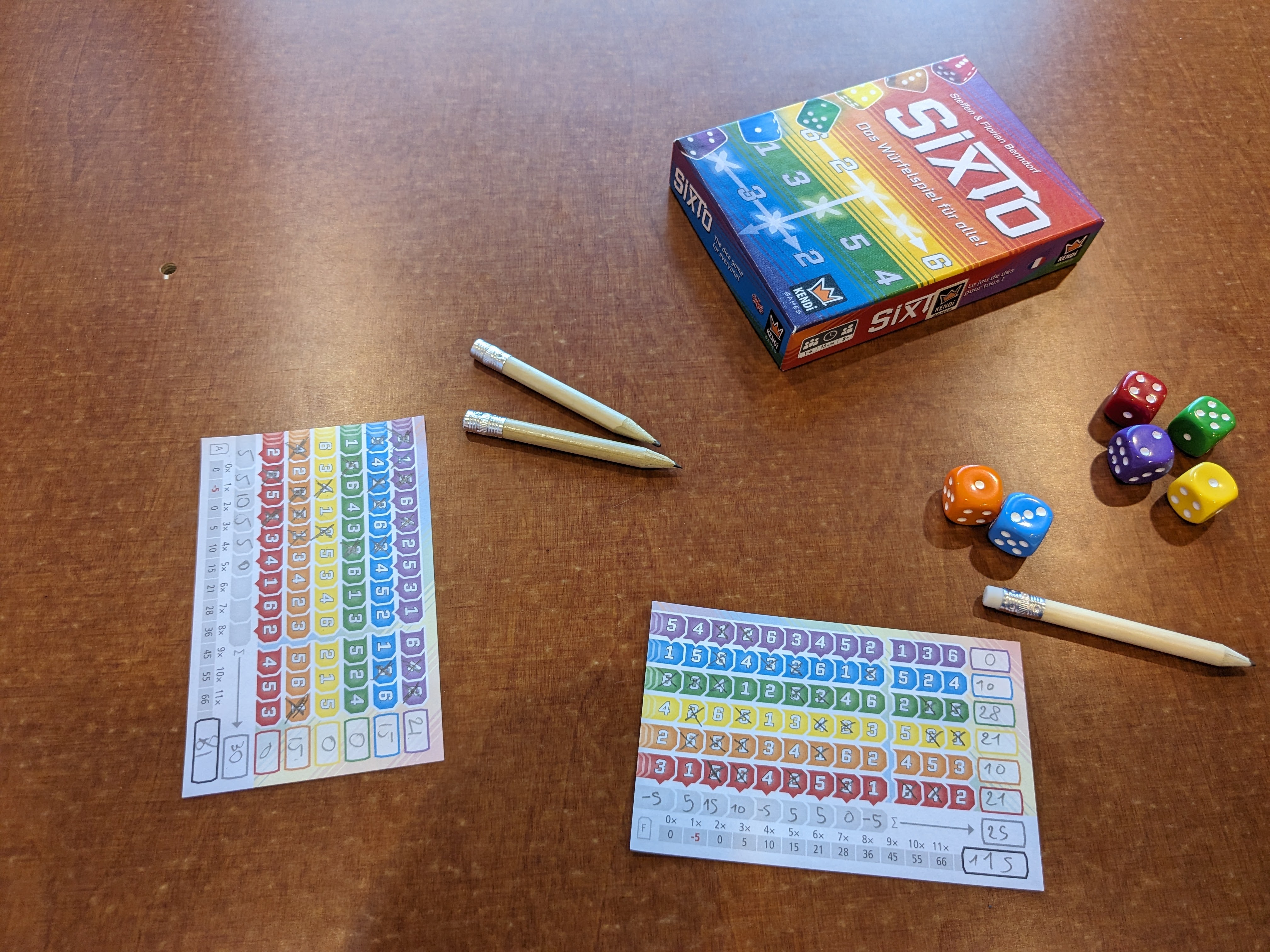
Sixto: 6-sided dice in 6 colors, and a marking sheet with numbers in striped lines.

Sixto is a roll&write game where you decide, on each roll, whether you want to cross the cell corresponding to a number and a color on your sheet. Crossing a cell prevents you from crossing cells to the left of it; scores depend on the number of crossed cells on each row and each column (and can be negative if there’s only a single cell crossed on a given line!). Could probably replace Yahtzee for most use cases, but we don’t play Yahtzee much 😉

Whale Street

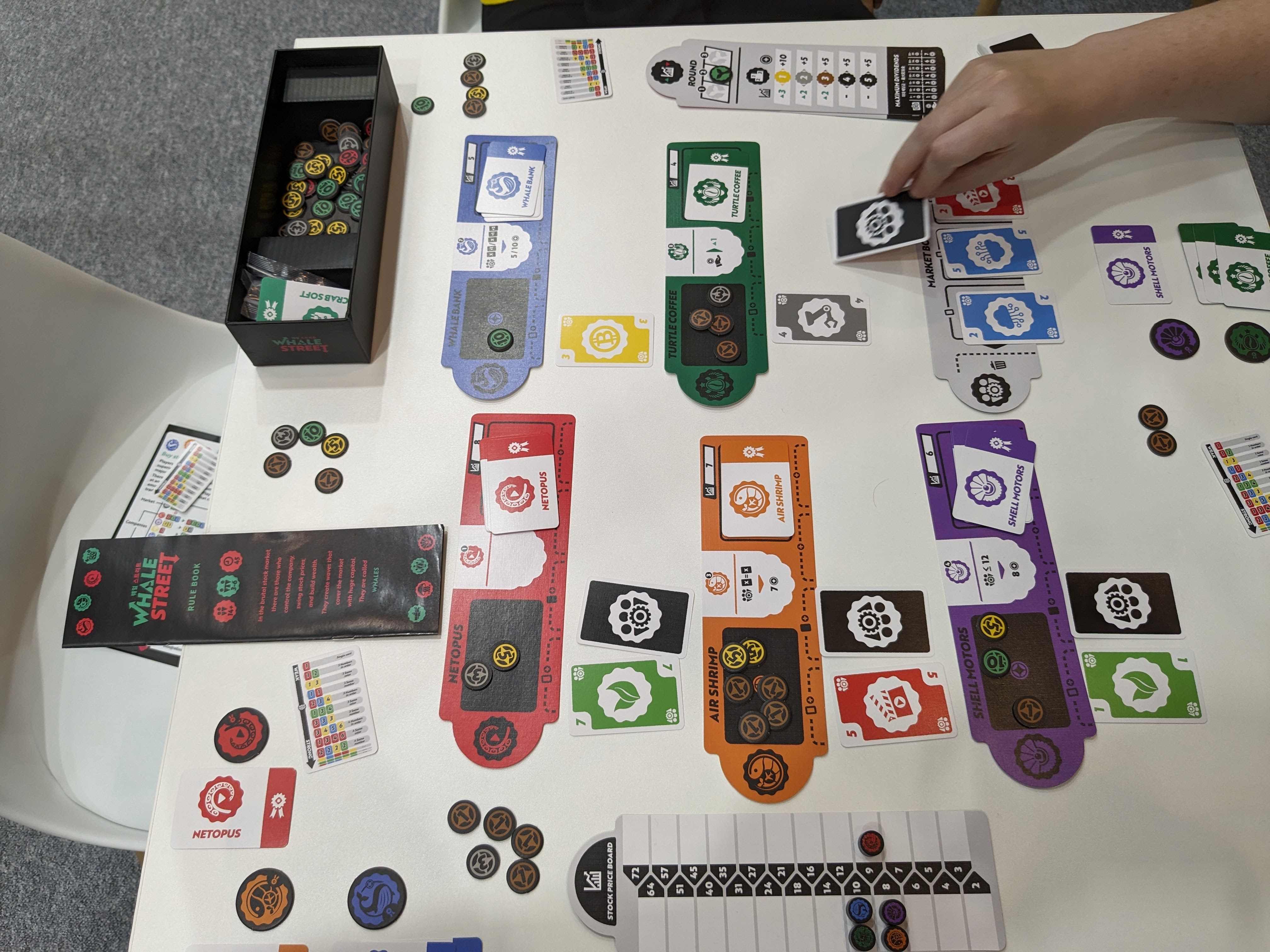
Whale street: small company boards with cards and money tokens; price ladder.

Whale Street is a stock exchange game where you try to invest your and your companies monies wisely (in order to maximize your final profit), while trying to be the “best operated company”. Honestly kind of neat, and clicked well together; playing it during the demo only the two of us may have removed a bit from the desired feeling of the game (as it was, we probably weren’t competitive enough with each other!), which may have been more fun otherwise.

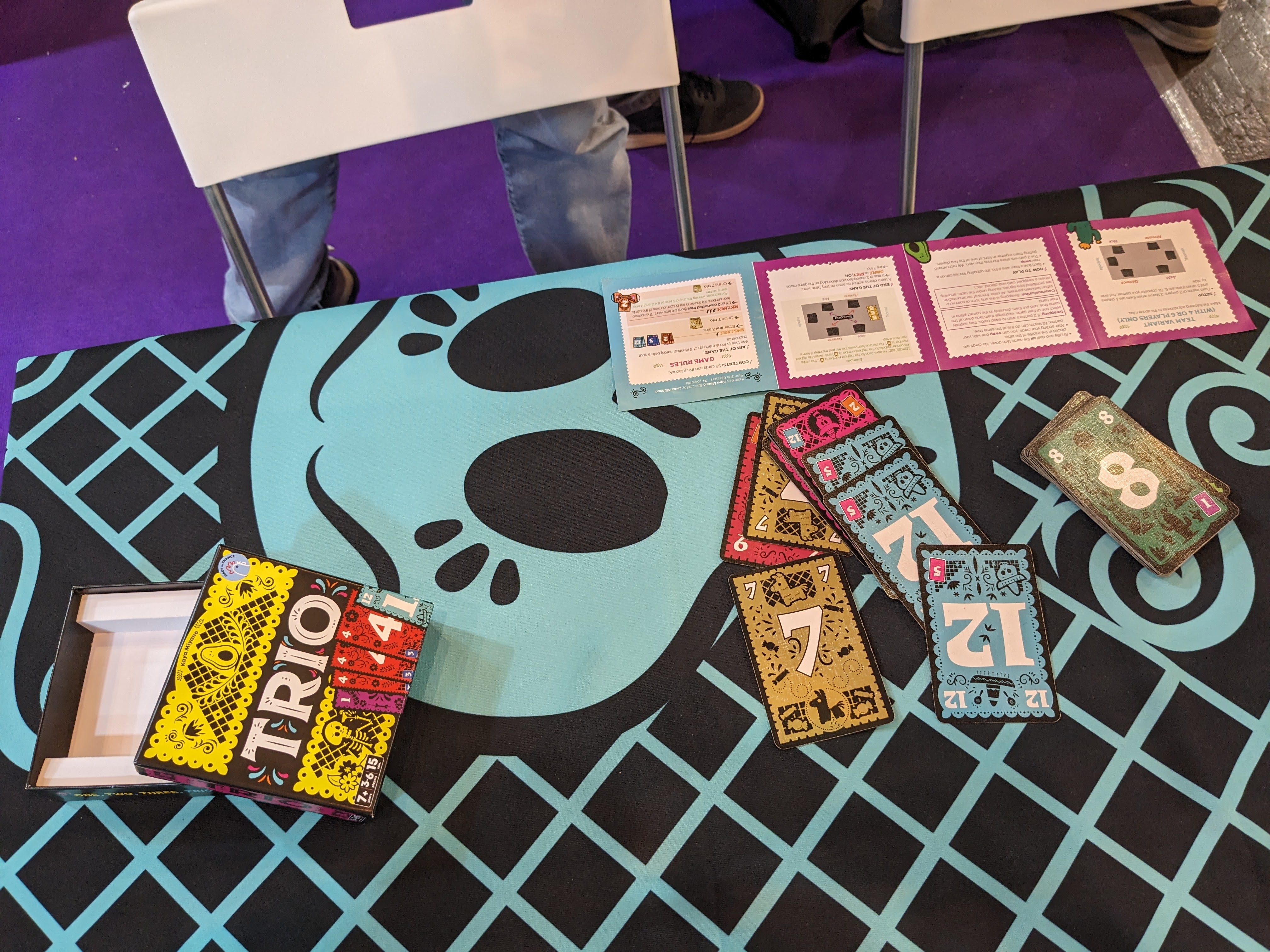
Trio

Trio: colorful numbered cards on top of a tablecloth with a skull

Trio was a “colored number card game”, so obviously we had to give it a try 😉 Cards are split between players and a third deck that gets laid faced down on the table. Players are trying to create three triples of identical cards by asking their opponents for their lowest or highest card, playing their own lowest or highest card, or flipping a card from the middle. requires quite some memory, but we had more than a few good laughs, it’s quick to play and… well, fun – so that’s another deck of numbered colored cards in the collection 😉

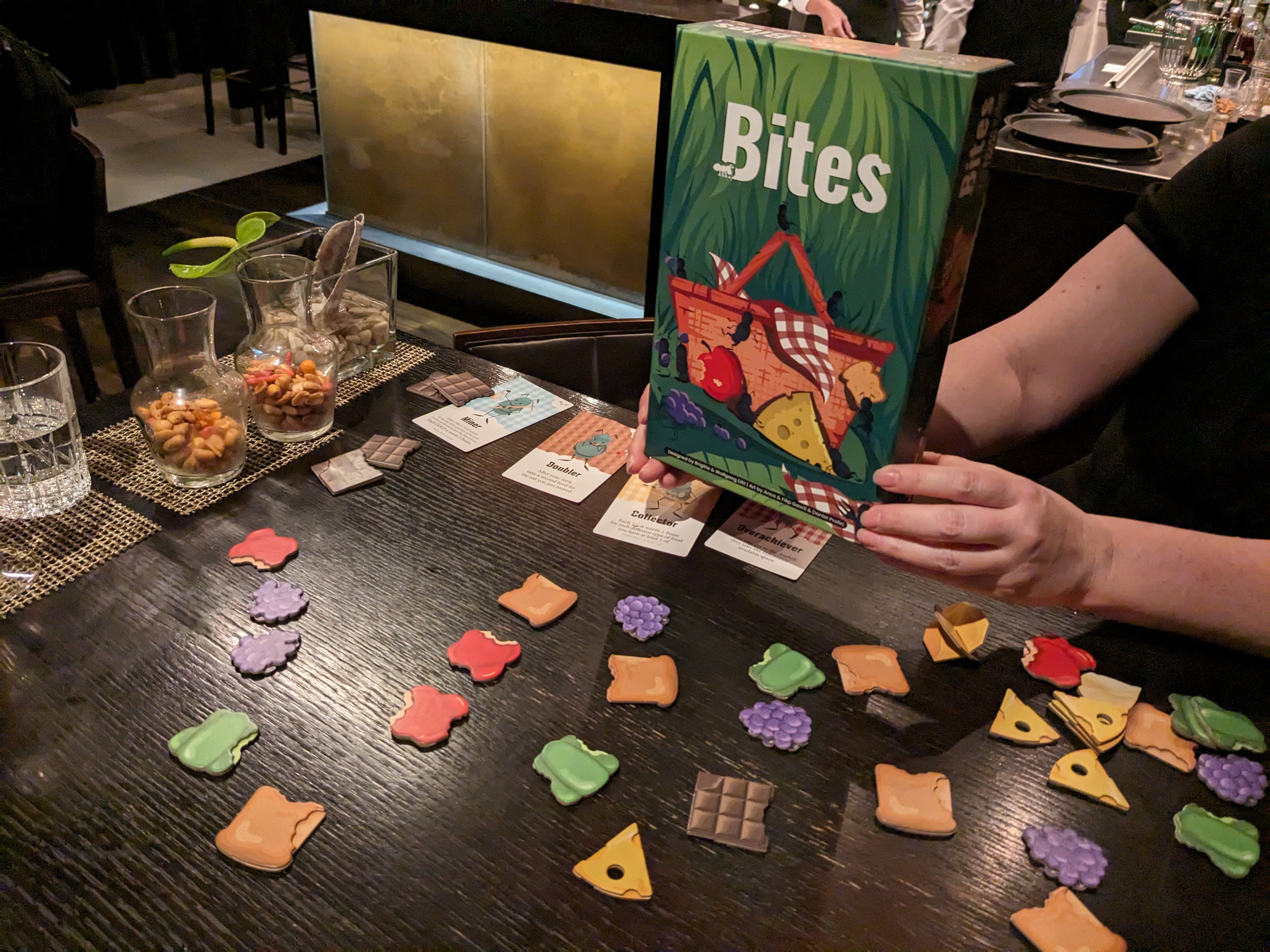
Bites

Bites: various food tokens laid as a path on a table

Bites has an unfortunate title for French-speaking gamers, but a cute theme where ants are trying to gobble picnic leftovers. All players control all the ants, and can get a piece of food on each round; the order in which the ants arrive at the end of the path determine which food is worth how many points. Modifier cards for each game round up the box. It’s well-designed and a fun casual game; we played it in the evening at the hotel bar and not during the Messe itself, so we didn’t get a copy then 😉

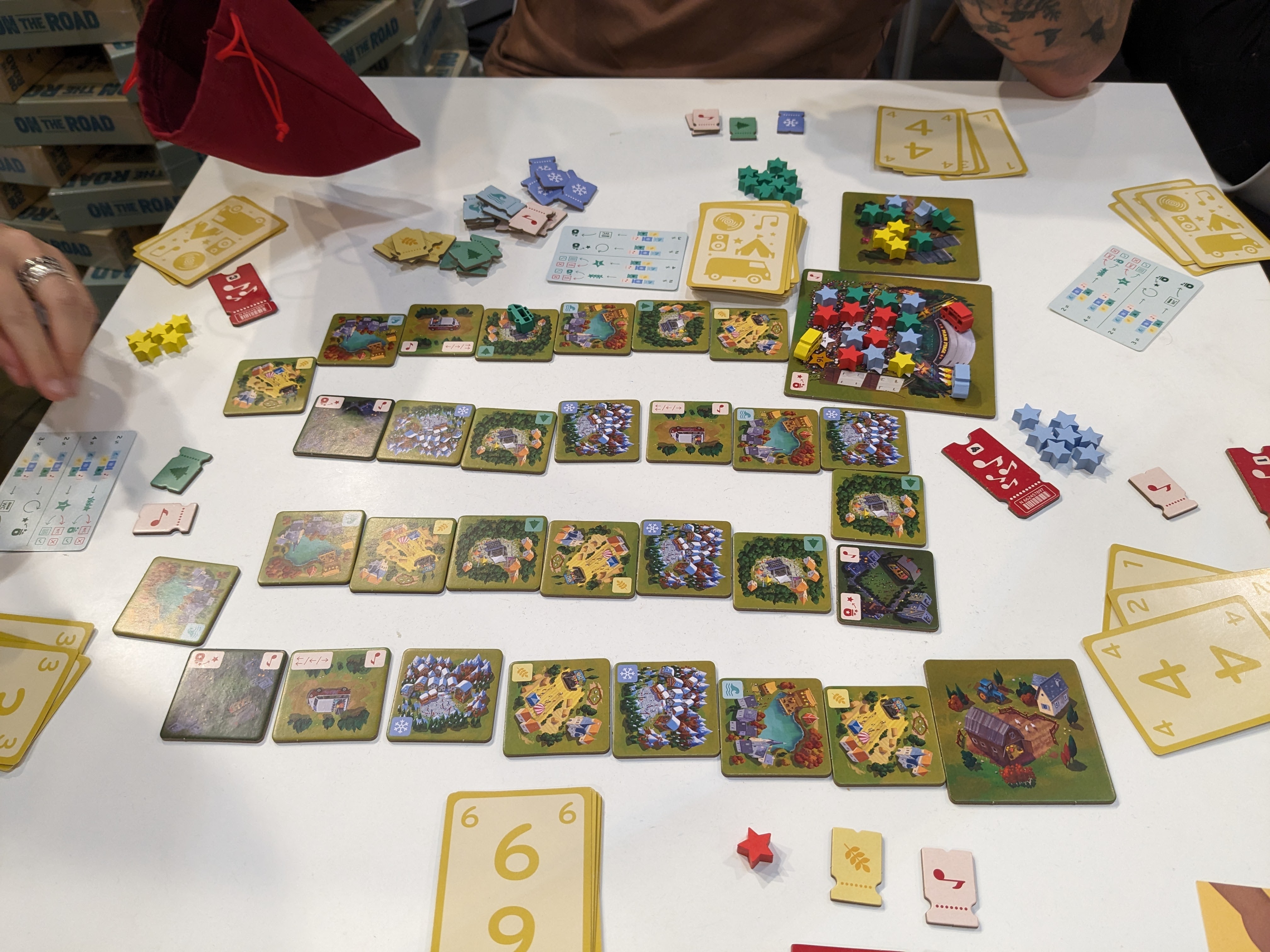
On The Road

On the Road: a trail of location tiles, some star tokens, concert tickets and numbered cards

On the Road lets players take the role of a group on their road to success, from their grandma’s farm to a large festival. They collect tickets that gives them fans which should eventually attend the festival… if you’re lucky, that is. Kind of nice, very cute components (the band vans are adorable), but it didn’t quite click enough for it to be a buy.

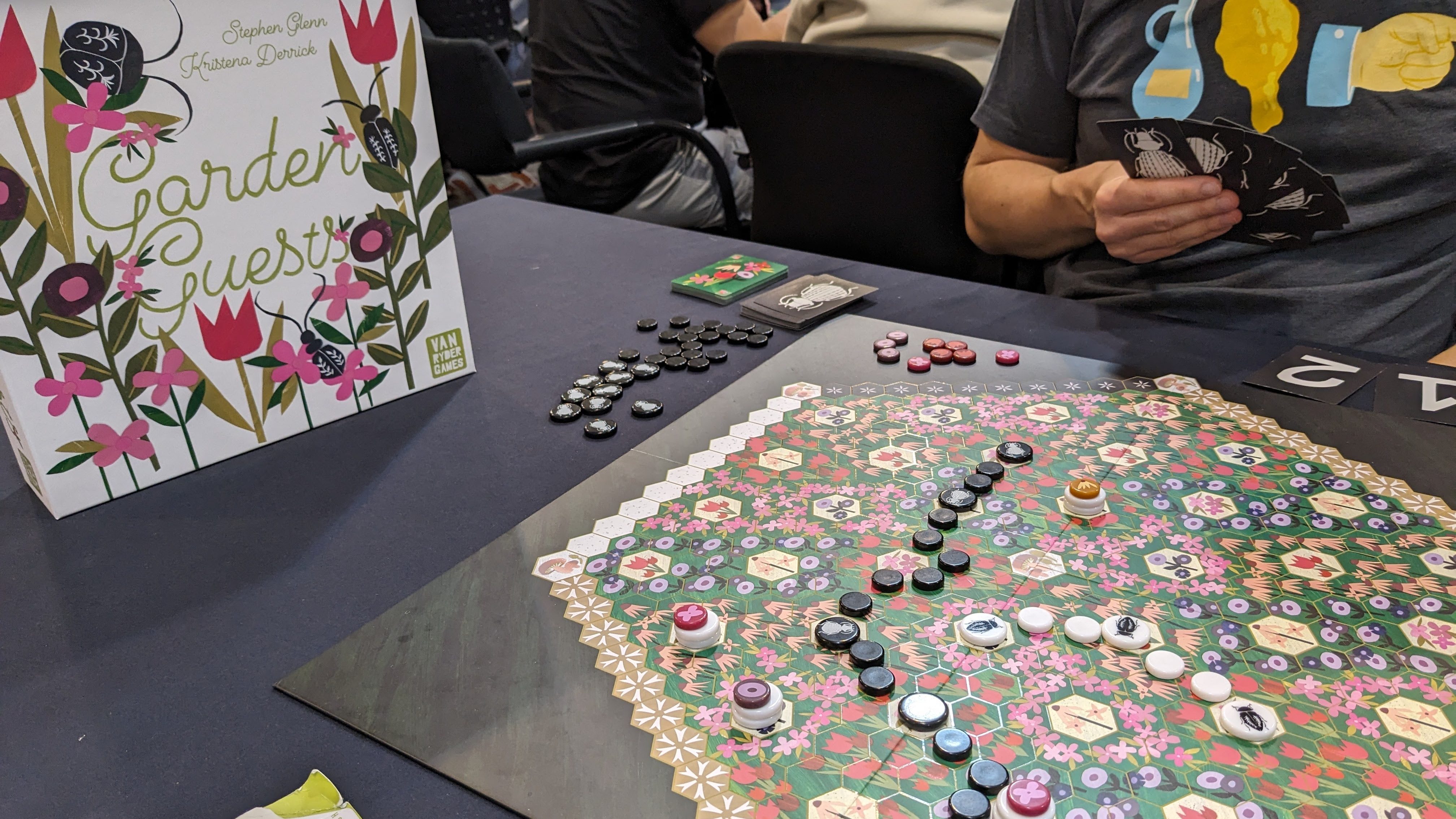
Garden Guests

Garden Guests: a hexagonal grid of hexagonal tiles with colorful flowers and tokens

Garden Guests is a distant cousin of Hex: players (or teams of players) want to connect one side of the hexagon to the other with their tokens. For that, they can build bases, and then build paths connecting these bases, depending on the cards they have in their hand. Lovely components, but too abstract for our usual fare. I’m a bit curious about the team play, though (players of different teams play alternatively, are not allowed to communicate but can pass cards between each other).

Sunrise Lane

Sunrise Lane: a board with colored buildings of different heights on it.

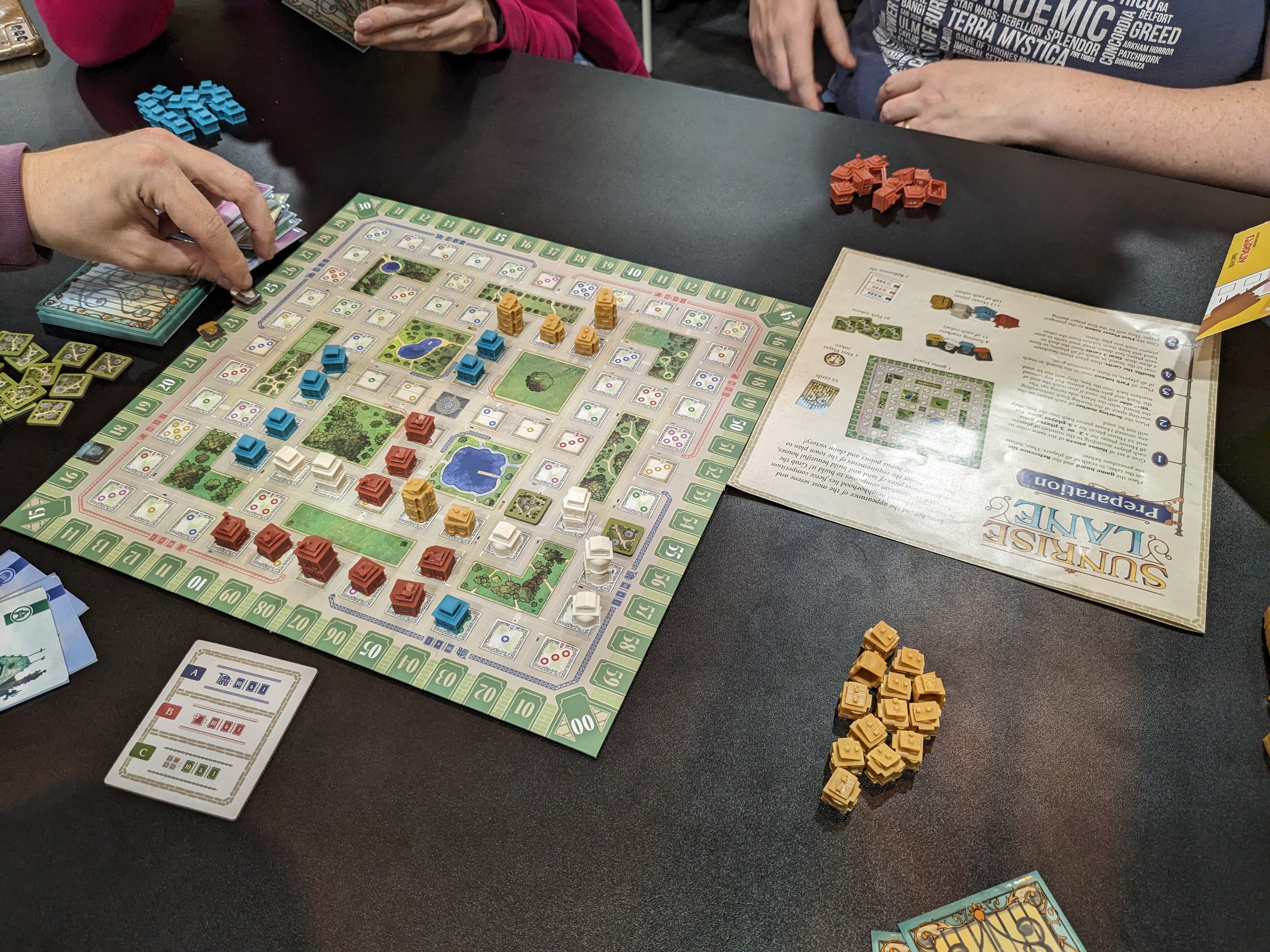
In Sunrise Lane, you build houses of different levels on marked spots to get points depending on the height of the buildings and the exact spot where you put them. You can continue building adjacently in a chain as long as you have the cards to do so. It felt more abstract that it looked, which is not a surprise as we learnt later that it was a reimplementation of Rondo, except on a square grid.

After Us

After Us: a central board with cards and resources, and player boards with primate cards

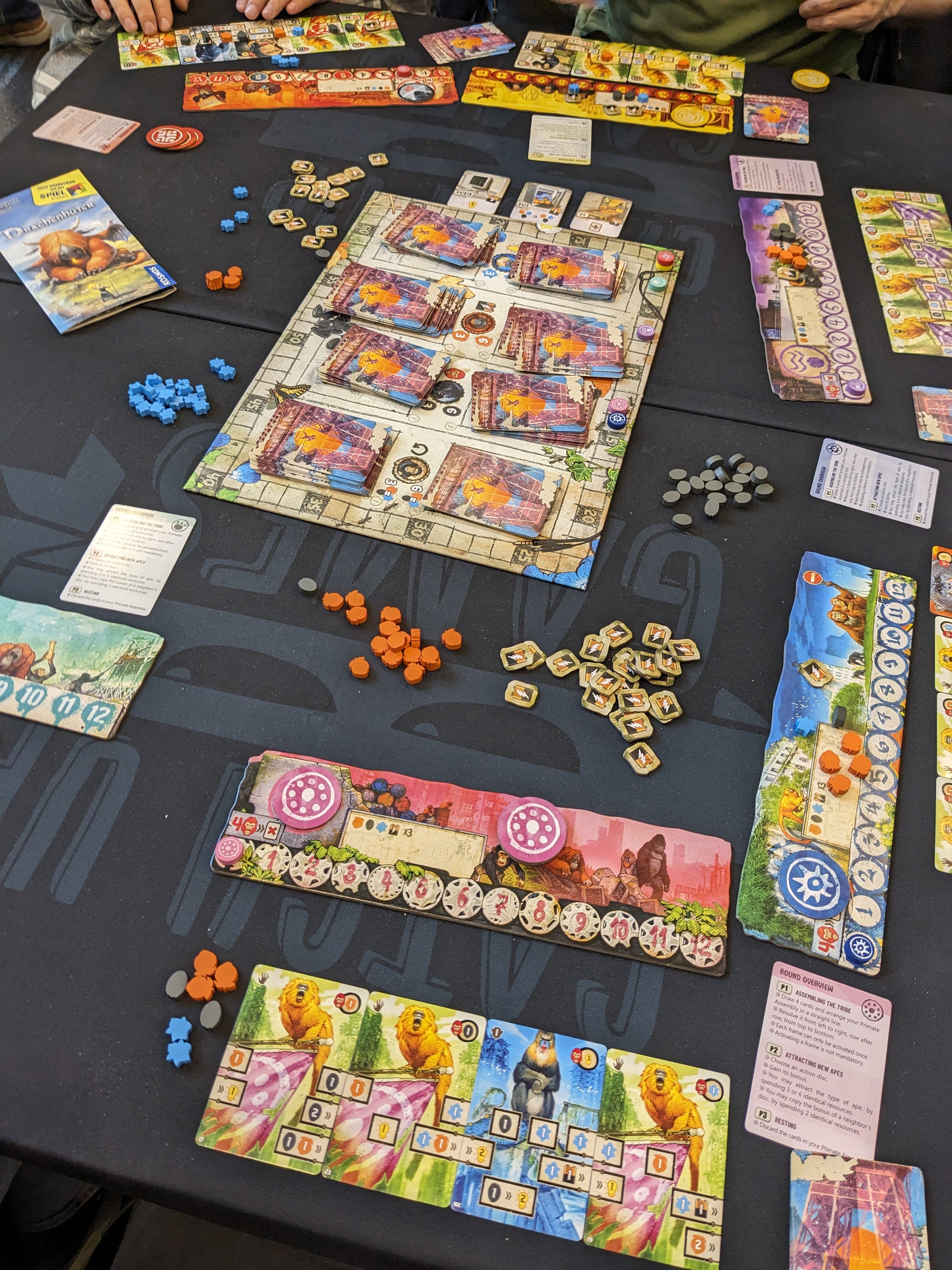
In After Us, players are trying to recruit a band of primates to be the first to evolve to intelligence. The primates cards typically give you some actions or half-actions that can be combined with other half-actions from other cards, allowing you to build resources to get more better faster stronger primates. I liked it a lot, so we got a copy; other players at the table bemoaned the lack of interaction, which is a fair question (but not one that particularly bothers us.)

Apocalipsocks

Apocalypsocks: A bunch of cards with cartoony socks on them

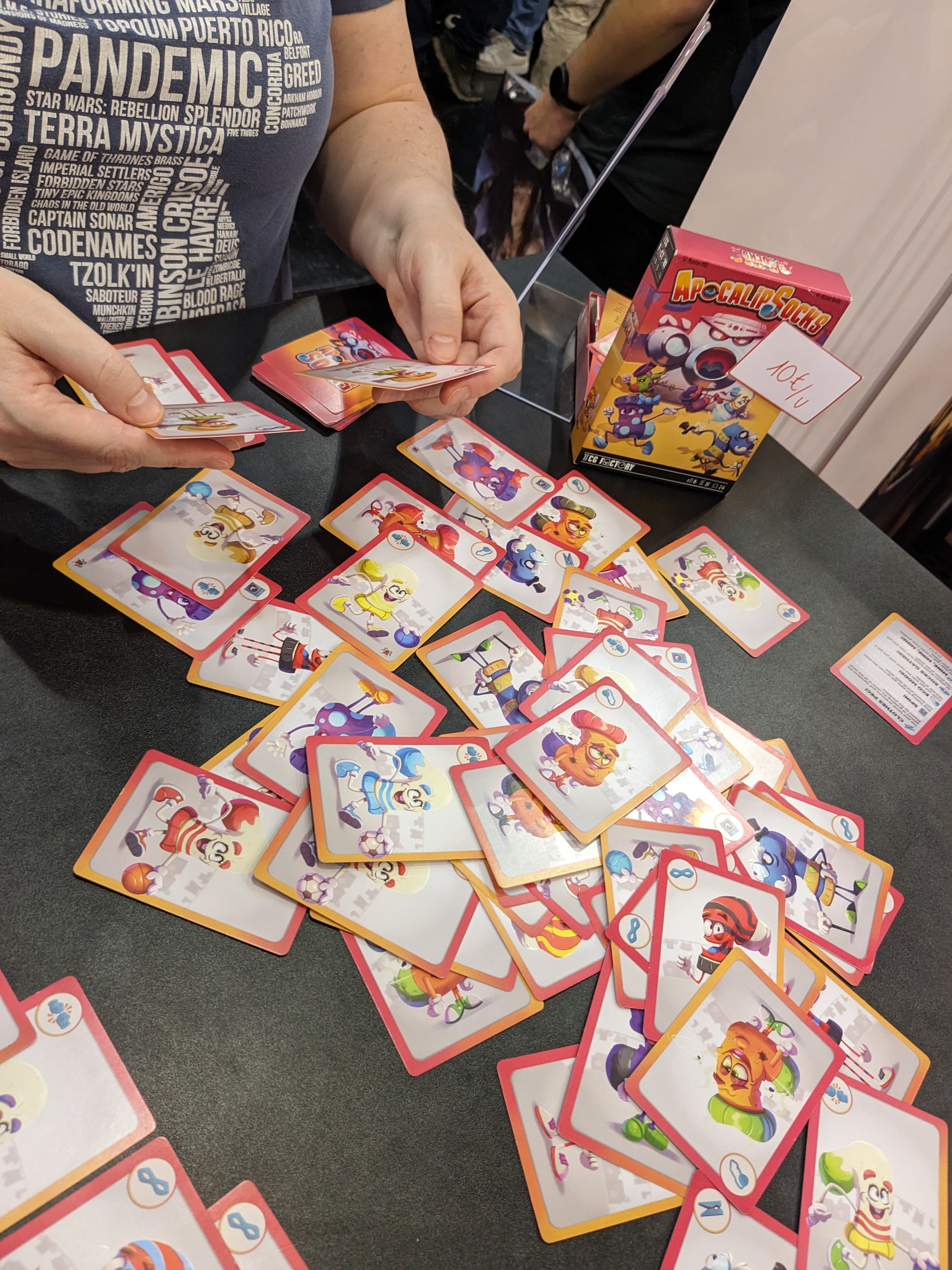
In Apocalipsocks, you try to pair similar-looking socks into identical pairs of socks and, when you do that, your opponents get to do something silly like turning on themselves or playing with one eye closed. It probably works for its audience, but that’s not us 😉 The cards are neat and the details to take care of are fun!

Rome In A Day

Rome In A day: hexagonal tiles of different colors, building tokens and cards

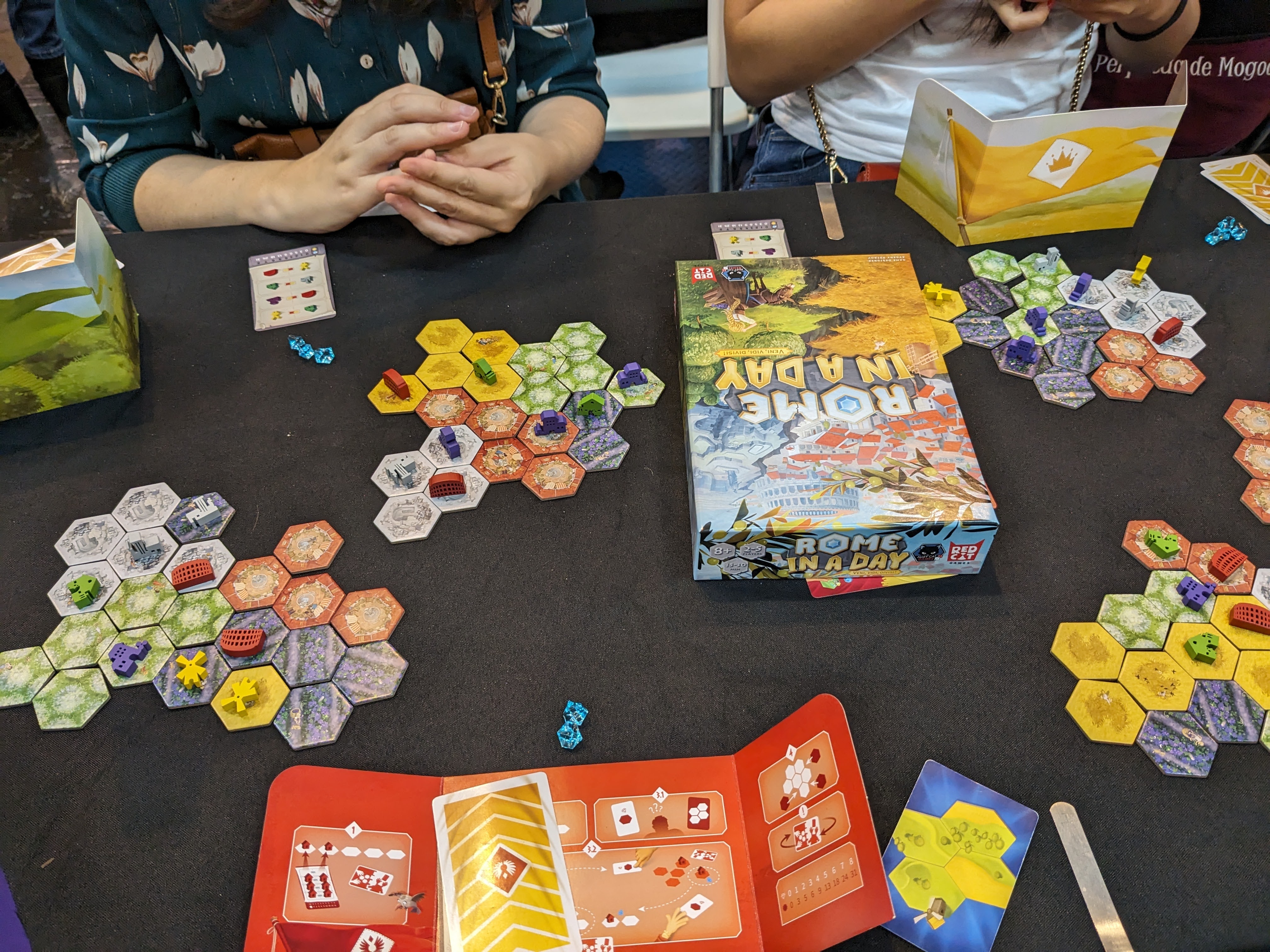
Rome In A Day is pretty similar to The Great Split, which we liked a lot last year: you split tiles behind a screen in two groups, and your neighbor player decides which group of tiles they want to add to their board. Compared to The Great Split, though, it felt like there was a bit more strategy involved in choosing groupings, because the other player’s boards are much more visible/readable; the “getting points” part of it also requires a bit more thinking. Long story short, we got a copy of this one.

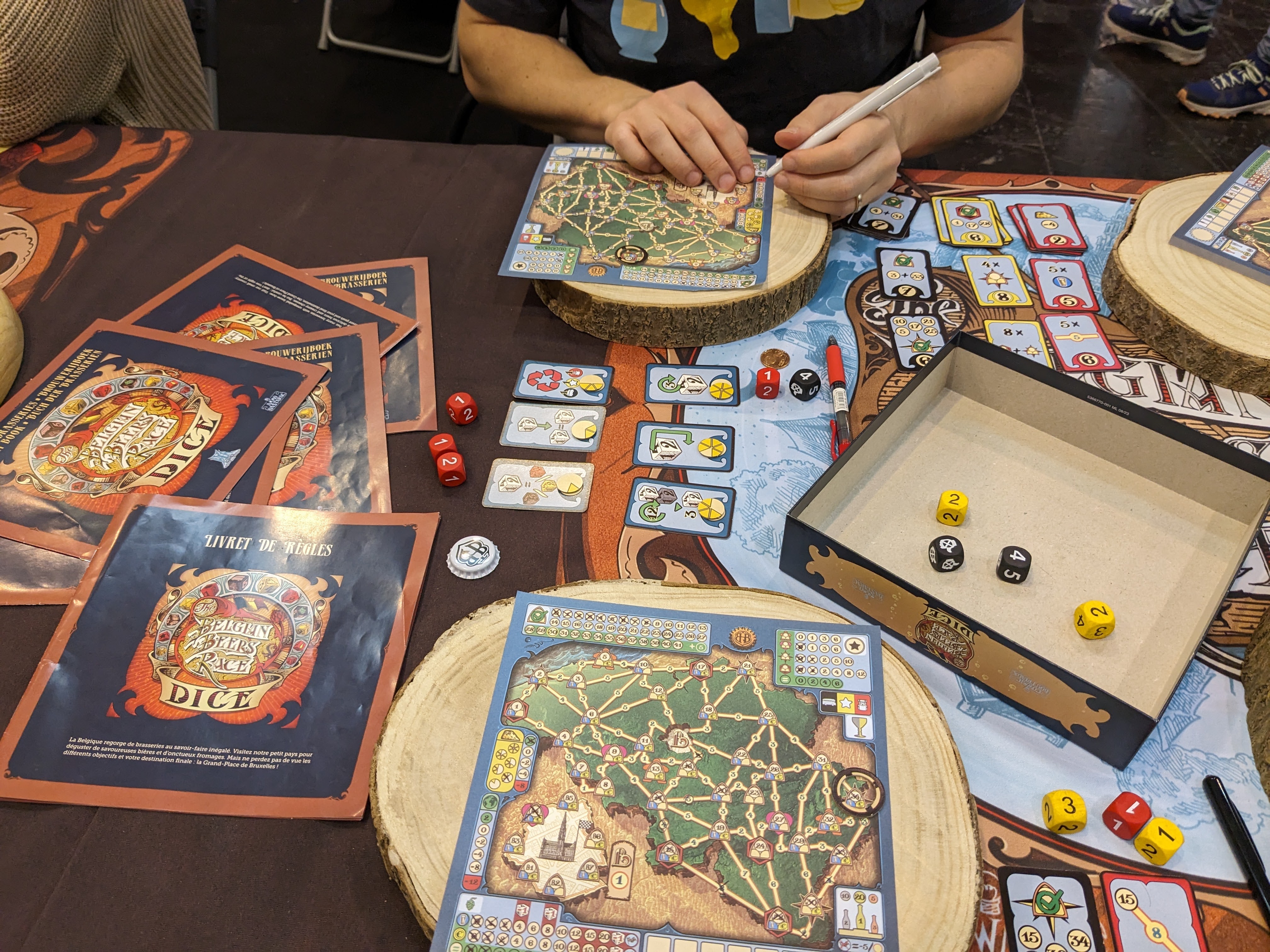
Belgian Beers Race Dice

Belgian Beer Race: a few dice, some objective cards, and writing sheets that look like the map of Belgium

Belgian Beers Race Dice is a roll&write version of Belgian Beers Race. The theme is similar: trying to visit as many breweries as possible while filling in objectives, not get too drunk, and come back to Brussels early enough. The marking sheet makes it kind of hard to follow what’s happening, and it’s quite easy to forget to cross something, which is a bit sad, because the rest of the game feels like a decent roll&write.

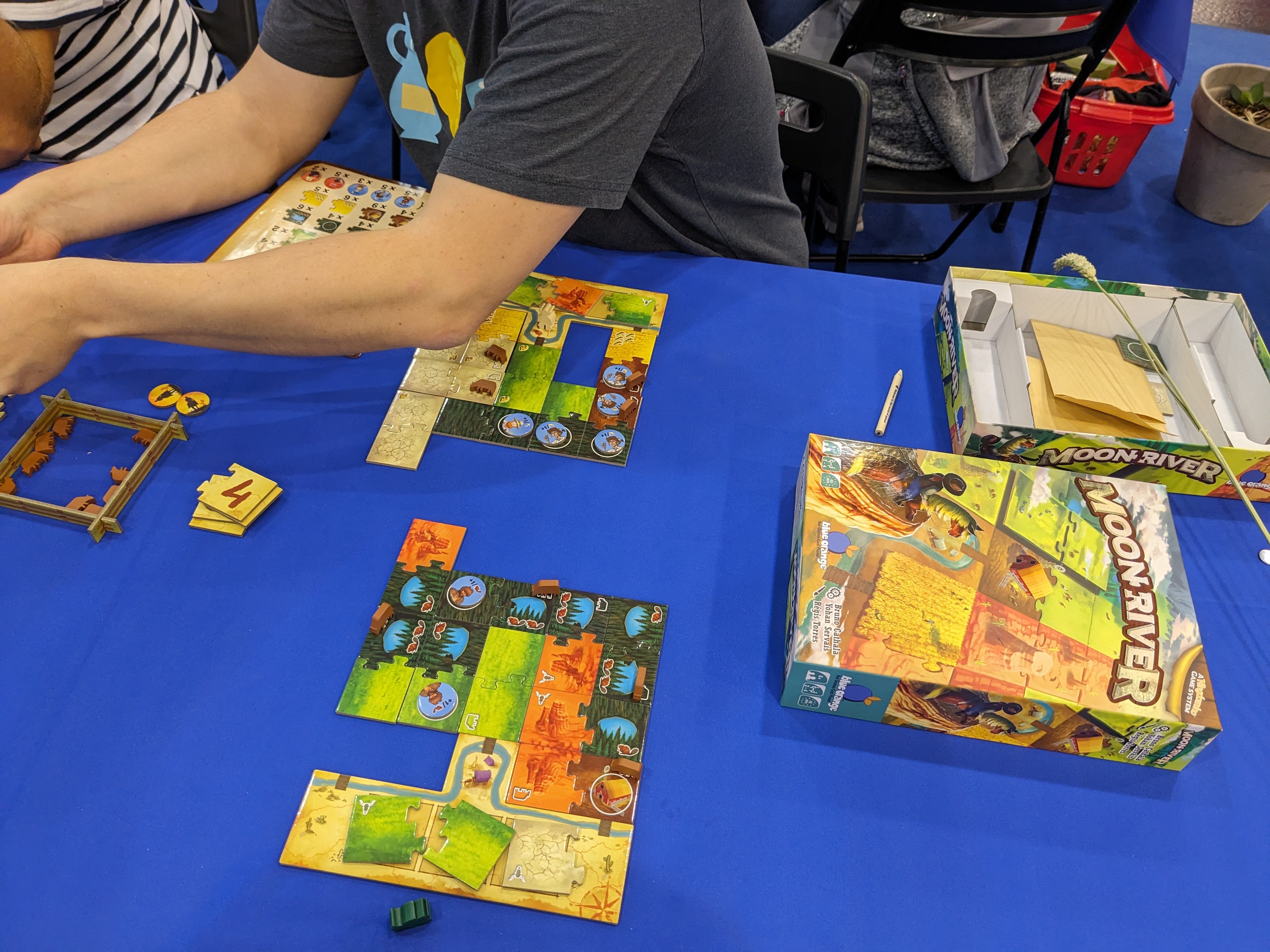
Moon River

Moon River: square jigsaw puzzle tiles assembled in dominoes with various terrain effects (colors, cows, beavers).

Moon River is a clear riff on Kingdomino, but where players get to build their own dominoes. Also, there’s cows. Kingdomino still has my heart, but I liked this specific take (while I was not necessarily convinced by other variants of it), which felt different enough and enjoyable enough to get a box for that “I’d play Kingdomino, but I’d like something just a tiny bit more complex” mood 😀 (yes, it’s a pretty specific mood.)

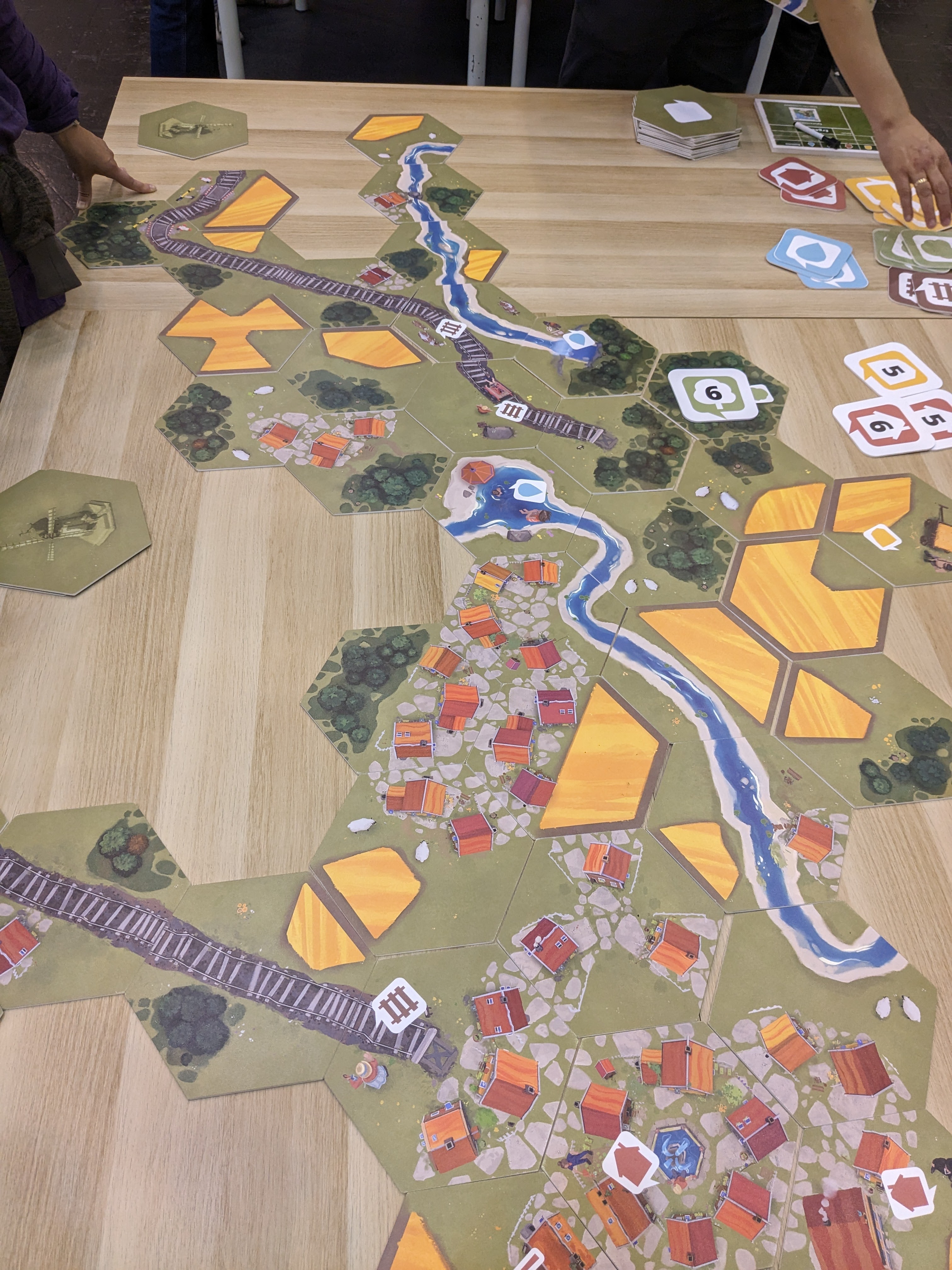
Dorfromantik

A giant version of Dorfromantik: hex tiles with villages, forests and fields, as well as railways and rivers, and some objective tiles on the side.

Dorfromantik is a cooperative game, adapted from the video game of the same name. I love the video game, I was excited to see the board game adaptation, then a bit skeptical because it didn’t sound that fun, then it got the Spiel des Jahres award, then I watched it played and was still not convinced, and then I played it myself… and it was super fun. We got a copy, I’m not sure how/with whom we’re going to play the campaign (you get to “unlock” more tiles depending on your score :)) but… worst case I’ll play solo 😛 The above picture is a giant version of it – the box version has much smaller tiles! (Which is a good thing for my table estate.)

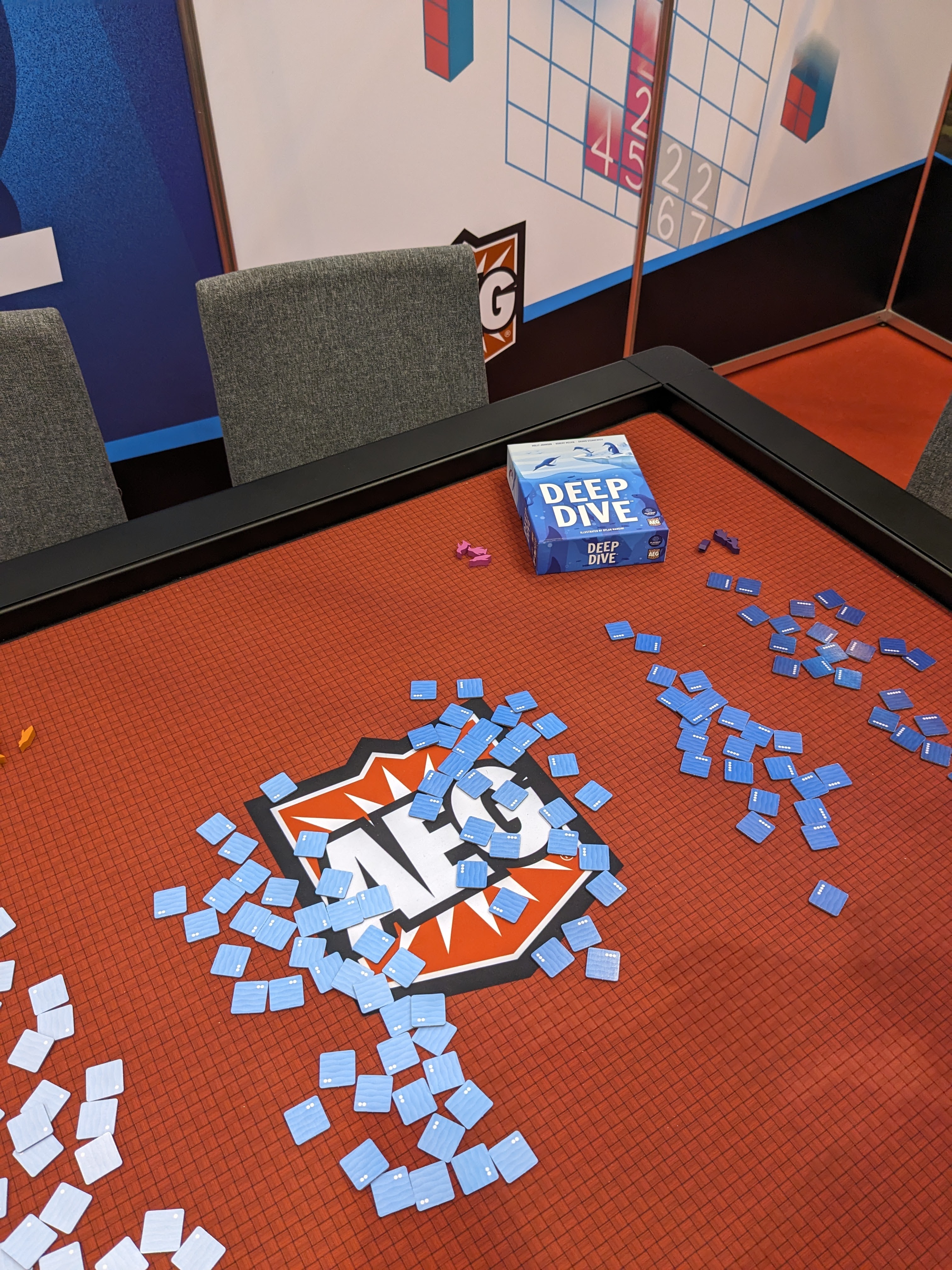
Deep Dive

Deep dive: 5 groups of face down tiles.

In Deep Dive, you have a colony of penguins looking for food. The deeper you go, the better the fish – but the higher the chance of getting trapped by a predator (No worries, though, you’ll get back eventually!). It’s a pretty fun push-your-luck game, it plays 6, we know who may appreciate that one, so that was a buy.

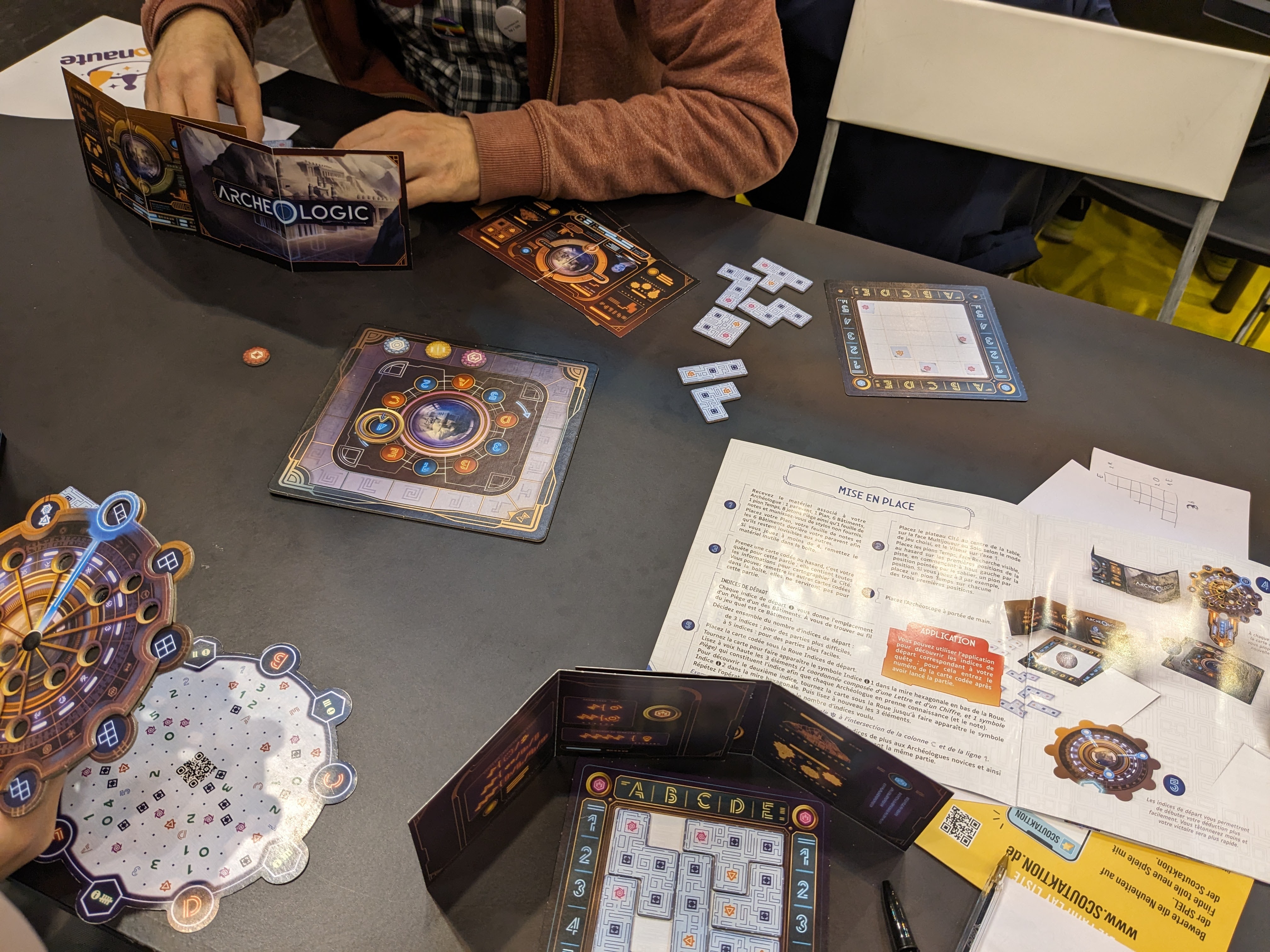
ArcheOlogic

ArcheOlogic: a grid with polyominos, a hint wheel, and a decoding tool to get the correct information from the hint wheel.

ArcheOlogic is a puzzle game that uses the same kind of mechanic as Turing Machine, but to make players guess the layout of an ancient temple. You get to ask questions such as “what are the parts of this piece that are on column C” or “how many empty spaces is there on line 2”, with various associated costs, and the “most efficient” player normally wins the game. It’s well-designed and actually far more accessible than it looks, but we feared not having the audience for it to be played multiple times.

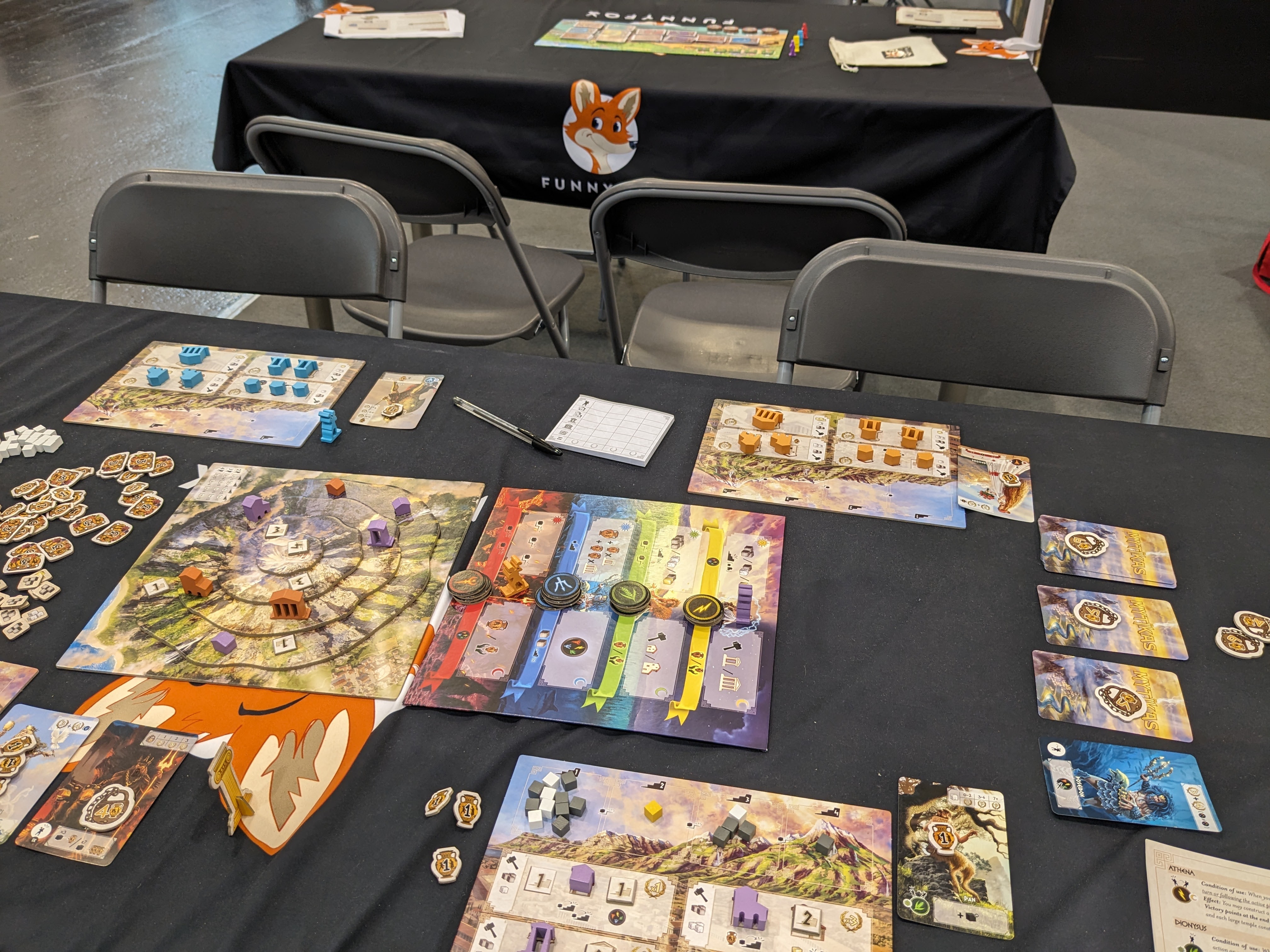
Mytikas

Mytikas: a multi-level building area, an action board, player boards with building tokens, various cards

In Mytikas, players try to build houses and temples on the Mount Olympus, while trying to gain the favors of the gods. It’s a resource-managing game, with light worker placement, and generally pleasant, but (for us) not enthusiastically so.

Essen SPIEL 2022

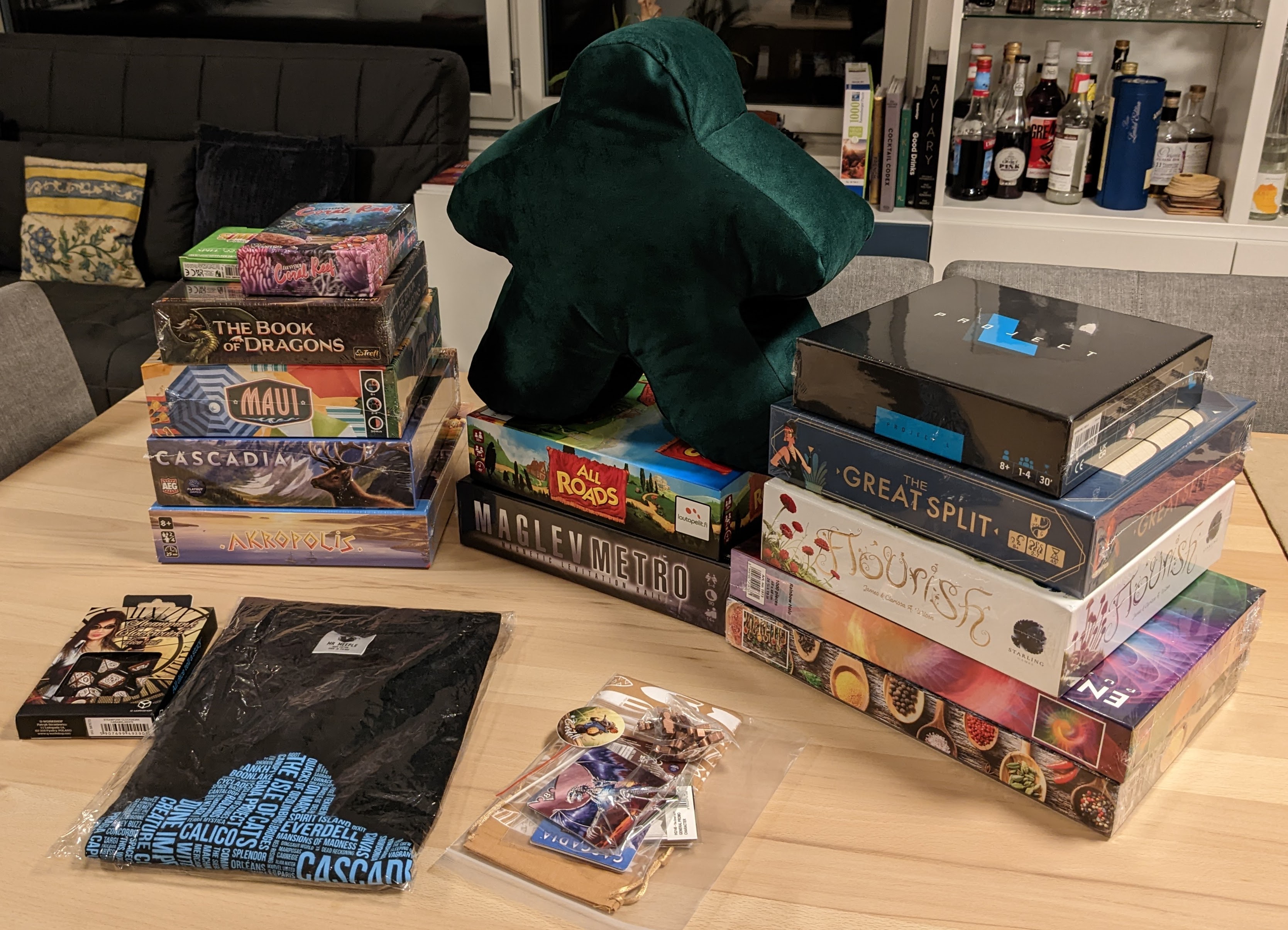
Loot from Essen SPIEL - multiple game boxes (Coral Reef, The Book of Dragons, Maui, Cascadia, Akropolis,All Roads, Maglev Metro, Project L, The Great Split, Flourish), a couple of jigsaw puzzles, a tshirt and a dark green meeple cushion.

It had been three years: last time we were in Essen was in October 2019. 2020 was a fully virtual edition; 2021 still felt too unsafe to go. This year, it felt OK enough, especially since there was a full mask mandate on the fair – we’ll see in the next few days if indeed it was! But in the meantime, it was SO GOOD to be back in Essen for SPIEL. We played a lot, we were ALMOST reasonable on our loot, we’re exhausted – but super happy to have gone 🙂
Now we’re back home… time for a few quick notes of all the games we saw! In order of play, because that’s approximately as arbitrary as I could make it anyway. I’ve been too lazy to add publishers/authors – but I’ve provided BGG links on the titles where available. Also, credit where credit’s due: many of these pictures are my husband’s 🙂 I kept these notes very short because it’s already a very long post; but I’m happy to give more details if you have specific questions!
Continue reading “Essen SPIEL 2022”

Scavenger Hunt #31 – Self-portrait

For the 31st Scavenger Hunt, I decided to create all my images within an overarching theme of “Board games” – and maybe take the opportunity to talk about said games during this post.

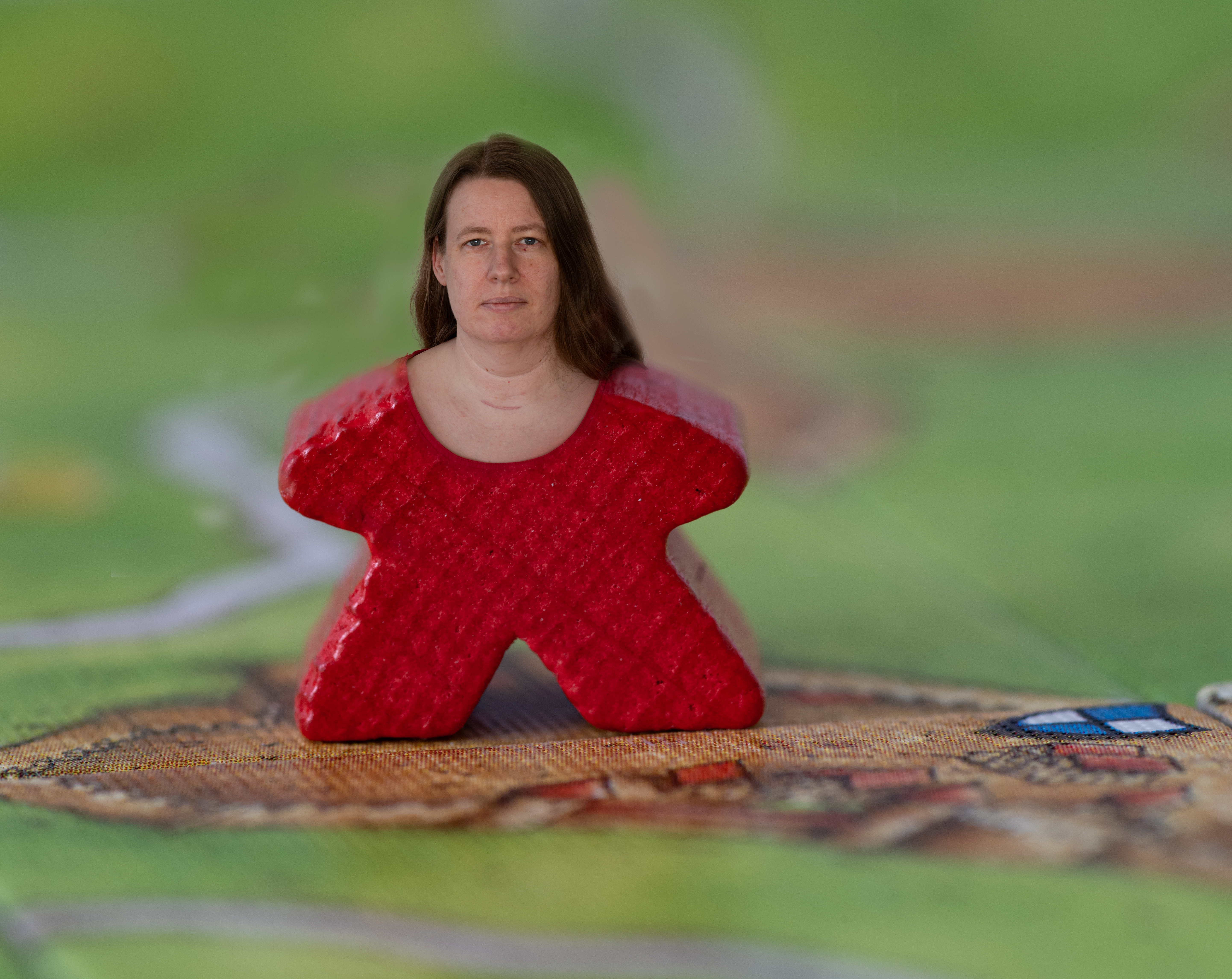
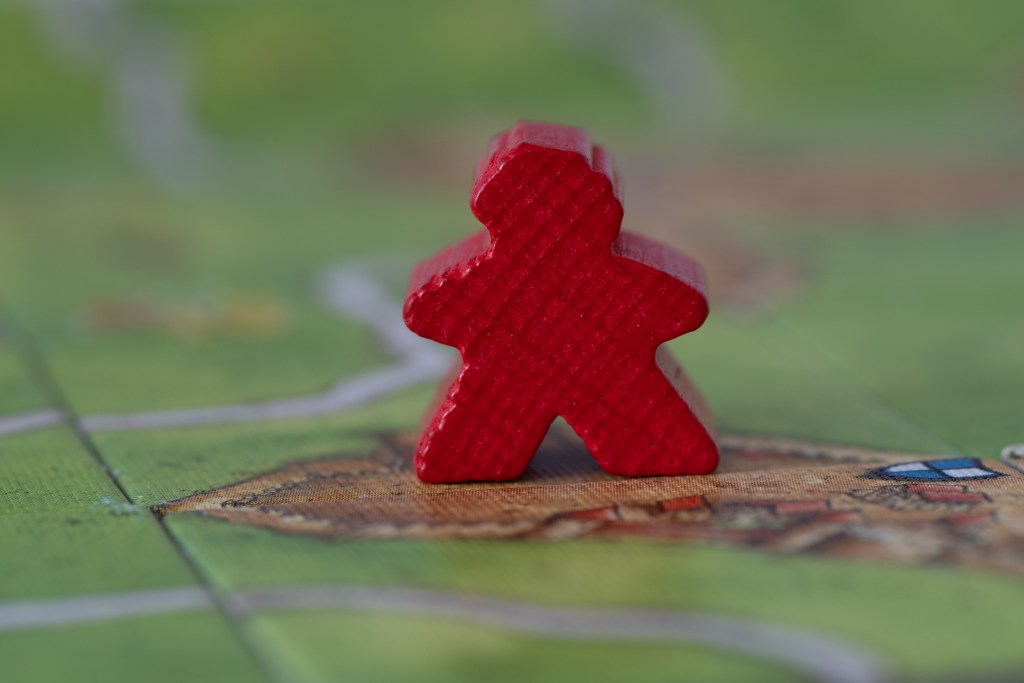
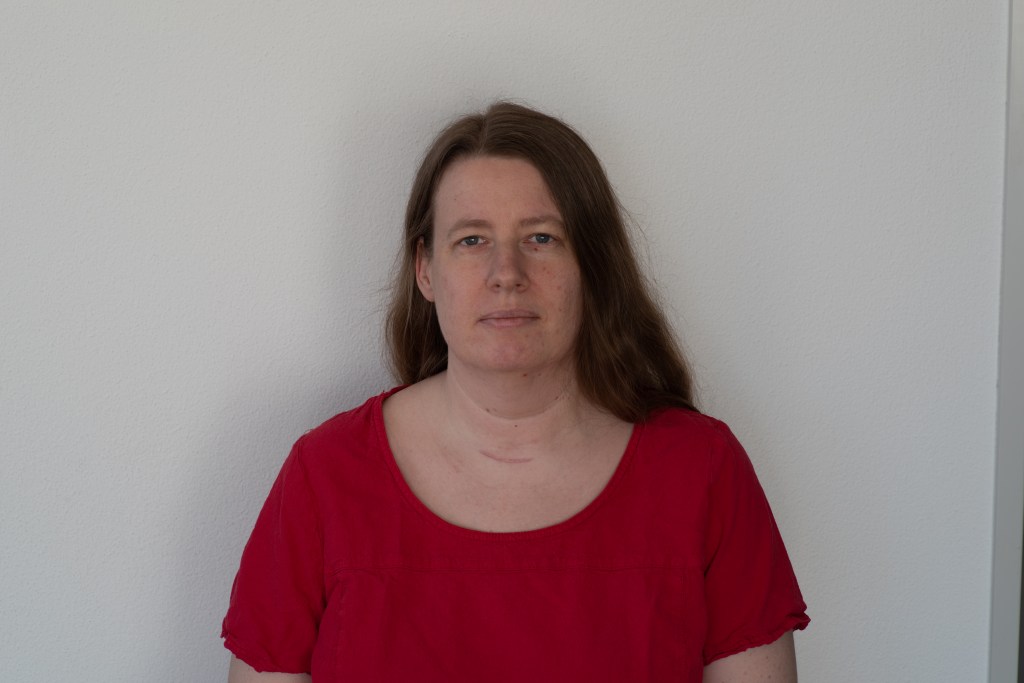
My fist idea was to take a picture of me in front and/or hiding behind board game boxes – and then I got a much funnier idea. Many board games have so-called “meeples” – the pieces that represent people. So I decided that transforming myself into a meeple could be pretty fun!

The original use of the word “meeple” comes from the game Carcassonne, which makes a significant use of them. In Carcassonne, players take turns adding square tiles to a common map and claiming various areas of the map; the final score is computed by considering the size and state of the areas controlled by each player.

It was consequently natural to set things up into a Carcassonne game. That said, my own copy of Carcassonne comes with transparent meeples, which would make the image all the more challenging, so I stole a meeple from another game. And I picked a red one, OBVIOUSLY, because I always play red.

My final image is a composite of a board game picture:

CameraPentax K-1 II
Lenssmc PENTAX-D FA MACRO 100mm F2.8 WR
Focal length100 mm
F-NumberF/9
Exposure time1/13 s
ISO640

and a self-portrait picture:

CameraPentax K-1 II
Lenssmc PENTAX-D FA MACRO 100mm F2.8 WR
Focal length100 mm
F-NumberF/10
Exposure time1/10 s
ISO320

Editing ended up being…. more straightforward than expected. I was afraid I’d have to fight way more than I did with the composition which, granted, took a bit of time, but ended up working out much better than I was expecting. I’m very happy that I thought of wearing a red t-shirt: it made the merging with the red meeple that much easier 🙂

The complete Scavenger album is available here: the Self-portrait album.

Scavenger Hunt #31 – Fluffy

For the 31st Scavenger Hunt, I decided to create all my images within an overarching theme of “Board games” – and maybe take the opportunity to talk about said games during this post.

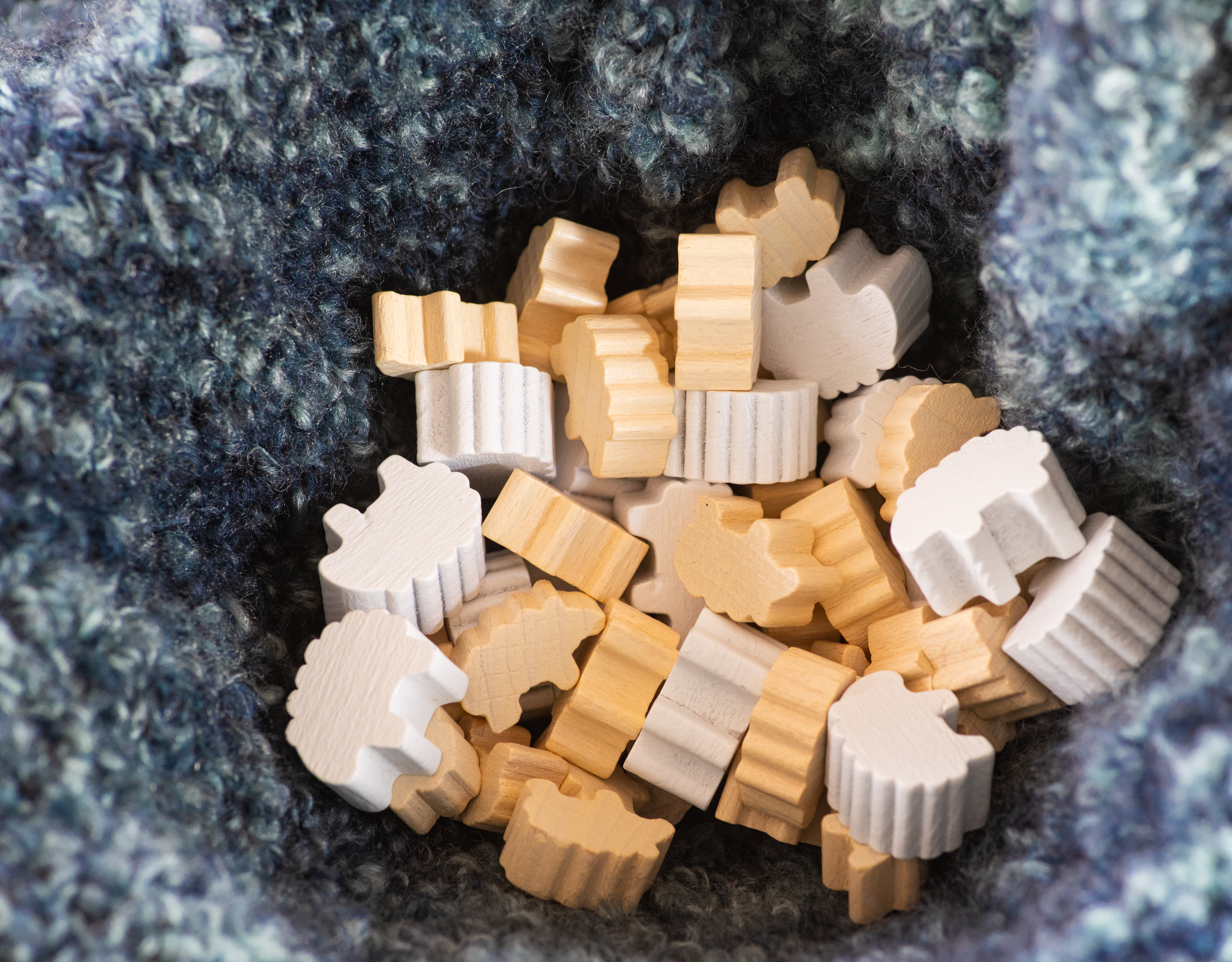
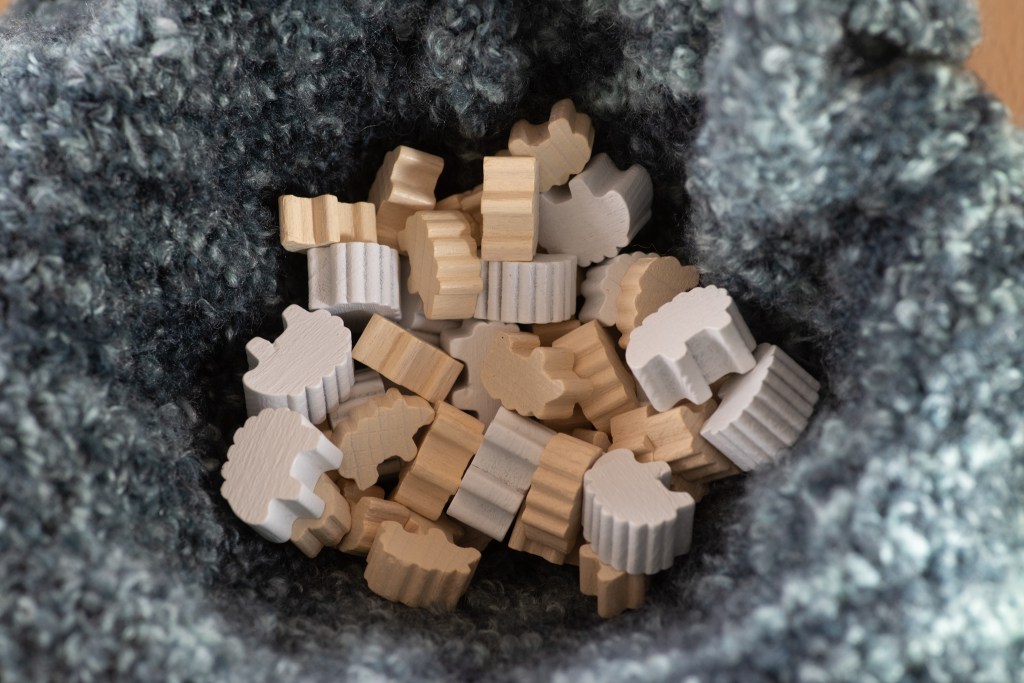
Farm themes are pretty common in board games, to the point that I have wooden sheep in a significant amount of them. I also have different models of sheep! The sheep in this picture come from two sources: Caverna (the darker/yellower ones) and Glen More II. Caverna is a worker placement game in which the player controls dwarves that try to earn the most gold by building facilities in their caves and going on adventures. Glen More II is a territory building game where the player controls a clan of Scots trying to gain resources, influence and whisky.

For the picture, I gathered all my sheep in a bowl that I had covered with fluffy material – my latest attempt at knitting, which “will be a scarf this winter” for probably 5 years now – but hey, photo prop! I own more wooden sheep than that, but the models for the other games was close enough from the Caverna style that I didn’t feel like sorting them out again afterwards.

This is the initial picture, for which the edits were straightforward.

CameraPentax K-1 II
Lenssmc PENTAX-D FA MACRO 100mm F2.8 WR
Focal length100 mm
F-NumberF/8
Exposure time1/40s
ISO1250

The complete Scavenger album is available here: the Fluffy album.

Scavenger Hunt #31 – Teal

For the 31st Scavenger Hunt, I decided to create all my images within an overarching theme of “Board games” – and maybe take the opportunity to talk about said games during this post.

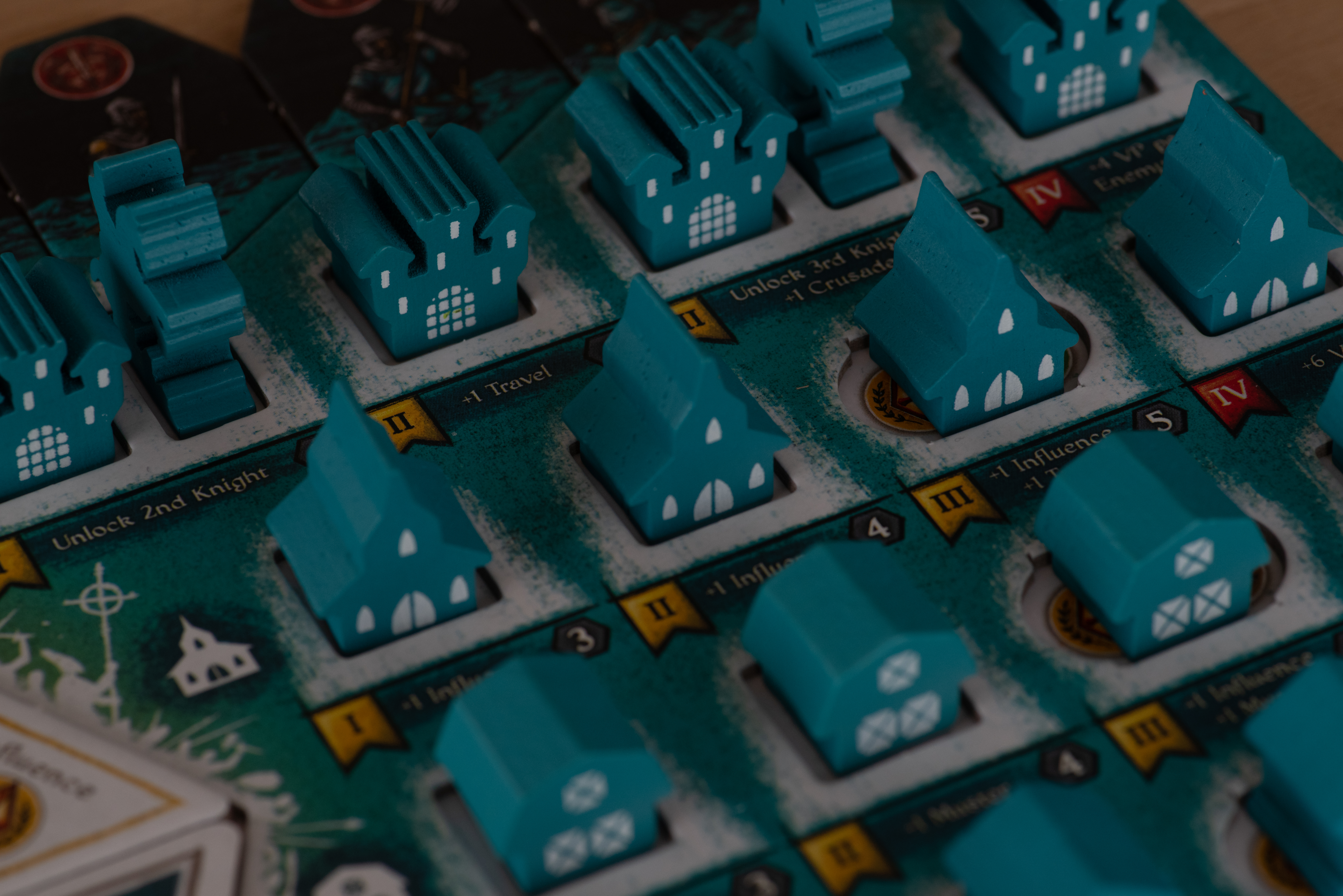
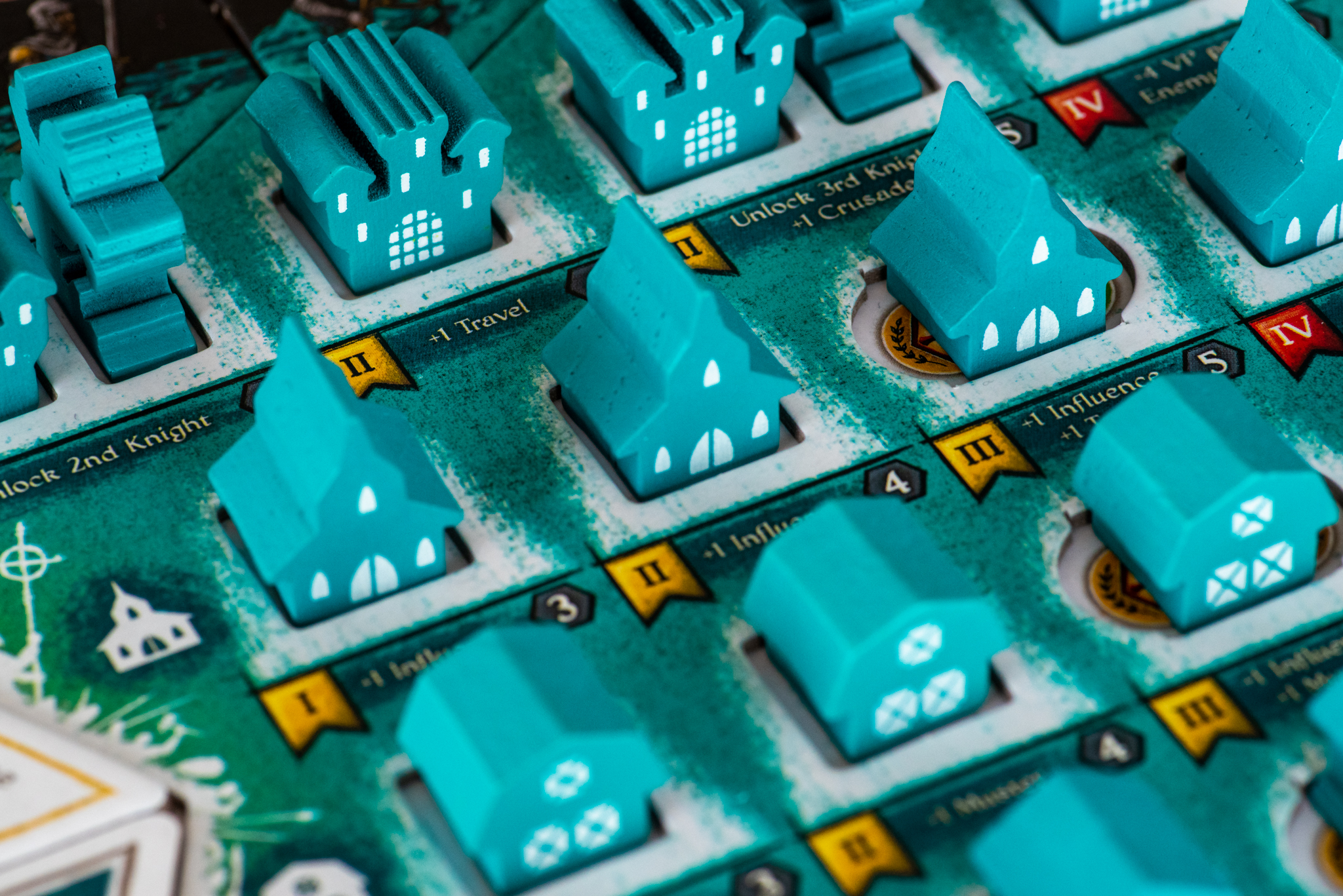
Teal is a common enough player color in board games that I had quite a lot of choice for my Teal picture. I chose the game Crusaders because it seemed like the best option if I wanted to have a sea of teal and not just a few pieces on the board.

In Crusaders, players fight for influence over Europe by traveling, mustering troops, building buildings, and the like. The different actions make the following actions easier or more powerful – which makes Crusaders fairly strong in the “engine building” category. It’s a bit intimidating to explain, but the game flows really well and it’s really enjoyable.

Here’s the initial picture, close enough from the end result that the edits were very straightforward:

CameraPentax K-1 II
Lenssmc PENTAX-D FA MACRO 100mm F2.8 WR
Focal length100 mm
F-NumberF/10
Exposure time1/25s
ISO800

The complete Scavenger album is available here: the Teal album.

Scavenger Hunt #31 – Tiny Creatures

For the 31st Scavenger Hunt, I decided to create all my images within an overarching theme of “Board games” – and maybe take the opportunity to talk about said games during this post.

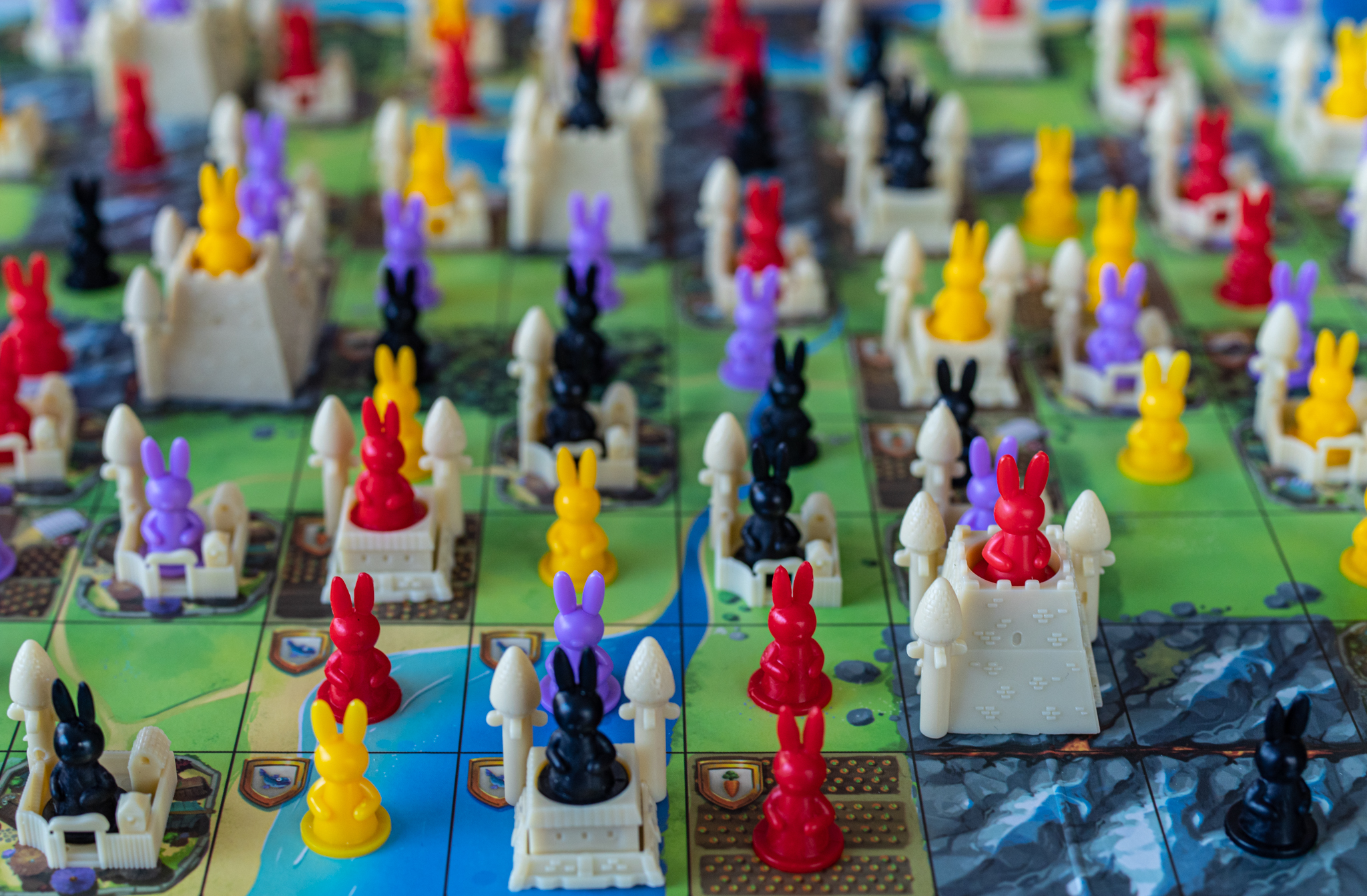
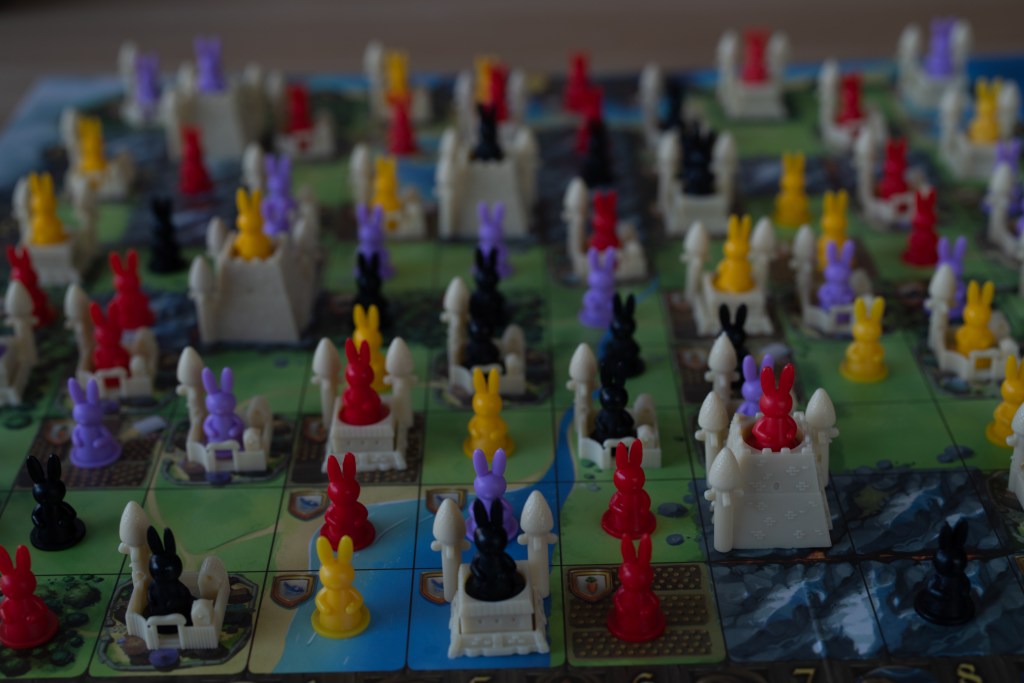
For the word “Tiny Creatures”, making a picture around Bunny Kingdom was completely obvious very early. The irony is that, at the scale of the game, these bunnies are actually HUGE – they take over whole fields and castles! But the first time we saw this game, we (okay, probably I) were enchanted by “LOOK AT ALL THE TINY RABBITS AAAWWW”.

Bunny Kingdom is a draft and control territory game. Players draft through a deck of cards that allow them to put a bunny territories, to upgrade these territories (with resources and castles), and to get various bonuses. And it has a lot of bunnies.

For this picture, I chose to not display a remotely valid game state: I felt that the addition of the bonus tiles would crowd the picture… and I wanted the picture to be crowded by bunnies, not by other game pieces. I also usually run through a reasonable-ish simulation of the game to get to a believable-ish state of the game for my pictures. For this one, I setup the castles first, then I put bunnies from each player in the castles, and I completed within what I would consider being reasonable moves within these parameters (but then, I suck at this game, so what do I know).

This yielded the following initial image, which was straightforward enough to edit.

CameraPentax K-1 II
Lenssmc PENTAX-D FA 50mm F2.8 Macro
Focal length50 mm
F-NumberF/6.3
Exposure time1/13 s
ISO320

The complete Scavenger album is available here: the Tiny Creatures album.

Scavenger Hunt #31 – Window

For the 31st Scavenger Hunt, I decided to create all my images within an overarching theme of “Board games” – and maybe take the opportunity to talk about said games during this post.

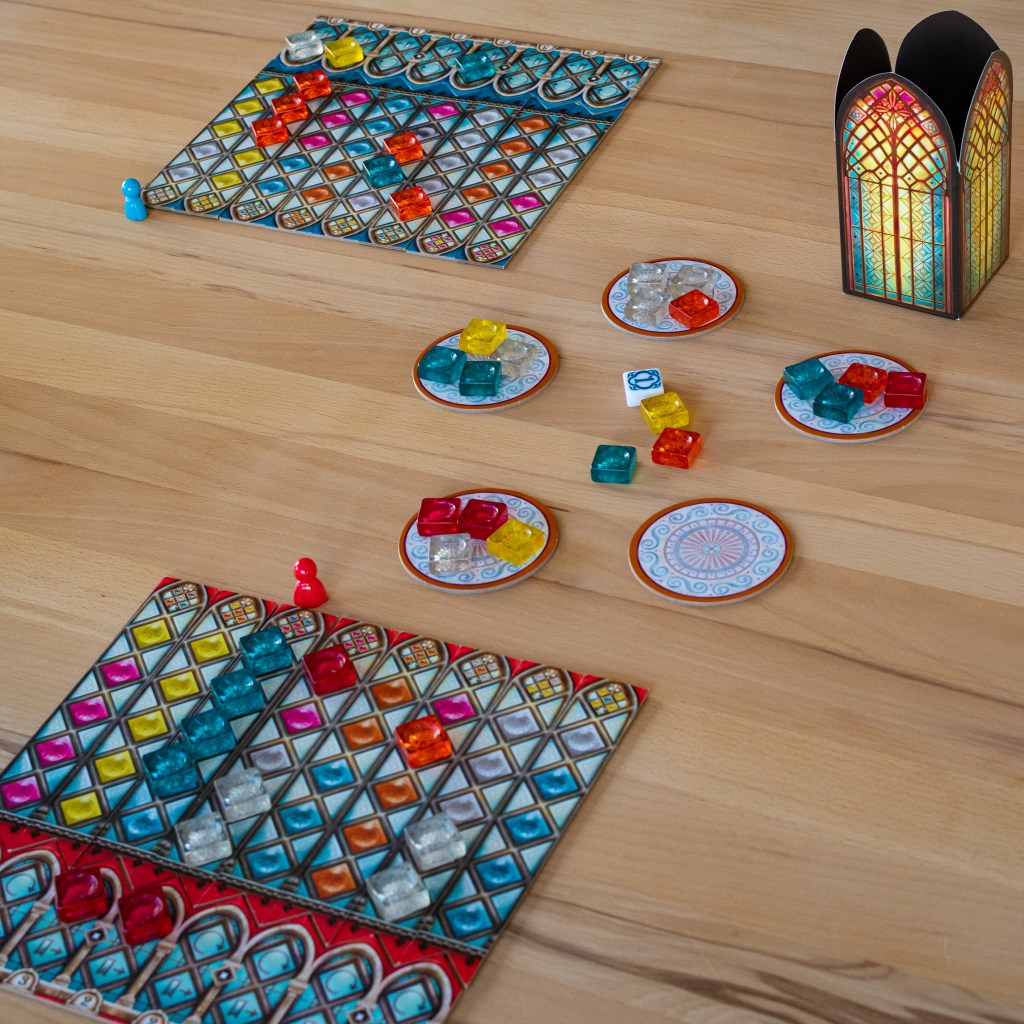
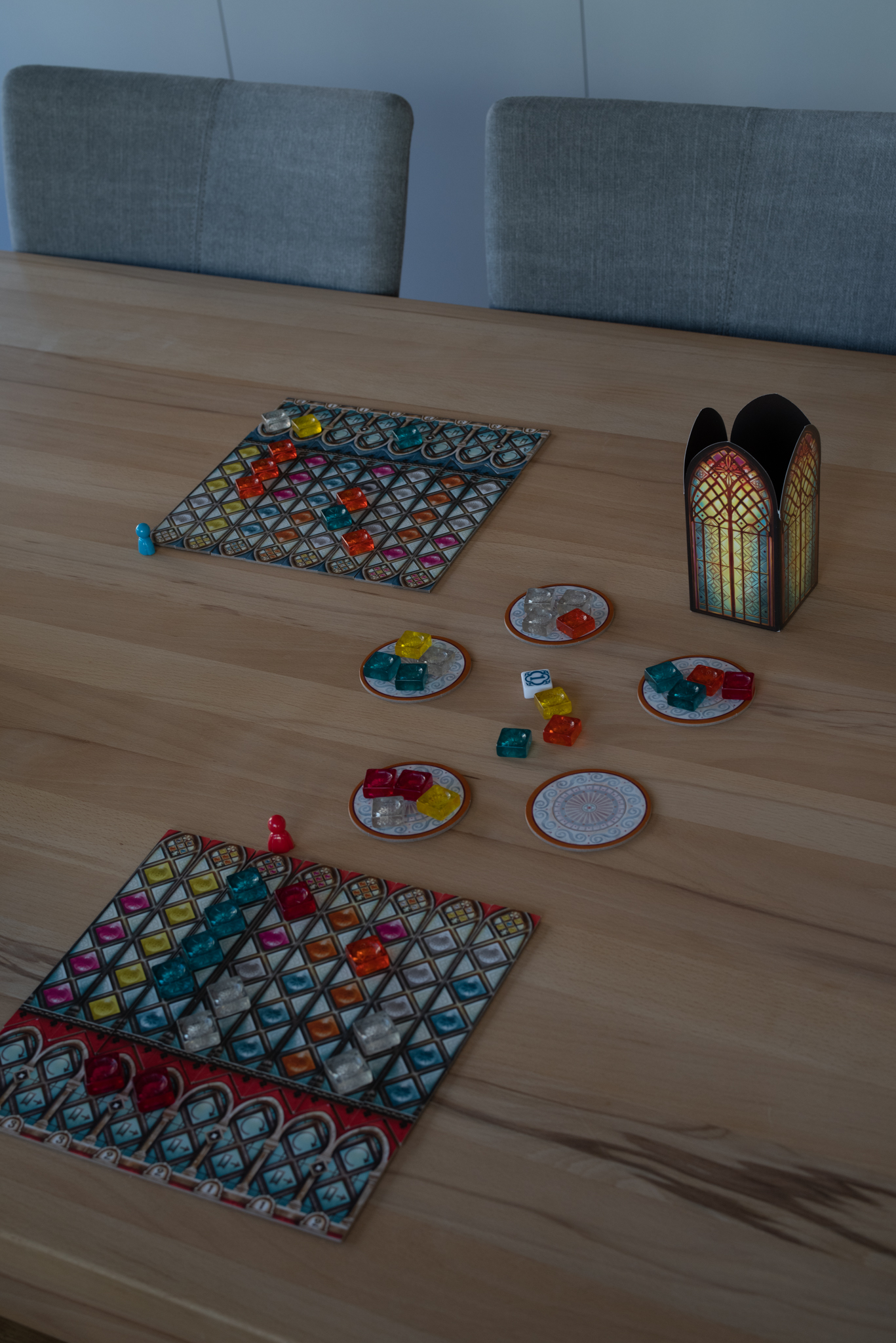
One of the words was “Window” and, while it may seem hard to have a board game themed image for that, there are two games that I know of that use the theme “let’s build stained window panels”: Sagrada, and this one, Azul Stained Glass of Sintra. Since I own the second one and not the first one, that’s the one I went for 🙂 Azul Stained Glass of Sintra is the second game of the Azul series (there’s currently, I think, three of them). They are abstract games that have the same core mechanics: tiles are randomly put into groups in the middle of the table. Players take turns taking all the tiles of the same color in a group and placing them on their board. Full lines give points; extra tiles count for the line count negative points. It’s a game we enjoy a lot… probably because it’s exactly our level of “cutthroat” 😉

I ran through a quick simulation between two players before taking a picture around what would be roughly early-mid-game, and this was the original picture, which didn’t require much edit work:

CameraPentax K-1 II
Lenssmc PENTAX-D FA 50mm F2.8 Macro
Focal length50 mm
F-NumberF/8
Exposure time1/30s
ISO800

The complete Scavenger album is available here: the Window album.

Scavenger Hunt #31 – Sparkle

For the 31st Scavenger Hunt, I decided to create all my images within an overarching theme of “Board games” – and maybe take the opportunity to talk about said games during this post.

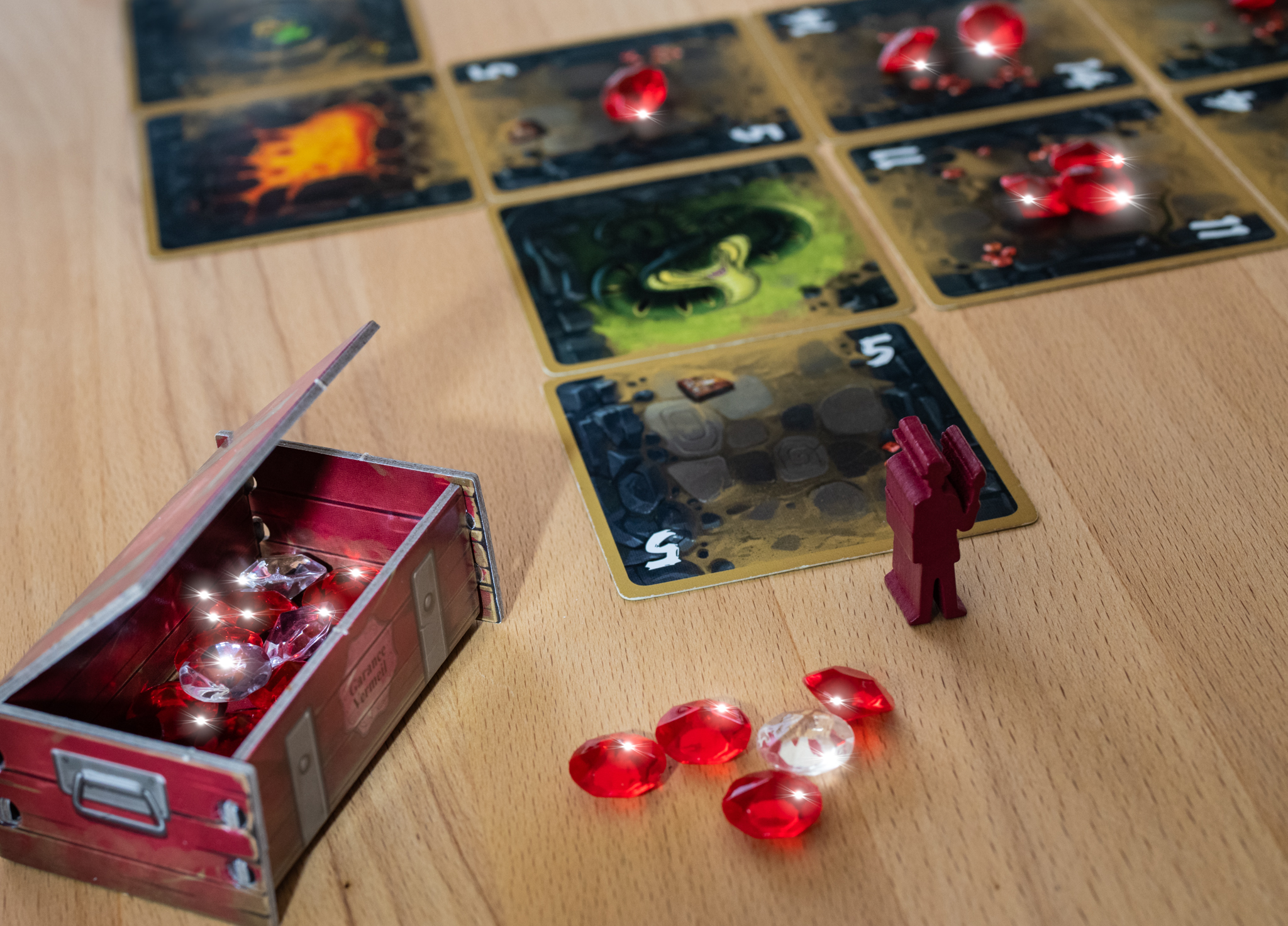
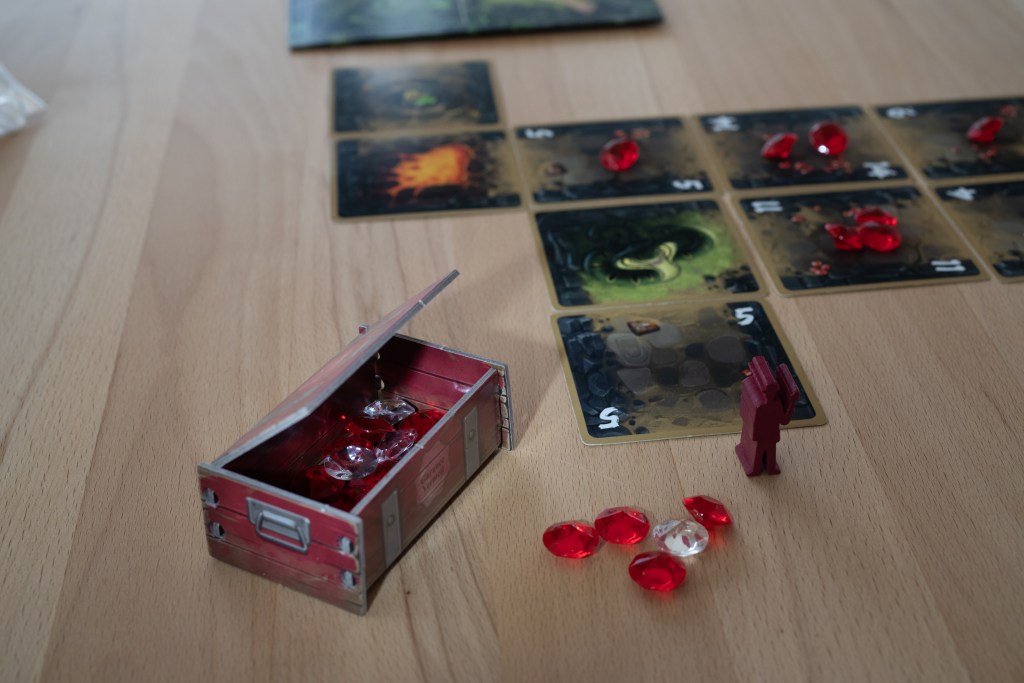
One of the word was “Sparkle” – and what’s more sparkling than diamonds? Hence, I had a pretty straightforward theme with the game Diamant. Diamant is a push-your-luck game where players collect gemstones in a dangerous (think Indiana Jones-dangerous) mine. The more they dig, the more they’ll bring home – but if they fall into a trap they don’t bring anything back!

Here’s my original picture:

CameraPentax K-1 II
Lenssmc PENTAX-D FA 50mm F2.8 Macro
Focal length50 mm
F-NumberF/8
Exposure time1/80s
ISO1000

This was most definitely not sparkly enough! Which meant that I need to add some sparkles to my diamonds… which meant that I created my first ever Photoshop brush. I mostly followed this video: Photoshop Tutorial: How to create a Star Brush Set. So I played with that for a while, and then I added a few (okay, a lot) of not-at-all-subtle digital glitter on my gems.

It was a lot of fun, and I’m actually quite happy with the final image!

The complete Scavenger album is available here: the Sparkle album.