Some Hugo-related Balisebooks

I’m not writing much about books anymore, but I’m taking the excuse of “I just read all of the Hugo-nominated novels for this year” to talk a bit about, well, books. The selection for the Hugo Awards for Best Novel 2025 had the interesting property of having two books by the same author, Adrian Tchaikovsky. I had heard from him but hadn’t read any of his work, so that was a good opportunity for an introduction.

I had read only one book from the selection before the nominations were announced, so I was fairly excited to see a lot of stuff that had escaped my radar so far! I was a bit less excited to realize that it looked like a fairly heavily body-horror-skewed list, but I also realized during this reading adventure that it was less of a deal-breaker than I thought it was.

I have not made final decisions on my ballot yet, apart from knowing what’s lower half, what’s upper half, and what will probably be on top of my ballot, but I don’t have the exact ranking yet. So, instead of going by rank, I’m just going to do like the WorldCon announcement and go by title alphabetical order.

Alien Clay – Adrian Tchaikovsky

Alien Clay is told from the perspective of Professor Daghdev, an academic whose dream of visiting alien worlds just got granted. But, in the vast “be careful what you wish for” tradition, it’s been granted by his exile to a penal colony on a very unhospitable planet, Kiln. Kiln has a very enthusiastic ecosystem, which tends to combine together and with everything, including alien-to-them life forms. It does not help with the planet hospitality, and the authoritarian penal colony conditions do not help either.

I was not super convinced by Alien Clay, maybe because I expected more of it. The world-building is honestly great, the whole biology stuff is very cool (albeit very creepy)… but the rest fell somewhat flat for me. My general impression was one of “you fell in love with your setting and the plot fell a bit short”. This is lower half of my ballot.

The Ministry of Time – Kaliane Bradley

The Ministry of Time is the only novel I had read before the nominations. It’s a story that stems from the question “what if we could extract people from their time just before their death, and bring them to our contemporary era?”. It follow an unnamed character who becomes a civil servant tasked with helping these extracted people integrate into society, and it devolves from there into a time travel romance and a spy novel.

I remember highly enjoying this when I read it back in November. I liked the premise of extracting people from their time rather than traveling through time, and I found the idea of having that handled by British civil servants tickling. I was not super convinced by the ending, which felt rushed, but not obnoxiously so either. But, to me, it does not read as genre/SFF fiction. It reads as literary fiction with some time travel sprinkled on top. Because of that, this will be lower half of my ballot – I believe that the Hugos should award a novel that’s more firmly inside the genre.

Service Model – Adrian Tchaikovsky

Service Model follows Charles (it’s complicated), a robot valet who suddenly found himself out of a job because of the unfortunate demise of his human owner. And it turns out that it’s getting very, very difficult to find another human in need of a robot valet. Thankfully, he encounters The Wonk, who will endeavor to convince him that he shouldn’t feel constrained by his programming, and that probably he already already isn’t anymore.

I enjoyed the characters and the situations, it was a very funny book, but somehow I do not remember the ending – I think it may have been quicker-paced than the rest of the novel and that it kind of confused me. It does end on the lower half of my ballot, but only because the other three books are stronger, as far as I’m concerned 🙂

Someone You Can Build A Nest In – John Wiswell

Someone You Can Build A Nest In was maybe the best surprise of this round of nominations. It is described by the publisher as a “creepy, charming monster-slaying fantasy romance—from the perspective of the monster”, and it is indeed exactly that. I was expecting to bounce off that one hard, especially since the monster, Shesheshen, is a blob that steals pieces from her human meals to build her own body in order to pass as human when needed. Charming indeed. Definitely HEAVILY full of body horror, that one.

And yet, I enjoyed it a lot. It’s funny, it’s queer, Shesheshen is oddly relatable apart from the people-eating issue, the romance is sweet, and it worked very well. I read it before it won the Nebula, and I’m very happy it got that award; definitely first half of my ballot.

A Sorceress Comes to Call – T. Kingfisher

A Sorceress Comes to Call is told from the point of view of Cordelia, 14 years old, who lives with her controlling mother, who is determined to remarry and have Cordelia find a rich spouse too. And by “controlling”, I mean “literally magically mind-controlling”. One night, Cordelia’s mother wakes her up and they flee to the estate of the Squire, a man that she has set in her sights as acceptable. The Squire is a nice man, his sister Hester even more so, and it becomes Cordelia’s goal to prevent her mother to wreck havoc on that family. Oh, and of course, there’s a horse.

I wouldn’t call this book “a delightful read” because the amount of family abuse and trauma around Cordelia is heart-wrenching and it does hurt. But the cast of secondary characters is fantastic, the book was hard to put down, and it fits solidly in the first half of my ballot too.

The Tainted Cup – Robert Jackson Bennett

I almost didn’t read The Tainted Cup, because it was provided in the Hugo voting package as watermarked PDF, but I sighed and bought another copy and I’m very glad that I did. In The Tainted Cup, we follow Din, the young assistant to Ana, a brilliant and eccentric detective. Din is an engraver: he got augmented to be able to have perfect recall of the memories he anchors by smell. It comes handy as Ana mostly refuses to go outside of her home and wears a blindfold most of the time to avoid over-stimulation. For their latest case, they investigate the death of an Imperial officer, who apparently died when a tree spontaneously sprouted out of him. Not an uncommon occurrence in Din and Ana’s world, where plant contagion does happen (and where plants and people can be manipulated to fulfill certain tasks), but still somewhat suspicious.

I loved The Tainted Cup and it has a high chance to finish on top of my ballot. I was faulting Alien Clay for “having a cool setting but lacking on the plot”; The Tainted Cup also has tremendous world-building (one that I’ll be happy to revisit in later books of the series) and I found the plot and story far more engaging. I’m definitely happy I read that book.

There, these were my thoughts on the Novel finalists. The Hugo Awards have many more categories, and I do try to vote on as many categories as I can, so I still have some reading to do before July 23rd 🙂
#balisebooks – Hugo 2021 Short Stories

I haven’t talked about books much (… if at all…) this year. Part of the reason is that I do not commute at all anymore, and my book-reading time got slashed in the process. Part of the reason is that I’m still struggling with committing to write longer pieces and, while my posts don’t go into much detail, they still take a significant amount of time that I’m having a hard time making, now that I’m back to working full-time.

And that’s how I end up on the day before the closing of the Hugo ballots going “argh, I haven’t read the short stories yet!” and doing that in a single evening, despite having had significantly more time than last year between the opening and the closing of the vote (In all fairness, this year I did rank all the Best Novel candidates!). And, since I thoroughly enjoyed all of them, I felt it would be a nice small, contained thing to blog about. So here we go! And you get my ballot order at the same time… and since they’re also available on their respective publisher’s websites, you also get some short reads if you feel so inclined 🙂

6. Metal Like Blood in the Dark, T. Kingfisher

“What if Hansel and Gretel were robots, and in space?” It was quite a lot of adventures for Sister-the-mining-robot and Brother-the-flying-robot, and I particularly enjoyed the existential discussion about lying and its consequences.

5. Open House on Haunted Hill, John Wiswell

“What if the only goal of the haunted house was to find new inhabitants?” This is a story told from the perspective of such a haunted house, and it’s quite heartwarming.

4. Little Free Library, Naomi Kritzer

“What if there was a mysterious but friendly borrower in a Little Free Library?” (you know these book boxes that spawn in various places? 🙂 ). This was quite cute, a bit sad, and it was a story about a library and the people that put and borrows books in it – what’s not to like?

3. Badass Moms in the Zombie Apocalypse, Rae Carson

“What if zombies were attracted to birth giving?” I was prepared to not like this one at all, due to not liking zombie stories in general. It turns out that the take, the relationships between the characters, and the general action and feminist badassery was enough to make me give my first enthusiastic 5* on GoodReads for this Hugo ballot of short stories (with the comment “I don’t even like zombie stories!”). Quite a feat.

2. The Mermaid Astronaut, Yoon Ha Lee

“What if the Little Mermaid wanted to go to space instead of marrying a prince?” That’s it, that’s the story. It has a strong “Becky Chambers” feeling, and I was pretty convinced until the last minute that it would be the top of my ballot.

1. A Guide for Working Breeds, Vina Jie-Min Prasad

“What if indentured robots had a fondness for dogs?”, I guess. I also do have a strong fondness for epistolary or epistolary-like narrative styles, so that helps. The voices of the robots are very distinct and I laughed out loud for the whole time I read this short story. This was absolutely fantastic, and the top of my ballot this year, even if the ballot itself is very, very strong.

All in all, I think the short story ballot has been my favorite this year. I couldn’t help but notice that all the stories were essentially happy or hopeful or both, with possibly less conflict and shock than one would typically expect from the genre. And, to me, this was very enjoyable: I finished the evening of “reading all the things and ranking them” happier than I started it, and that’s worth a lot in my book.

Last #balisebooks of 2020

The Duke Who Didn’t – Courtney Milan

A very cute and completely wholesome romance that takes place in victorian Wedgeford, a village whose population is primarily composed of people of Asian descent. Chloe Fong is one of these people; she makes lists and helps her dad perfect the large-scale production of his “unnamed sauce”. Jeremy Wentworth came to the village a few years before and, unbeknownst to the people of the village, he’s the duke that… owns the entire village. Beware: this book will make you hungry for bao buns. You’ve been warned.

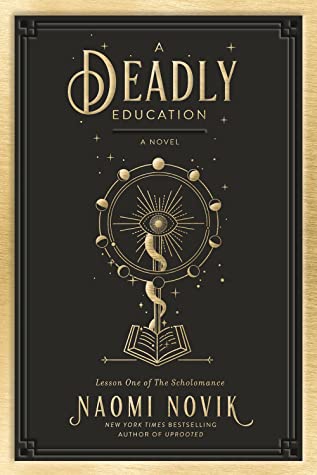
A Deadly Education – Naomi Novik

A Deadly Education plays with the idea of “what if Hogwarts, instead of being a reasonably safe place for kid wizards to learn their craft, was incredibly dangerous – but still the best and safest place for young wizards to learn their craft, even though they have a significant chance of not surviving the monsters living in the school? This was a fantastic book, and I enjoyed every minute of it. The setting is tense and scary without being nightmare-inducing, the characters end up being liked despite not being a priori likeable, and that world building is :chef-kiss:. Loved it, and really looking forward to the second book.

L’Anomalie – Hervé Le Tellier

(no English translation yet)

I don’t often read in French, and for once that I do, that book ended up getting the Prix Goncourt (one of the most prestigious French literary awards). In L’Anomalie, something very weird happens to the passengers of a Paris-New York flight (and saying anything more would spoil a lot, so I’m not doing that). We follow the story through the eyes of multiple people that are on that flight as we get hypotheses about what exactly happened. This was very entertaining, thrilling, and the writing is superb.

Discount Armageddon – Seanan McGuire

I discovered Seanan McGuire earlier this year when I read ALL THE THINGS for the Hugo Awards, and she’s absolutely my favorite discovery this year. Discount Armageddon is the first book of the InCryptid urban fantasy series, which follows Verity Price, cryptozoologist (and ballroom dancer). Cryptozoologists tend to want to protect all the cryptids/monsters that are not particularly dangerous to humans, whereas the Covenant is more of the opinion that a good cryptid is a dead cryptid. And when these worlds collide in New York, well, we get urban fantasy. And this was some great UF, completely hilarious at times, and I absolutely want more of that series.

The Testaments – Margaret Atwood

The Handmaid’s Tale is a literary masterpiece. The TV series adaptation is fantastic – it does add a fair amount of “fluff” around the book (and it’s esthetically superb). The Testaments is a “fifteen-years-later” sequel to The Handmaid’s Tale book that ties in very neatly to the TV adaptation. We read a story told by an Aunt and two teenagers in two different situations (one is in Gilead, one is in Canada), and it beautifully echoes the mood of the show. A very good read.

A Wizard’s Guide to Defensive Baking – T. Kingfisher

Consider a universe where a minority of people have some magic. Some of these people have “useful” talents (like being able to control fire). One of these people is Mona, a 14-year-old girl whose talent is around bread. She can make muffins not burn, and she can make gingerbread men dance, and she’s not entirely sure whether the sourdough in the basement is sentient or not. And when a dead body is found on the floor of the bakery she’s working in, Mona gets in trouble – obviously, who else than the home wizard would be responsible? I really, really liked this book – especially how seemingly unimpressive powers can get very useful in the face of adversity 🙂

Every Heart a Doorway – Seanan McGuire

As mentioned above, Seanan McGuire is my strongest entrance of the year on the list of my favorite authors. Every Heart a Doorway is the first book of the Wayward Children, and introduces Eleanor West’s Home for Wayward Children. All the children in the Home have, at some point, found a door to another world; they’re back, and they need a way to cope. Nancy is the newest addition to the home and, shortly after her arrival, another boarder gets killed. I loved the atmosphere and the characters. I actually already read the fourth novella of this series (it was nominated for the Hugo Awards this year), and I absolutely want to read the other ones.

Other reads

  • 99 Erics: a Kat Cataclysm faux novel – Julia Serano – this was some hilarious meta-fiction about a writer who decides to date 99 people named Eric “for science” (and to learn about conflicts in writing). I really enjoyed it, but I may have enjoyed it more at smaller doses 🙂
  • Glory in Death; Immortal in Death – J.D. Robb – second and third book of the “In Death” series, a VERY large series of “detective stories / romance / sci-fi”. Somewhat formulaic. but very enjoyable; I could definitely see this series becoming my new go-to “I need something comforting to read”. And that was a perfect read for the few hours I spent in the hospital after surgery 🙂
  • A Beautifully Foolish Endeavor – Hank Green – the second book after An Absolutely Remarkable Thing. It was good, and a good conclusion to the story, but I found it pretty hard to “reconnect” to the story (which I had read two years ago), and that kind of colored my enjoyment of this one.
  • Spoiler Alert – Olivia Dade – a very cute romance between a fanfiction writer and the main actor of the series of the topic of the fanfiction writing (who is… also a fanfiction writer). This was also pretty funny… and made me want to read and write fanfiction.

And if I had to choose one…

A Deadly Education. But Every Heart a Doorway is a very close second.