Iceland – Day 4

We left our friends after breakfast and drove to Víðgelmir, a lava cave, where we enjoyed a guided tour. All caves I had visited so far were caves dug into the rock by water; this one was made by a river of lava whose exterior cooled while the lava inside continued flowing and draining.

It was fascinating to see the differences and similarities of structures – fluid, whether lava or water, will still do similar things, but also leave different patterns – and different colors and geology too. Our guide was also very entertaining, and overall we were delighted with the visit.

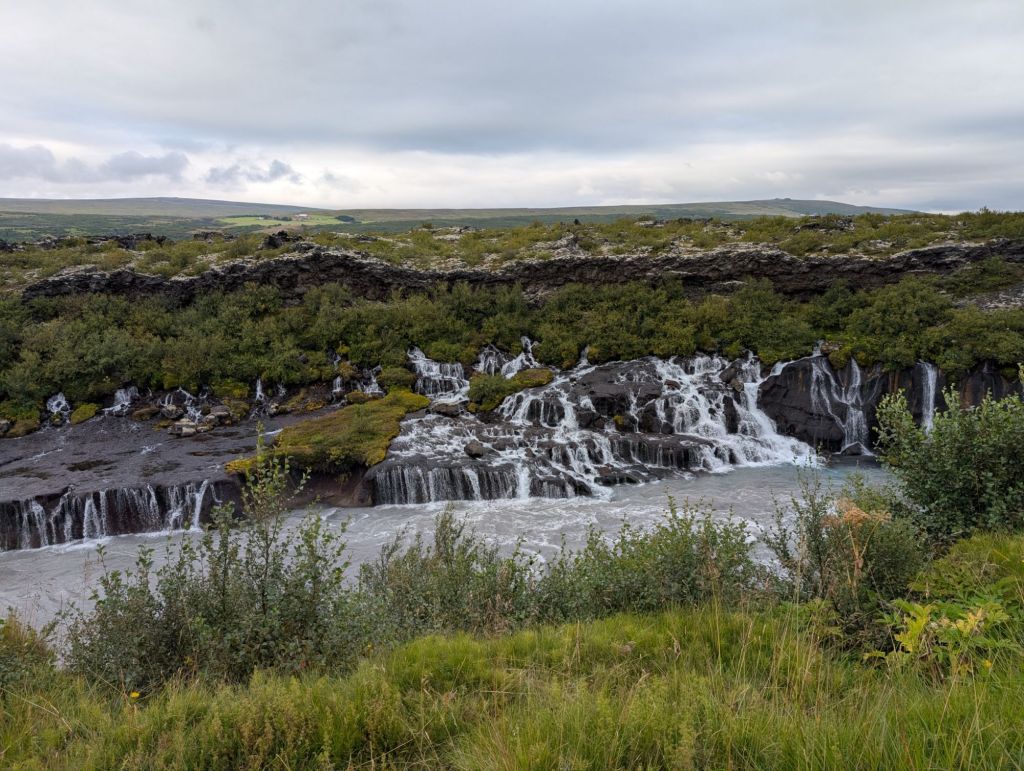
Not too far away, there’s also the waterfalls of Barnafoss and Hraunfossar (both on the same site). Barnafoss is a powerful waterfall that goes below a stone arch, it’s impressive and very picturesque. But my heart definitely goes to Hraunfossar and its gazillion of waterfalls coming from the rocks – as far as I understand, the aforementioned lava river flew over the water, but water still had to go somewhere, and that’s Hraunfossar.

A cliff with many many waterfalls spawning from the middle of it and flowing on lower levels

At that point we were both a bit hungry, so we got a couple of slices of cake at the Hraunfossar café – they were much appreciated!

We went back on our tracks to get back to the ring road and continue our way towards Laugarbakki where our next hotel is. We enjoyed the beautiful scenery on the road, stopped a few times for pictures, and arrived there around 5PM.

We made a small break in the room, and I debugged my photography backpack: I had in my mind that it was much easier to put the camera back, and after a few tries in a quiet place with a mirror, I figured out the trick again (I need to lift the camera pocket a bit so that it slides correctly in its place).

We had some time before dinner, so we decided to get out again for a little bit – initially, the plan was “get out, go see the horses nearby, and then we’ll see”. We did end up doing a much larger loop than that, following a path that had indicators but not much of a ground track: small hike, but large adventure 😛 But I managed to not hurt myself despite the fairly challenging terrain: yay me!

To end the day, we had dinner at the hotel restaurant; the selection of “icelandic tapas” and both our mains were excellent; the desserts were good but less memorable. And now we’re just chilling in the room – we have a fairly long road planned for tomorrow!

The photo album for this day is here: Iceland – 2025-08-17.

Iceland – Day 3

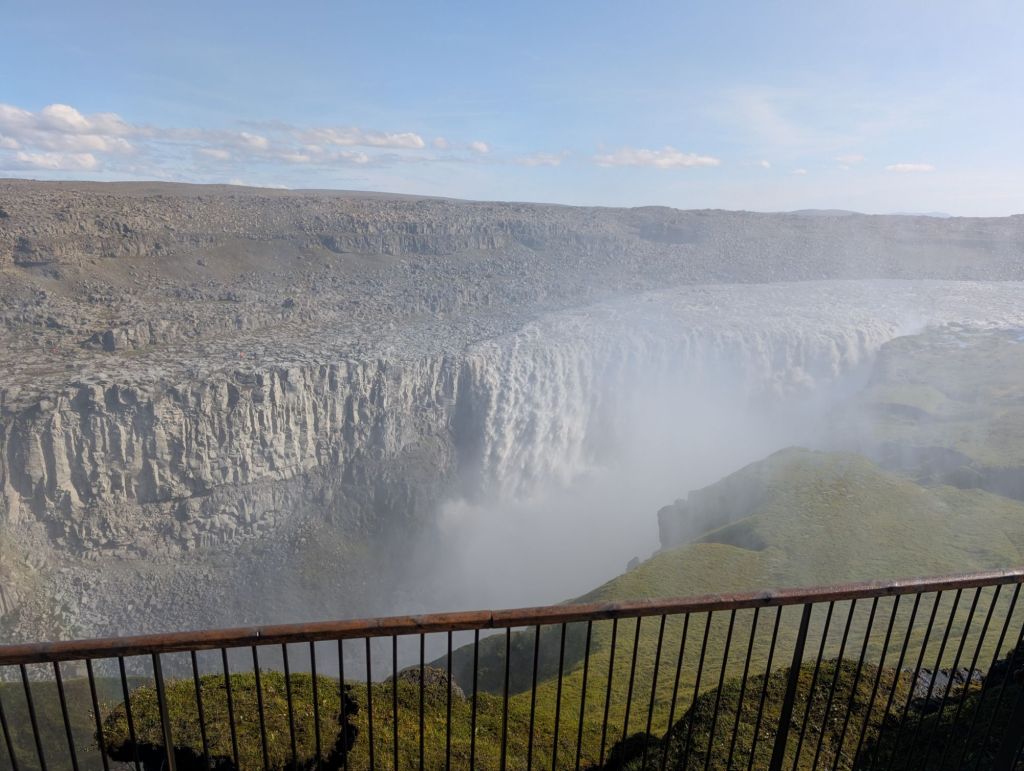
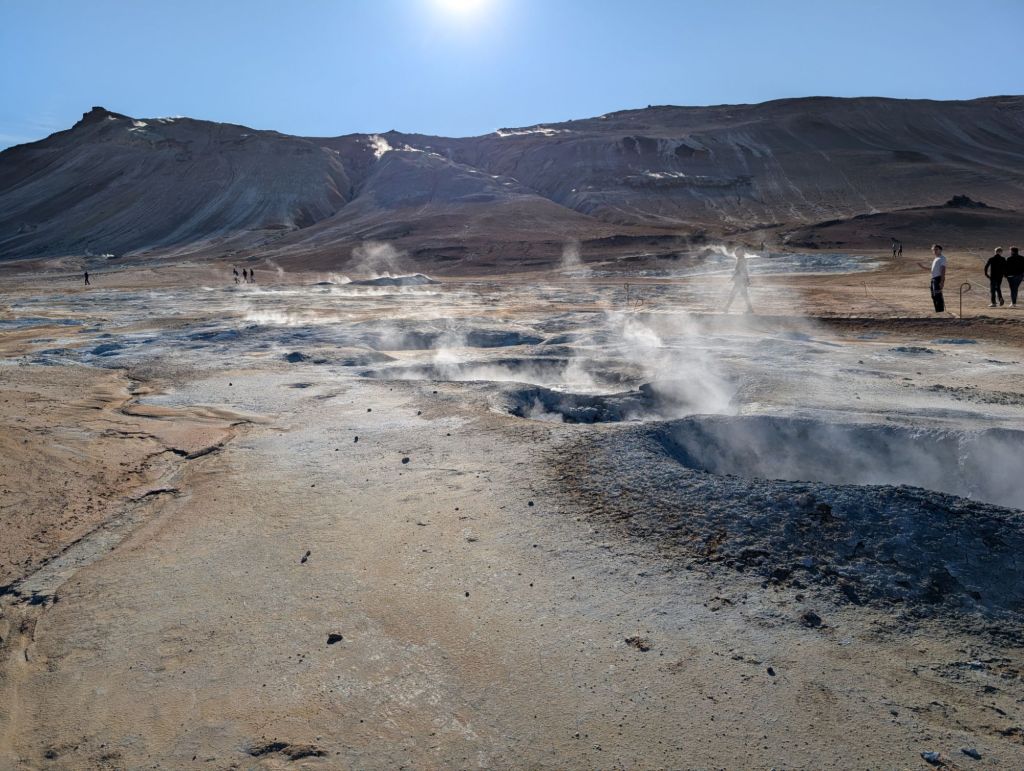
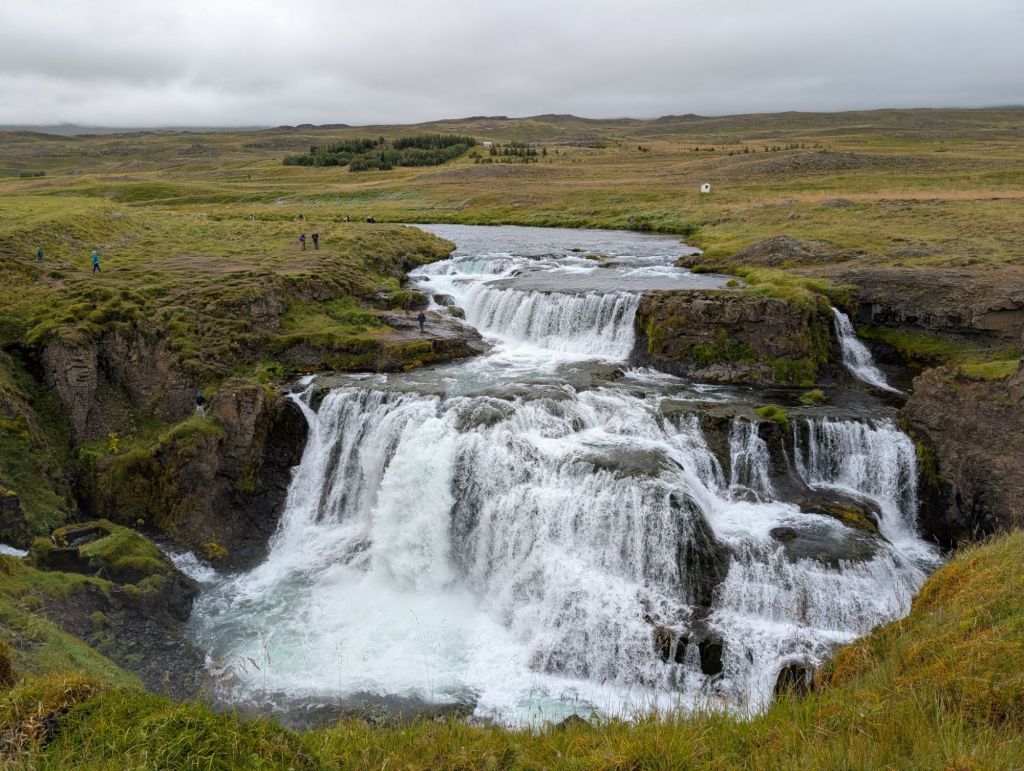
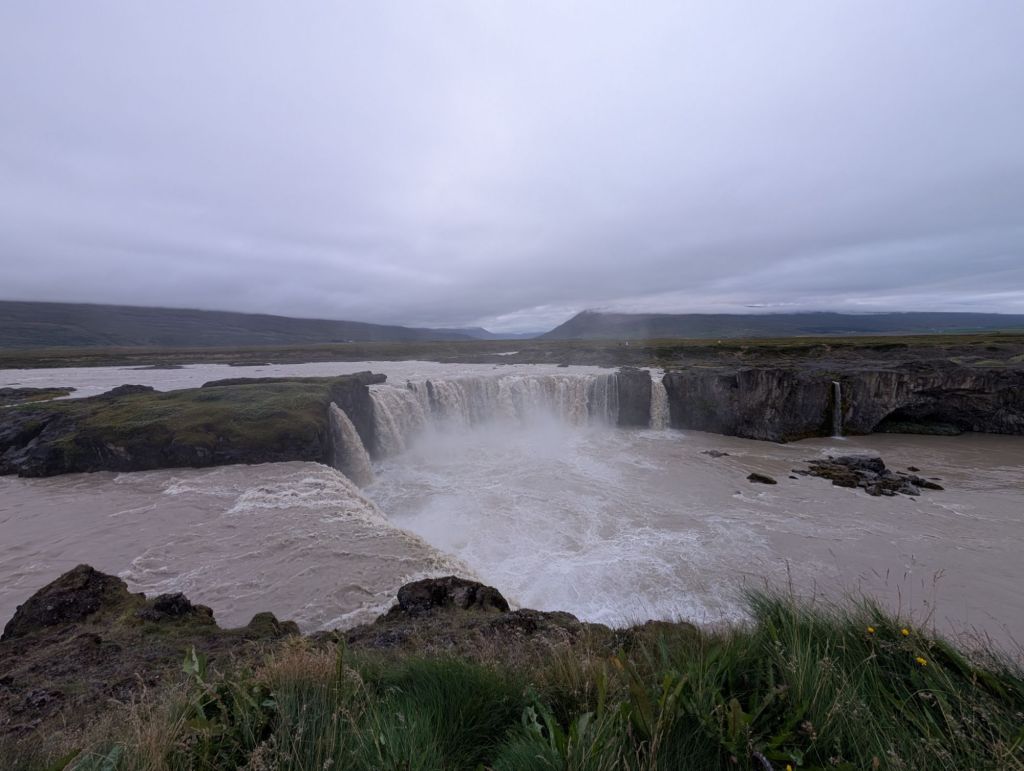
For our 3rd day, we spent the day in the vicinity of our friend’s cabin, and did a few short hikes around.

In the morning, we went for a hike around the Hreðavatn lake, uphill to get a view of the lake and the surroundings, and then up to a cascade between basalt columns, very pretty.

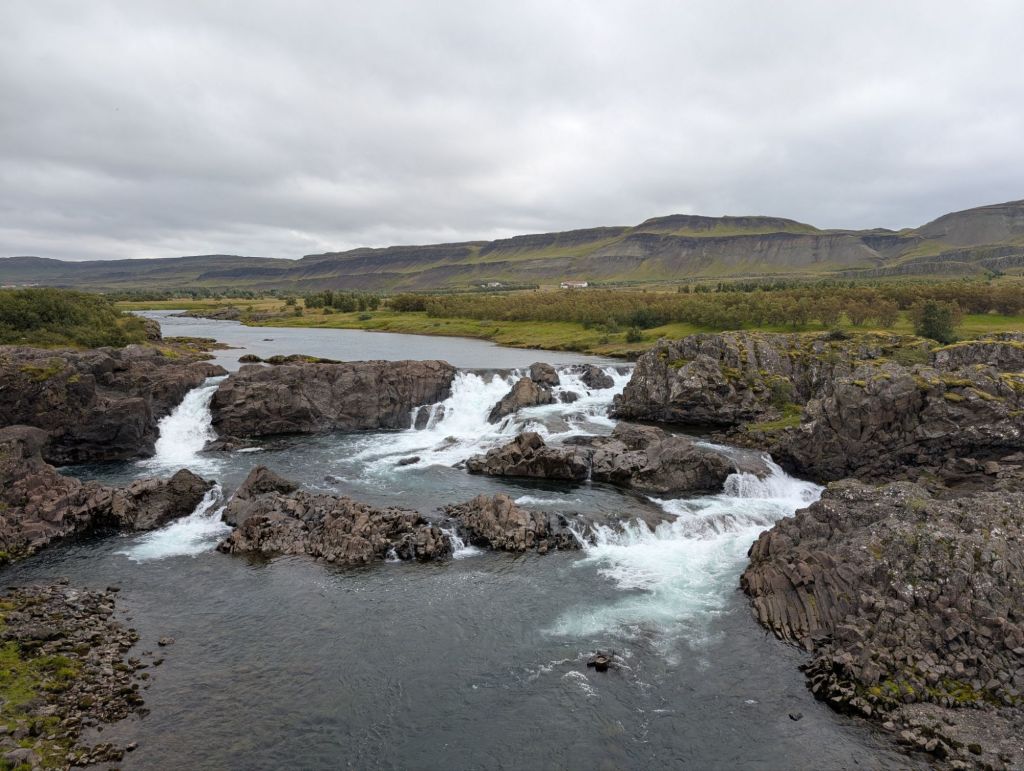
Not far from there, there’s the Glanni waterfall, which we had seen 9 years ago, and which is still very pretty and impressive too!

By then it was lunch time, we made some pizzas (and saw our first Ooni oven in the wild 😀 ), played a game of SCOUT, and then everyone was feeling kind of in the mood for a nap, so we took some quiet time (I read a bit, I caught up on Mastodon, that sort of things.)

After the nap, we went for another stroll to the nearest lake, picking some flat stones on the way to skip stones there (which did happen, but not for me, because I don’t know how to skip stones 😛 )

We walked back to the cabin, had dinner, played a few more games (Innovation, Decrypto and Skull King – Decrypto was really good!), and then we put a map on the table, explained our itinerary and where we were stopping, and got all the places we could and should see along the road.

Another good day – and the weather was far more pleasant than yesterday, there was some sun and a much clearer view on everything!

The photo album for this day is here: Iceland – 2025-08-16.

Iceland – Day 2

We didn’t have a very precise plan for the beginning of the day today; we had plans for the middle/late afternoon, though, but we kind of made plans as we went before then.

Pierre went for a run before breakfast; he came back and pondered whether he wanted to have something more than his shorts in the current weather. We decided we’d go have a look and that it would be one of our morning missions.

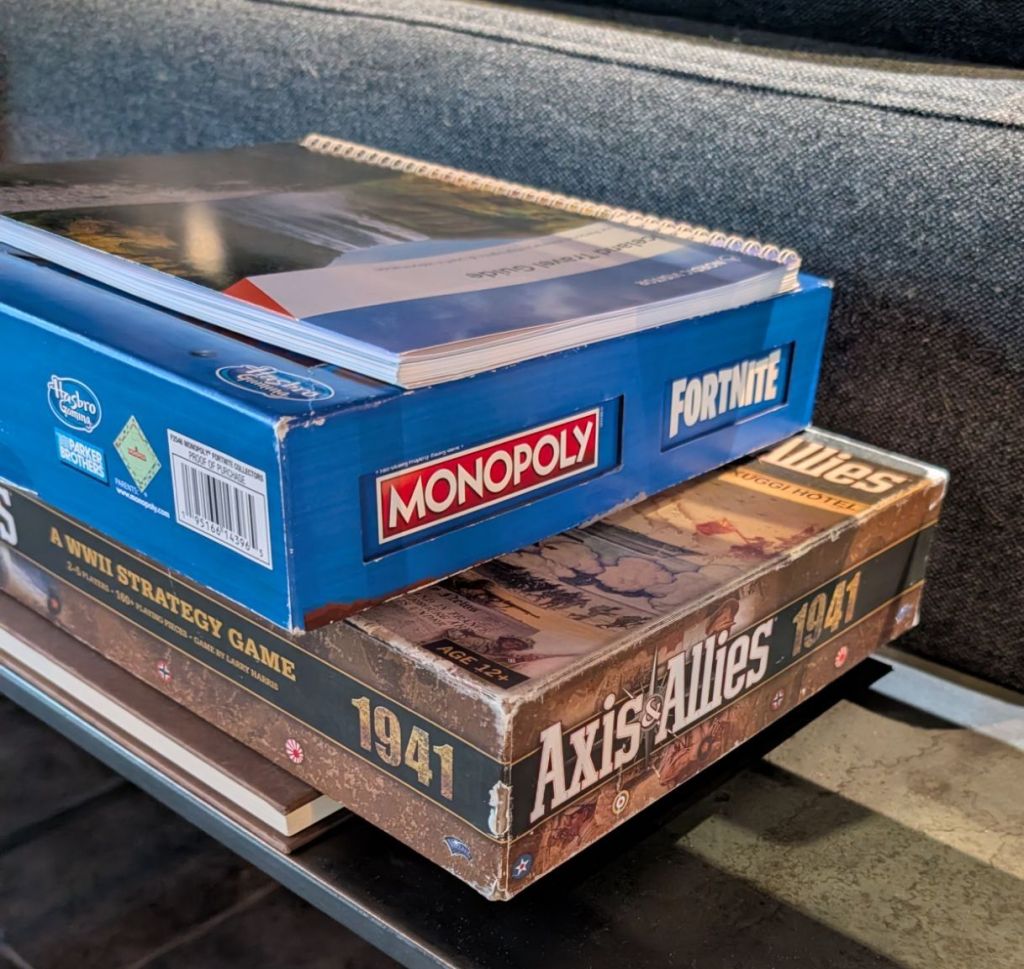
But first, breakfast – fairly unremarkable (quite good though, and surprisingly good bread), apart from the tiny shelf of board games that Pierre noticed:

A Fortnite Monopoly and an Axis&Allies box: some choices have been made, but it’s unclear how 😛

After breakfast, we went to Ice Wear to try to find running leggings for Pierre, and we found something! Interestingly, this is the same shop chain where he had bought a beanie hat 9 years ago (and he’s still traveling with this hat 🙂 )

Then it was time to go and explore. We knew there was a lighthouse not very far, so we went to see the lighthouse; however, we didn’t know that the lighthouse wasn’t accessible at high tide, and… low tide was 5 hours before we arrived.

We still got our first selfie, and it’s a lighthouse selfie, as it should be, even if the lighthouse is a bit far away.

We could have gone for a walk from there, but we decided to start from a bit further away as I’m not entirely confident in my right knee these days (so let’s not fuck it up from the start…); we drove a bit further away to go for a small loop around the nearby golf. It was pretty nice, some sea all around, flat terrain, good stuff. And a hilarious sign at the beginning of the loop, saying essentially “you can relax here, you should hurry here because golf balls fly in this and that direction” 🙂

After that walk, we decided to go to the open air museum on the other side of Reykjavik: it’s a museum where they moved old houses and made a few exhibitions around, mostly, “life in Iceland from the 19th century to now” – there was a lot of neat stuff, and the work on the museum  and the exhibitions was very well done.We also saw one of the (as far as we understand) two locomotives that ever were in Iceland (there are no trains here), which was an unexpected bonus!

We had plans to go see the nearby park/canyon/river, but eventually decided against it as we were quite tired already and the rain started pouring quite heavily.

But, this is where our mid-afternoon plans were starting too! We’re spending a couple of days at our friends’ summer house an hour away from Reykjavik 🙂 We made plans to meet around the local board game shop, Nexus (very nice shop, by the way – good and diverse selection), we went for a bit of grocery shopping (and we got some travel snacks for ourselves), and we arrived in the early evening at said summer house.

We chatted a bit, had dinner, played a couple of board games (Harmonies and Forest Shuffle, both good in different ways!), and it’s now time for bed, for more adventures in the area tomorrow!

The photo album for this day is here: Iceland – 2025-08-15.

Iceland – Day 1

Last year I wrote my Denmark travel log as I was traveling, and it was a pretty good experience – apart from the fact that writing on a phone is miserable. I’m still writing on a phone, but I added a BlueTooth keyboard to the mix – this should help!

Do not necessarily expect pictures in these posts, as I’m mostly using my DSLR and I’ll process stuff when I come home; but maybe the occasional selfie will still happen here 🙂

Anyway, the first day was mostly a travel day – we left home at 11, spent significant time in the airport because our flight was at 2PM and security was a breeze (the security person made appreciative noises at my camera 😁). We had lunch, we boarded the plane, and we landed in Keflavik after what felt like a long (4 hours) but completely uneventful flight.

Last time we were in Iceland was 9 years ago and we remember the feeling that the airport was under strain, especially in the car renting area; this time around it felt far more streamlined. We had the bad surprise to see that our car had been reserved for 2 days rather than 12; we decided to pay for the difference and handle it with our travel agency (which handled it swiftly) – good thing we could actually do this, it wasn’t a trivial amount of money!

After this small kerfuffle, we took the car from Keflavik to Reykjavik, where we had our first hotel. And, it turns out we have friends in Reykjavik, so we met with them for a small stroll in the city center, followed by an excellent dinner at Monkeys – great food and great company, what more can you ask for!

We ended the day with another stroll around the water, with the hope of digesting a bit (food was great, I had a bit too much of it ˆˆ;). It didn’t completely work – I had a fairly hard time falling asleep after that, and the couple of leg cramps that I attributed to plane and dehydration didn’t help either. But, overall, for a travel day, it worked well, and we did take advantage of our first few hours in Iceland!

Some Hugo-related Balisebooks

I’m not writing much about books anymore, but I’m taking the excuse of “I just read all of the Hugo-nominated novels for this year” to talk a bit about, well, books. The selection for the Hugo Awards for Best Novel 2025 had the interesting property of having two books by the same author, Adrian Tchaikovsky. I had heard from him but hadn’t read any of his work, so that was a good opportunity for an introduction.

I had read only one book from the selection before the nominations were announced, so I was fairly excited to see a lot of stuff that had escaped my radar so far! I was a bit less excited to realize that it looked like a fairly heavily body-horror-skewed list, but I also realized during this reading adventure that it was less of a deal-breaker than I thought it was.

I have not made final decisions on my ballot yet, apart from knowing what’s lower half, what’s upper half, and what will probably be on top of my ballot, but I don’t have the exact ranking yet. So, instead of going by rank, I’m just going to do like the WorldCon announcement and go by title alphabetical order.

Alien Clay – Adrian Tchaikovsky

Alien Clay is told from the perspective of Professor Daghdev, an academic whose dream of visiting alien worlds just got granted. But, in the vast “be careful what you wish for” tradition, it’s been granted by his exile to a penal colony on a very unhospitable planet, Kiln. Kiln has a very enthusiastic ecosystem, which tends to combine together and with everything, including alien-to-them life forms. It does not help with the planet hospitality, and the authoritarian penal colony conditions do not help either.

I was not super convinced by Alien Clay, maybe because I expected more of it. The world-building is honestly great, the whole biology stuff is very cool (albeit very creepy)… but the rest fell somewhat flat for me. My general impression was one of “you fell in love with your setting and the plot fell a bit short”. This is lower half of my ballot.

The Ministry of Time – Kaliane Bradley

The Ministry of Time is the only novel I had read before the nominations. It’s a story that stems from the question “what if we could extract people from their time just before their death, and bring them to our contemporary era?”. It follow an unnamed character who becomes a civil servant tasked with helping these extracted people integrate into society, and it devolves from there into a time travel romance and a spy novel.

I remember highly enjoying this when I read it back in November. I liked the premise of extracting people from their time rather than traveling through time, and I found the idea of having that handled by British civil servants tickling. I was not super convinced by the ending, which felt rushed, but not obnoxiously so either. But, to me, it does not read as genre/SFF fiction. It reads as literary fiction with some time travel sprinkled on top. Because of that, this will be lower half of my ballot – I believe that the Hugos should award a novel that’s more firmly inside the genre.

Service Model – Adrian Tchaikovsky

Service Model follows Charles (it’s complicated), a robot valet who suddenly found himself out of a job because of the unfortunate demise of his human owner. And it turns out that it’s getting very, very difficult to find another human in need of a robot valet. Thankfully, he encounters The Wonk, who will endeavor to convince him that he shouldn’t feel constrained by his programming, and that probably he already already isn’t anymore.

I enjoyed the characters and the situations, it was a very funny book, but somehow I do not remember the ending – I think it may have been quicker-paced than the rest of the novel and that it kind of confused me. It does end on the lower half of my ballot, but only because the other three books are stronger, as far as I’m concerned 🙂

Someone You Can Build A Nest In – John Wiswell

Someone You Can Build A Nest In was maybe the best surprise of this round of nominations. It is described by the publisher as a “creepy, charming monster-slaying fantasy romance—from the perspective of the monster”, and it is indeed exactly that. I was expecting to bounce off that one hard, especially since the monster, Shesheshen, is a blob that steals pieces from her human meals to build her own body in order to pass as human when needed. Charming indeed. Definitely HEAVILY full of body horror, that one.

And yet, I enjoyed it a lot. It’s funny, it’s queer, Shesheshen is oddly relatable apart from the people-eating issue, the romance is sweet, and it worked very well. I read it before it won the Nebula, and I’m very happy it got that award; definitely first half of my ballot.

A Sorceress Comes to Call – T. Kingfisher

A Sorceress Comes to Call is told from the point of view of Cordelia, 14 years old, who lives with her controlling mother, who is determined to remarry and have Cordelia find a rich spouse too. And by “controlling”, I mean “literally magically mind-controlling”. One night, Cordelia’s mother wakes her up and they flee to the estate of the Squire, a man that she has set in her sights as acceptable. The Squire is a nice man, his sister Hester even more so, and it becomes Cordelia’s goal to prevent her mother to wreck havoc on that family. Oh, and of course, there’s a horse.

I wouldn’t call this book “a delightful read” because the amount of family abuse and trauma around Cordelia is heart-wrenching and it does hurt. But the cast of secondary characters is fantastic, the book was hard to put down, and it fits solidly in the first half of my ballot too.

The Tainted Cup – Robert Jackson Bennett

I almost didn’t read The Tainted Cup, because it was provided in the Hugo voting package as watermarked PDF, but I sighed and bought another copy and I’m very glad that I did. In The Tainted Cup, we follow Din, the young assistant to Ana, a brilliant and eccentric detective. Din is an engraver: he got augmented to be able to have perfect recall of the memories he anchors by smell. It comes handy as Ana mostly refuses to go outside of her home and wears a blindfold most of the time to avoid over-stimulation. For their latest case, they investigate the death of an Imperial officer, who apparently died when a tree spontaneously sprouted out of him. Not an uncommon occurrence in Din and Ana’s world, where plant contagion does happen (and where plants and people can be manipulated to fulfill certain tasks), but still somewhat suspicious.

I loved The Tainted Cup and it has a high chance to finish on top of my ballot. I was faulting Alien Clay for “having a cool setting but lacking on the plot”; The Tainted Cup also has tremendous world-building (one that I’ll be happy to revisit in later books of the series) and I found the plot and story far more engaging. I’m definitely happy I read that book.

There, these were my thoughts on the Novel finalists. The Hugo Awards have many more categories, and I do try to vote on as many categories as I can, so I still have some reading to do before July 23rd 🙂

Fun with maps

My AlphabeticalZürich project may not be very active when it comes to content, but it’s been an interesting source of tinkering lately. I’ve moved it out of WordPress to a statically-generated set of pages (that’s a story for another blog post, which I should write before I forget everything) and, in the past couple of days, I’ve added a progress map.

The idea of a progress map has been around since the early days of the project – I’m pretty sure Matthias was the one suggesting it in the first place, and it stayed in a corner of my brain. At the time, it felt somewhat overwhelming; I had explored stuff around the OpenStreetMap ecosystem, but had not dug that rabbit hole deep enough to get anywhere interesting.

And then, a few days ago, a few stars aligned in the form of “having a few days off”, seeing a Mastodon post about custom maps, remembering that the person in question DOES have custom maps on her website, digging around source code to see how that kind of things could possibly work, and finding the right resources at the right time.

First thing first: displaying map tiles

The data I want to display are lines representing streets of Zürich. And technically I could probably display a set of lines of different colors and be done with it, but a map is nicer with stuff like context and labels, so I needed a base map. The canonical way of displaying a map is to use tiles, so I knew this was one of the building bricks of my project.

The fact that I found Protomaps early in my “okay, how would I do this”-research was instrumental in the existence of this project, because the rest felt far more achievable on my own. Protomaps has a free tier that should be more than enough for the needs of my tiny website, and it looked easy enough to integrate. Its main feature is also to provide the tiles in a single file, so if I wanted to move that to my own storage, that’s a possibility. I went for the Leaflet integration because the doc promised me it was simple, and indeed it was.

Add centering coordinates, decide for a color scheme (I’m cheating, this came a bit later 🙂 ), and I have map tiles, which is one problem solved.

Adding progress data

To my map tiles, I wanted to add colored lines for “streets that I have published”, “streets that I have visited but not yet published” and “streets that I have planned to visit next”. I have this information in a spreadsheet, so that’s easy enough to exploit; but to be able to add lines to the map, I needed coordinates. The one format I’m vaguely familiar with (because I have written some code for Kartographer, the map extension of MediaWiki) is GeoJSON, and Leaflet supports that, so GO, GO, GO! I first started playing with the idea of making my own geometries with geojson.io and promptly decided against it (“this is going to make my publication process more complicated, how about no”) and remembered that Zürich has a lot of open data, and in particular the Strassennamenverzeichnis (“street name directory”) that does have line geometries in there.

So I wrote a small script to merge my spreadsheet (exported to CSV) and the Zürich open data source into a custom GeoJSON, and added it as a layer to my map. As a first test, I copied the whole thing in geojson.io, and for the first time I had a map of “where did I go already”, which felt pretty good!

It required some tweaking to get it to work on Leaflet, because, as it turns out, while the geometry definition is well-specified by GeoJSON, there doesn’t seem to be a standard for their display. The styles are typically defined as properties stuffed along the geometry, and these properties do not have consistent naming or schema depending on the display software. Still, eventually, I did manage what I wanted, and so at that point I had, on my local machine, a map base enriched with progress information. Wonderful.

That said, I had colors, but no legend whatsoever, and a map without a legend isn’t very useful. Thankfully, Leaflet has a way to add a “control”, which can contain arbitrary DOM – so I added a small legend in a very ugly but hopefully still vaguely reasonable way. (I’ll need to fix that at some point.)

Interlude: limiting the access to the API

So I had all my stuff still on my local machine, and the goal was still to have that map somewhere on AlphabeticalZürich. And there came something that kind of bothered me: the access to Protomaps puts the API key in the URL, and provides a way to define CORS limitations (which are client-side, not server side – although in that case there is some validation on the server side too). I am reading this as “API keys are not secret”, and the usage policy made me believe that, if my key was used by someone else that would mess up with my free quota, I could recover from that, but I took it as a challenge to try to not leak that key. Turns out, it was a bad idea, as I realized when writing that post.

Additionally, I’m trying to be a good citizen, and to not hit my wonderful tiles API more than I should. In particular, if I can avoid accessing tiles from any other area than Zürich, it feels like a good idea.

Some reverse proxying fun (and learning some lessons)

Now for the “let’s avoid leaking the key” part. It was pretty obvious that anything client-side would leak, so my goal was to send requests to my own stuff, inject the key there, transfer the request and get the result back. That’s the job of a reverse proxy, so I played with my Apache config until it worked (and I didn’t mess up Apache restart once in the process, proud of myself there).

Now, obviously, I do have an open URL on my website (because client-side Javascript needs to be able to access it), which doesn’t have an API key, that gets transformed behind the scenes to an url with said API key. Which means that anything can use my public URL to hit the Protomaps API without a key. Somewhat counter-productive.

The following train of thought was to add a filtering on the HTTP referrer of the URL, which does work, but which is also trivial to bypass by injecting the same header. That kind of made the whole process useless overall, but it felt “well, not worse than having an API key on the page, because the potential abuse mechanism I can see also basically is “add a HTTP header and be happy”.

Except, it actually *is* worse, which I realized when writing this blog post and feeling uncomfortable writing this down. It is actually worse for two reasons:

  • All the requests in the reverse proxy abuse scenario are eventually made from *my* machine – I’m basically running an open proxy for which I’d be responsible to shut down bad traffic (oops)
  • More importantly: it makes “changing the API key in case something goes wrong” COMPLETELY useless (large oops).

So all in all, I was feeling very smart when I made Apache do what I wanted to do, and very stupid when I realized that what I wanted to do was utterly counterproductive and actually actively harmful. Lesson learnt: if your client is supposed to access the key, so be it, and don’t try to outsmart documentation to deal with imaginary dangers. And yes, I suppose I could have gone the route of making a proper back-end and running things server-side and be happy, but I really don’t want to have a back-end on this website. This thing is made to be integrated to a web page, this is the way.

I’m probably still going to want to avoid putting that key on a public git repository, because there’s a difference between “it’s in a JS somewhere on a low-traffic website” and “it’s on GitHub open to anyone searching for ‘key='”, but that’s a problem for future me, probably (and actually an easy enough problem, since I’m already adding menus to that page programmatically.)

Handling map boundaries

I still wanted to handle map boundaries correctly, because that just felt nicer. It was an interesting problem, because for a while I thought it just wasn’t working – but, in fact, it wasn’t working *as I expected*. What ended up working was a combination of three settings on Leaflet.

  • Setting maxBounds to “area around Zürich” – this is what I expected to need to do, so far, so good.
  • Setting maxBoundViscosity to 1 – that’s a setting on Leaflet that defines how much the maxBounds are actually enforced; by default it’s 0; 1 bounces the display back into the bounds if the user pans out of the map
  • Setting minZoom to 12 – that’s the thing that required me to think most. I was very confused at the beginning, because I could zoom out to the world and then zoom back in to any place in the world outside of maxBounds, and I wasn’t sure why – until I noticed that the maxBounds documentation was explicitly talking about panning. Hence, setting a minZoom to “some value that will allow to see the whole map but would not allow to zoom in to something wildly outside of the chosen bounds” seems to work decently enough. I was happy to have a tiny bit of a sense of how tiles are structured, because it made me connect a few dots in my head quicker than it would have otherwise.

Bells and whistles: Zürich city boundary

For the finishing touch, I also wanted to add the Zürich city boundary to the map. It was somewhat more annoying to get the correct data – I didn’t find it on the Zürich-city level (because everything I had was defining multiple areas, for which I would have needed to get the outer polygon – feasible, but annoying), and finally found it on the Zürich-canton level. Note to self, as it took me a while to find how to do this (and a while to find AGAIN how to do this): click on the “Datenbezug” download arrow, and then on the first question instead of “OGD Produkte” choose “WFS-Datenquelle”, and then the rest is relatively straightforward.

RELATIVELY, because there’s a final trap: the default coordinate system is in the Swiss coordinate system, and it took me a bit of time to understand why I wouldn’t get a polygon on my map. Once that was fixed, I fought a bit with the styling definition, but I finally got the map I wanted to have.

Conclusion

I’m happy that I started with “okay, how would I do this” and managed to get through the whole project, which was not that large, but on which I had given up previously, and that connected quite a few points and a couple of rabbit holes. I’ve learnt stuff and I have something to show for it, so all in all that was very satisfying 🙂
Essen SPIEL 2024

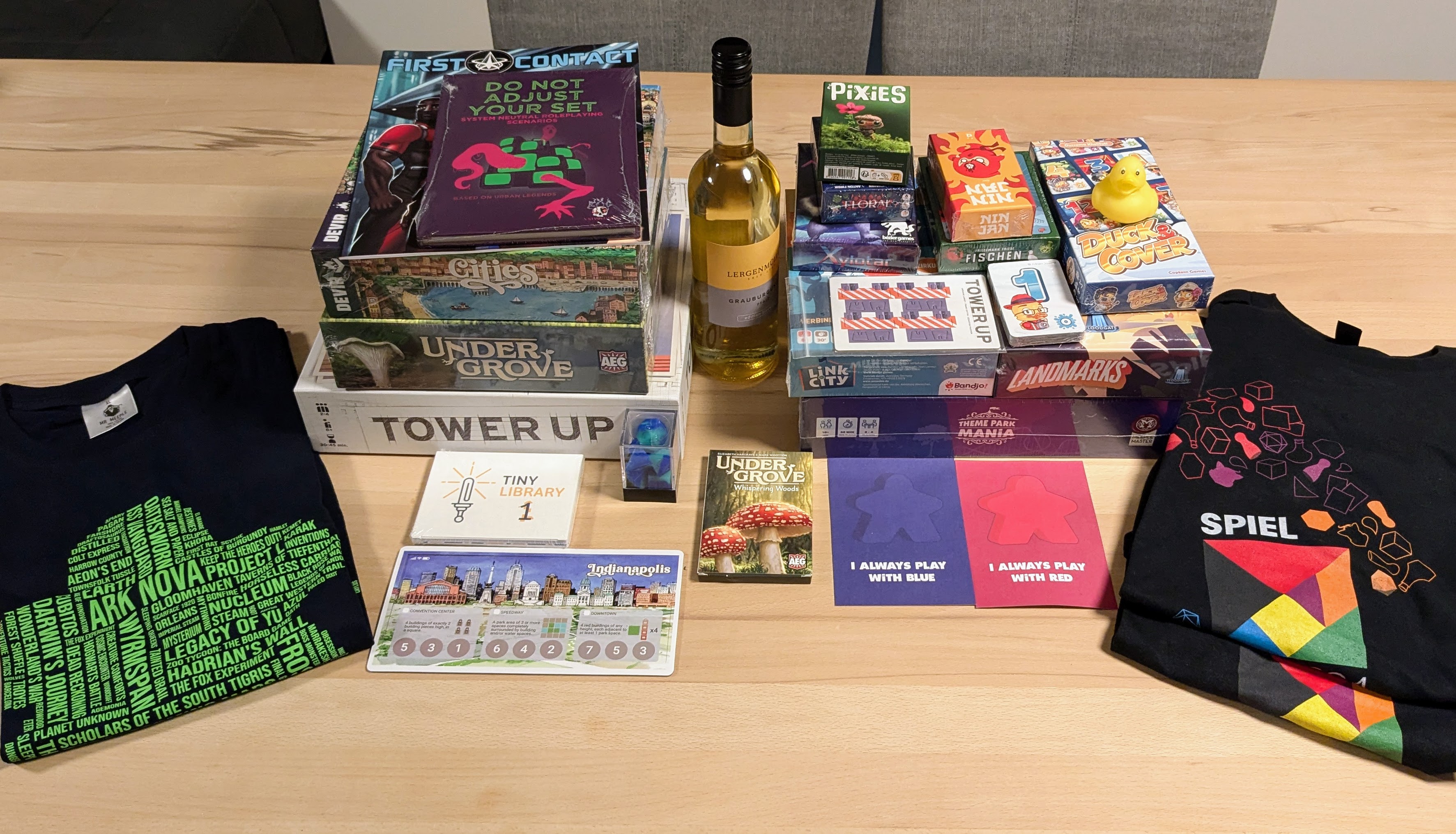
A table with board game boxes, three t-shirts, a bottle of wine and a yellow rubber duck

There, SPIEL Essen 2024 is behind us, and it was another great edition. It was slightly awkward when we saw “by the way, the 4-day tickets are sold out” before we got ours; thankfully we managed to get daily tickets before they ran out as well. This is the first year that they have contingents, and they hit them every day, so it was, well, a busy fair. Anyway, let’s go for the (by now) traditional back-from-Essen post! I counted 37 games in this post, so brace yourselves, it’s a long one 😉

Continue reading “Essen SPIEL 2024”

Writever – July 2024

These pieces are pieces of microfiction written on Mastodon for Writever in July 2024. The list of words has been established with the theme “the mental health of people experiencing discrimination is moving from the Margin to the centre”; I have chosen to interpret the words individually and not necessarily within the context of said theme.

July 1st – Psy

Psy (noun): unit of measurement of mental pressure. 1 psy is equal to 6,895 xaviers.
Etymology: from psychic; wordplay on psi, equal to 6,895 pascals.

July 2nd – Collective

Esteemed gaggle of colleagues, the incorporation of our planet to the Federation gives us the unique opportunity to discuss collective names for our new associates. The Greys are delighted with “a grisaille of Greys”; the Mantids prefer “a vigil of Mantids” over “a congregation of Mantids” and that’s fine for us; however the Blue Avians are afraid that “a murder of Blue Avians” would be somewhat derogatory. Does anyone have a better suggestion?

July 3rd – Margins

“Isn’t it weird that life on Ægir is entirely aquatic, and that nothing apparently ever got the idea of conquering their continents?
— It’s not that weird if you consider the geology of it. Here on Earth, our plates are well behaved, we have continental margins between the continental and oceanic crust, so the transition is, in practice, reasonably smooth. On Ægir, it just… drops abruptly. Or, from the Ægian perspective, their world is surrounded by huge walls.
— It’s still weird they went to space before exploring their surface.
— And as weird for them it took us so long to explore the depths of our oceans…”

July 4th – Build

Compiling light             ##### 100%
Testing light ##### 100%
Compiling planets ##### 100%
Testing planets ##### 100%
Compiling all living things ##### 100%
Testing all living things ##### 100%
Compiling eternal life ## 40% ERROR - Build failed - Missing ';' at line 9210912093

July 5th – Joy

I always found joy in seeing the seedlings pop from the soil after planting them. Seeing seedlings appear on this particular soil, the soil we reclaimed from a wasteland that hadn’t seen a hint of green in years, makes me feel something beyond joy. I’m going to call that exseedlaration.

July 6th – Convictions

“We got raided again, the muffalos ate half our reserves, Alex is close to mental breakdown, and to be fair so am I because I ate without a table again. How can you stay hopeful?
− You don’t stay hopeful. You use your convictions as a lighthouse, the strong belief that you can make a difference every day to make things better for you and your fellow colonists. Hope is not a feeling, it’s acting for a better tomorrow.”

July 7th – Questioning

It must have been weird in the Before Time, needing to choose your studies and your career and your partner.

Sometimes, I yearn for that freedom. But removing questioning also avoids mistakes; or, if it does not, it avoids the associated guilt. We seem to be happier that way. Although maybe that’s the Mood Optimizers talking.

July 8th – Solidarity

The TRAPPIST colonies, strongly condemning the acts of the Gliese planetary system state, and expressing strong support towards Earth and the Solar system, call for an immediate and durable cessation of hostilities.

For Earth, we stand in Sol-idarity.

July 9th – Travel

I don’t think I’d want to go back.

But it used to be that, to feel fully “on vacation”, you traveled for roughly a day. Whether you were traveling 900km at 150km/h, 6’000km at 1’000km/h or 400’000km at 50’000km/h… you were still essentially traveling for a day.

Teleportation made travel times moot, and maybe we have lost something there.

July 10th – Interstices

Humans say that the greatest trick I ever played was convincing the world that I did not exist. I beg to differ: it was convincing the world that idleness was a sin.

I have so much more opportunities to sway people my way, in all these interstices of time where they used to daydream and are now trying to fill at all cost.

July 11th – Share

The problem with trying to replicate services that worked reasonably well in the 21st century is that some things really don’t translate well. Car-sharing did assume that people would refill the tank before leaving the vehicle; but antimatter stations are not exactly common enough for starship-sharing to make any kind of sense.

July 12th – Queer

I’m not super sure I like this one – I think it might say things I do not intend / be misinterpreted. This was still part of this month’s production, so I’m adding it; but I might reconsider an alternate entry when/if I get an idea.

“You mean, they were living with a single partner?
− Most of them, officially, yes.
− And they believed in binary genders?
− It was the prevalent view at the time, yes.
− And they were pairing exclusively with people of the other gender?
− Exclusively, no; by a large majority, yes.
− How queer.”

July 13th – Training

Modern town planning tends to put the hatcheries in the middle of the town and not on its limits, as it used to be. Sure, it has its dangers, but if you avoid going outside during class times, you’ll be fine. And dragon training is definitely more compatible with forges, ovens and glass and pottery manufacturing than with forests.

July 14th – Situated

FOR SALE

Cozy manor, 10 rooms, piped water, central chimney heating.
Well situated, good road to the town center, quiet area. Friendly neighbors, mostly quiet spirits.
Some work (ceilings, floors, exorcism) needed. Furniture available on demand.

Write to agent for pricing.

July 15th – Listening

The strongest argument against devices allowing anything remotely close to telepathy is surveillance agencies.

They read our mail, they listened to our phone calls, they watched our online activity… do we really want them listening on our thoughts?

July 16th – Flamboyance

“The kingdoms are competing for the most exuberant gifts for the royal wedding.
− As expected.
− We have received a lot of the usual: gold, jewels, art, spices, fabric… and a group of flamingoes.
− Of… flamingoes?
− That’s the best flamboyance the Queen of Isla could come up with, considering the circumstances of her territory.”

July 17th – Care

“Why do you care?
− I have hypermerimnasia.
− What now?
− From hyper, excessive, merimna, care, suffix -ia, denoting the disease.
− You suffer from giving too many fucks?
− From giving ALL the fucks.
− Sounds exhausting.
− You have no idea.”

July 18th – Relieve

“So this is Heaven?
− Yes, welcome.
− As in… eternal bliss?
− Not exactly. The only thing we do when you pass the Gates is relieving your from all your earthen emotional baggage. What you do next is up to you.
− Sounds close enough, to be honest.”

July 19th – Sibling

One of the earliest techs developed by our civilization was DNA testing. When you have 1/ strong genetic diversity rules 2/ 4000 siblings coming from the same clutch on average, that specific problem gets solved VERY FAST.

July 20th – Bissap

Vampires lost a lot of their mystique when a particularly meddlesome young girl discovered they had switched from blood to bissap centuries ago with no other side effect than much better cholesterol levels.

July 21st – Support

QuanticStorage is not liable for data or information loss resulting from the use of the products in a manner that is not in accordance with the use cases specified in the documentation. In particular, due to the high risk of data transmission error, QuanticStorage does not support the usage of the products in teleportation appliances or any other present or future apparatus using physical matrix transmission.

July 22nd – Walk

The vintage self-help books I found in my grandmother’s trunk all have a similar theme: going for a walk is easy and can solve a ton of problems.

I’m not saying it can’t, and the few times I did, it did help. But they vastly overestimate the “easy” part in a context where you need a pressurized suit, air bottles and magnetic boots to go for a walk outside.

July 23rd – Maroon

Stupid transmission errors, stupid Make-a-Wish AI. I had won a low-grade wish, so I wished for something realistic: twelve dozens macaroons. This is currently the 54th deserted island I’m marooned on in a row. 120 to go…

July 24th – Partners

“Are you two married?
− We can only be registered partners for now. Our state just barely made robot wedding legal; we’re still fighting for human/robot wedding.
− I’m sure we’ll get there.
− I hope so. I can’t wait to marry my human.”

July 25th – Dream

Of all magic essences, Dream is considered the most powerful and the most dangerous one. The ability to conjure anything at all, no matter how small, big, complex or twisted, by the power of thought comes with the need to control one’s nights with an unwavering consistency. Accidents happen way too often; thankfully, no mage has yet managed to Dream themselves out of the Enclave.

July 26th – Play

“Pff, technology is really getting worse and worse. In my days, things were much more intuitive. This new holoviewer you gave me is full of buttons that are completely opaque to anyone who hasn’t spent hours watching the tutorial, because there’s not even a written, let alone paper documentation coming in the box. Not to mention, watching the tutorial requires starting the thing; and I don’t even know how to do that!
− Have you tried pressing <Play>?”

July 27th – Group

Space exploration brings some more or less expected issues. Aliens, fine. Stupid behaviors in the vicinity of c, and in wormholes, nothing new.

But the chemists are really unhappy with the discovery of fractional atomic number elements. Worse: they won’t fit neatly into groups, because they’re all over the place in the periodic table.

The current consensus is to call them “foramenvermites”, add a new table below the f-group and be done with it.

July 28th – Decenter

As the climate change is becoming a more and more pressing issue, more and more ludicrous ideas are gaining traction. The latest I’ve seen is the Decenter project, whose goal is to modify the orbit of Earth around the Sun so that it’s a bit further away (and colder) and somewhat off-center (to get a longer cold season). And to take the opportunity to offset a bit more to compensate for the CO2 production necessary for such an endeavour, obviously…

July 29th – Speaking

“Sasha and I aren’t exactly on speaking terms anymore.
− Oh, what happened? Did you fight?
− Quite the opposite! We got matching My-Mind-To-Your-Mind implants, so speech became mostly useless between us.
− Only mostly?
− Yeah, puns are still much better out loud.”

July 30th – Survey

When I was a kid, I wanted to be a librarian. More than the books themselves, I think I had a fascination for the Dewey system, and finding the right code for every book.

Later, I found tremendous joy in inputting and organizing all kinds of data, from my sticker collection to samples at the lab.

When the new exploration mission started recruiting, I applied for the survey cataloger job. The day I got selected is still the happiest day of my life.

July 31st – Black

Most colonists adjust pretty well to the underground facilities. A lot of effort has been made to give a good day/night cycle, and the progress around sun-substituting lights have been impressive (the people working the ‘ponics even need sunscreen!)

But we haven’t found a way yet to get stars look like anything else than a bunch of lights projected on too black a screen. Turns out, nightlight is much harder to get right than daylight.

Scavenger Hunt #39 – Bonus – Break the rules!

The 39th Scavenger Hunt had an overarching theme, Rose, and 10 other words to associate to it. I went for a very literal interpretation of that, got myself a rose bouquet (on discount because they were starting to fade quite a bit) and managed the whole Hunt in one (long) afternoon.

This was my entry for the bonus word, “Break the Rules!”. And, well – the first rule of photography is that you don’t destroy your subject 😉 So, that’s what I did first. I also went for a very “on-the-nose” centered composition (which is supposed to be “boring”). I also had a lot of out-of-focus takes, but they were working significantly less well than this one.

A disk of pink rose petals and green rose leaves centered on a black square background.

And the original – not much to be said here except for the exposure/color and crop.

A disk of pink rose petals and green rose leaves centered on a black background. The picture is underexposed.
CameraPentax K-1 II
Lenssmc PENTAX-D FA 50mm F2.8 Macro
Focal length50mm
F-NumberF/5
Exposure time1/50s
ISO800

Other pictures from my fellow Scavengers: Break the Rules

Scavenger Hunt #39 – Silhouette

The 39th Scavenger Hunt had an overarching theme, Rose, and 10 other words to associate to it. I went for a very literal interpretation of that, got myself a rose bouquet (on discount because they were starting to fade quite a bit) and managed the whole Hunt in one (long) afternoon.

This was my entry for the word “Silhouette”, and it is both my favorite picture… and the one I spent the most time on 😉 (Coincidence? Probably not.) I wanted the rose bouquet to be recognizable as such; I wanted it to be reasonably “tidy”, I wanted the wooden support to have the “right” angles on each side, and I was working with a fairly narrow margin on my white wall. This is not PERFECT, but this is the closest I could get. Probably should have gotten a tripod out there 😉 (yeah, it’s a theme of this hunt.)

A silhouette of a rose bouquet on a wooden stool, with a pink background.

Here’s the original version, which DOES show the narrow margin on the background 😀 I’m quite happy I decided to process it in a pink hue, I think it worked really well.

A silhouette of a rose bouquet on a wooden stool, also showing a bit of the "outside" context (the end of a back wall, a frame on the wall).
CameraPentax K-1 II
Lenssmc PENTAX-D FA MACRO 100mm F2.8 WR
Focal length100mm
F-NumberF/8
Exposure time1/100 s
ISO800

Other pictures from my fellow Scavengers: Silhouette