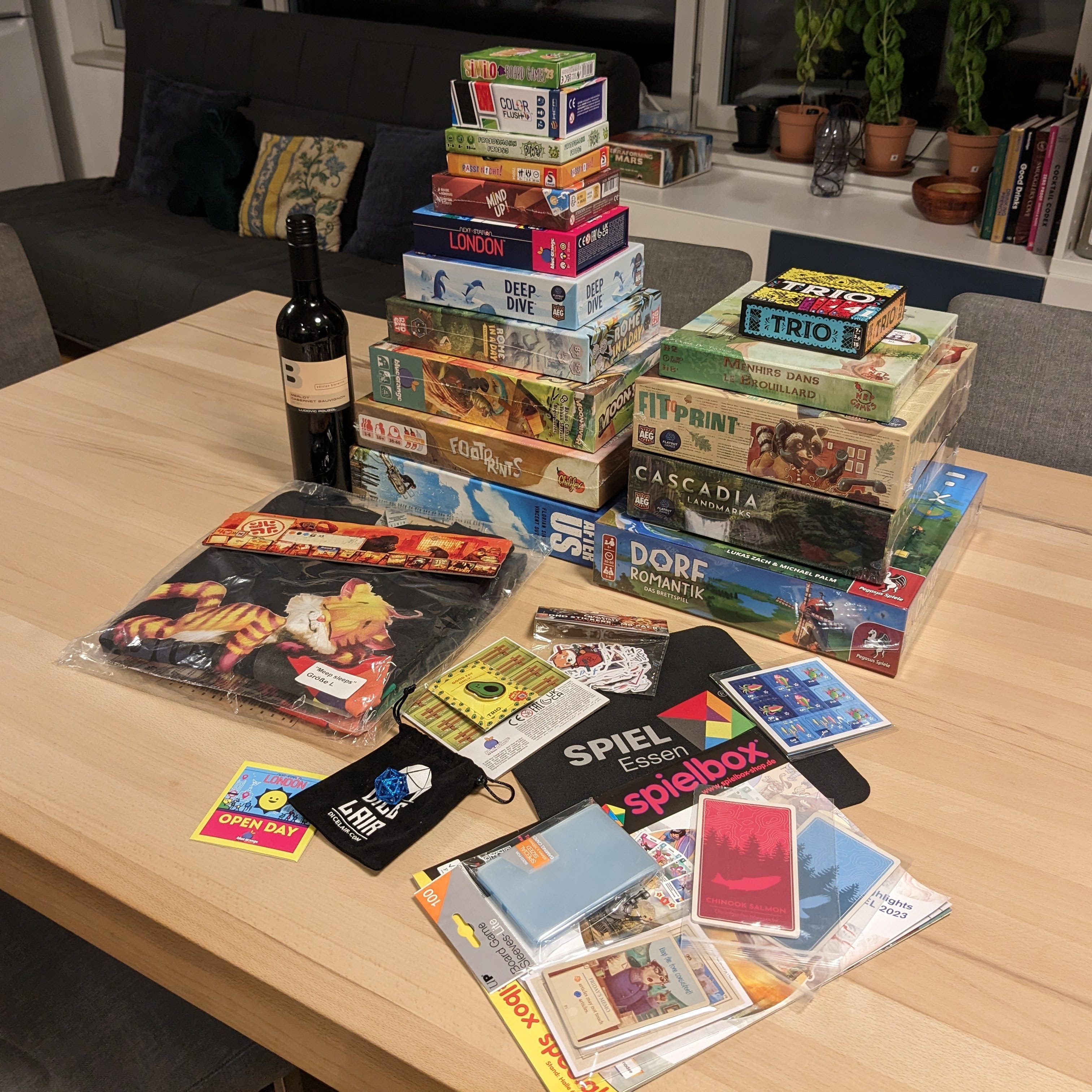
Another year, another SPIEL, and it keeps delivering, as an event. A lot of games played, a lot of games bought, a lot of fun 🙂 And, if you’re wondering about the bottle of wine on the loot: we went to a restaurant (Fischerei) and got their fixed menu with wine pairing, and got treated with a bottle on our way out! (Food was delicious, by the way – highly recommended if you’re in the area. And like fish.)
So, let’s talk about games and, like last year, let’s do that in order of games played, because that’s actually easier to narrate. We’ve tried really hard this year to not buy games we weren’t sure about (“maybe is no”), but we may have failed a few times as the fair went on.
Papertown
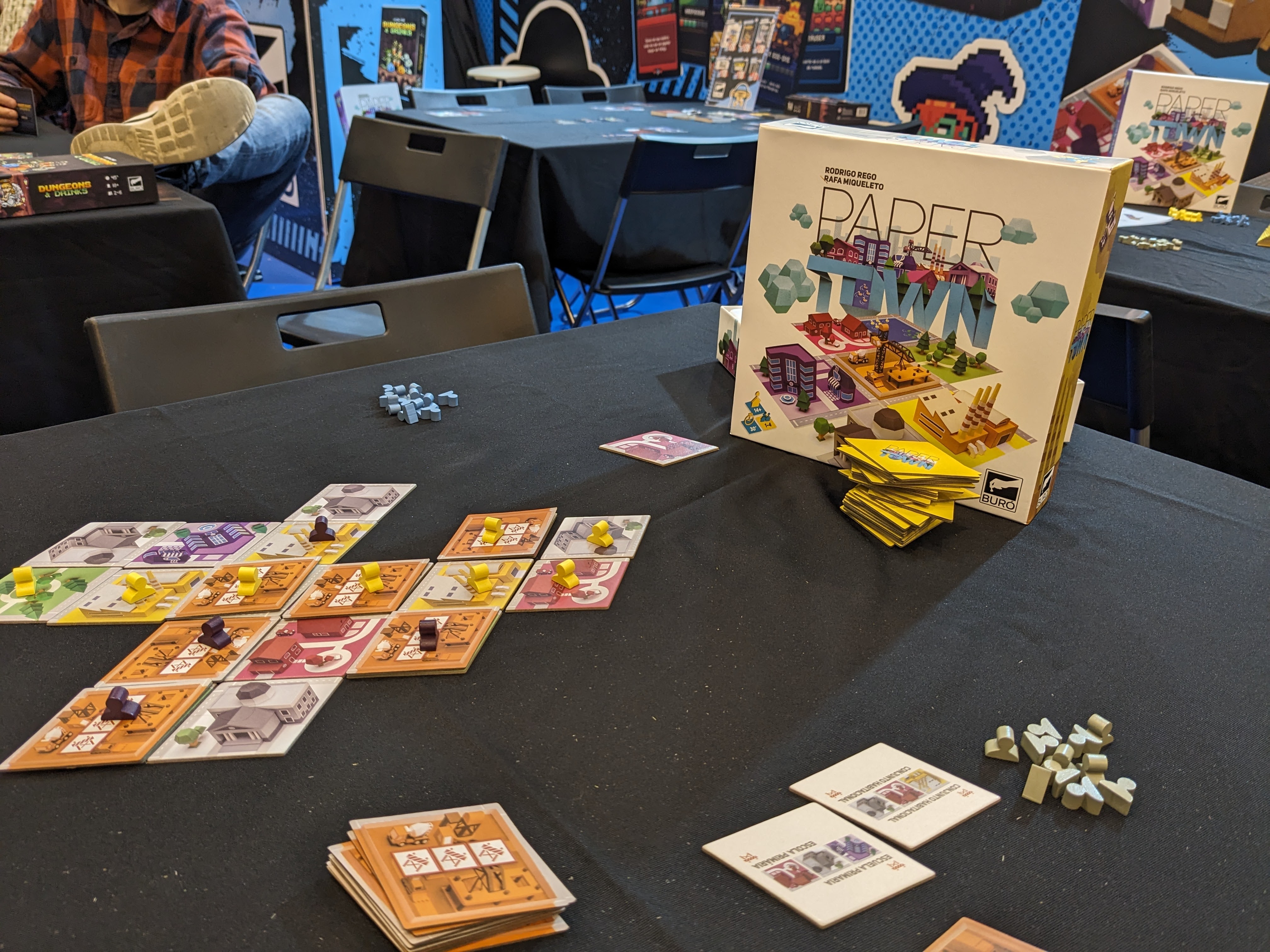
Papertown is a tile-laying game, where you try to make geometric combinations of tiles to place your buildings/objectives and the corresponding meeples. The twist is that the tiles are in isometric 3D, which makes it a bit harder to fit in one’s head! That twist might have been enough to make it a pick later during the Messe, but we still had enough self-control at that time to not get it.
Balloon Pop
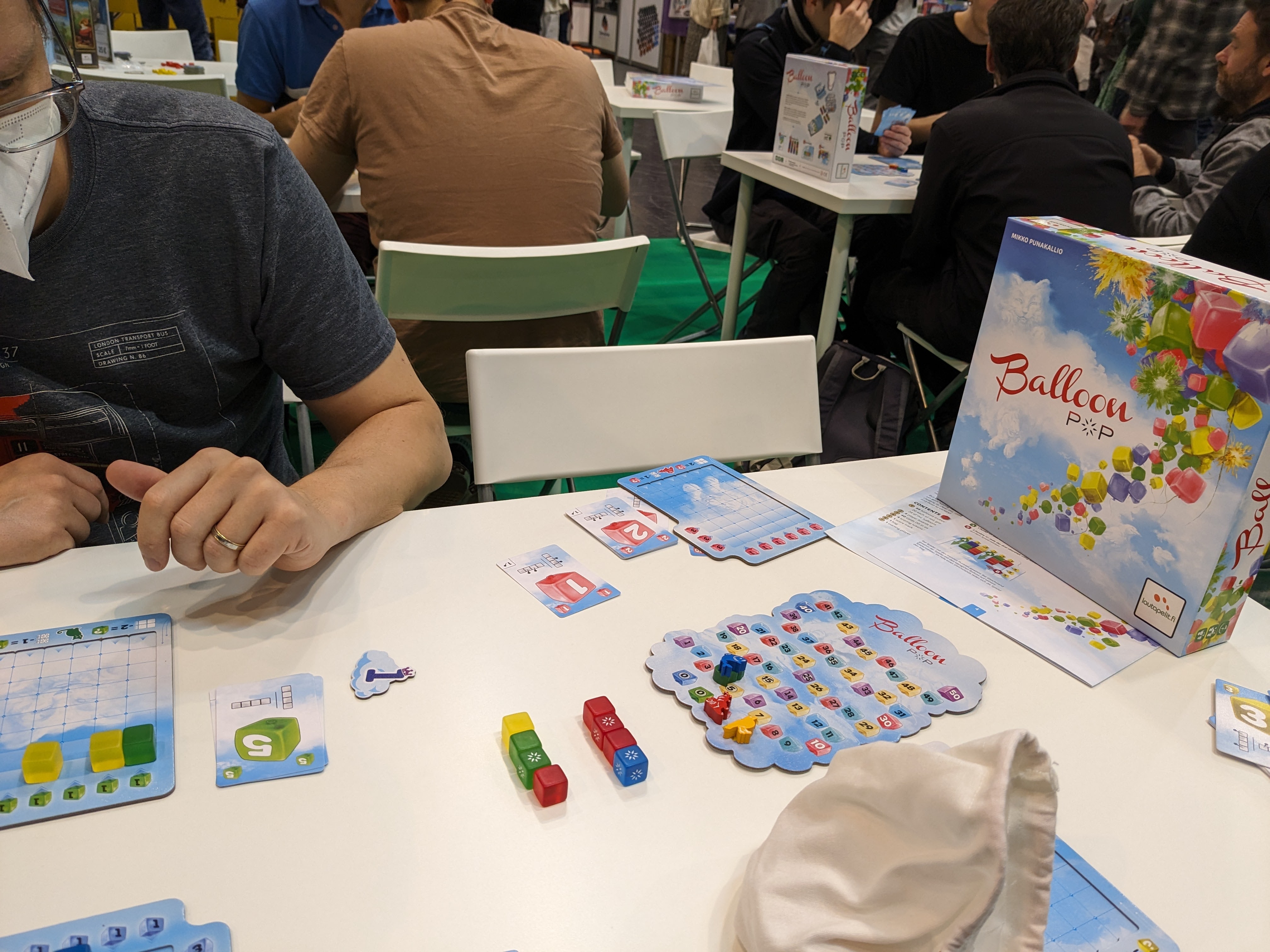
In Balloon Pop, you get a row of colored cubes, representing balloons, that float on top of your board, and they pop (making points) when they reach a certain threshold. The cards are used to define both the priority order and what you’re allowed to do with the balloons (place them horizontally, vertically, discard some of them). Pretty clever, and that may be the one I’m regretting not getting right now.
Menhirs dans le brouillard
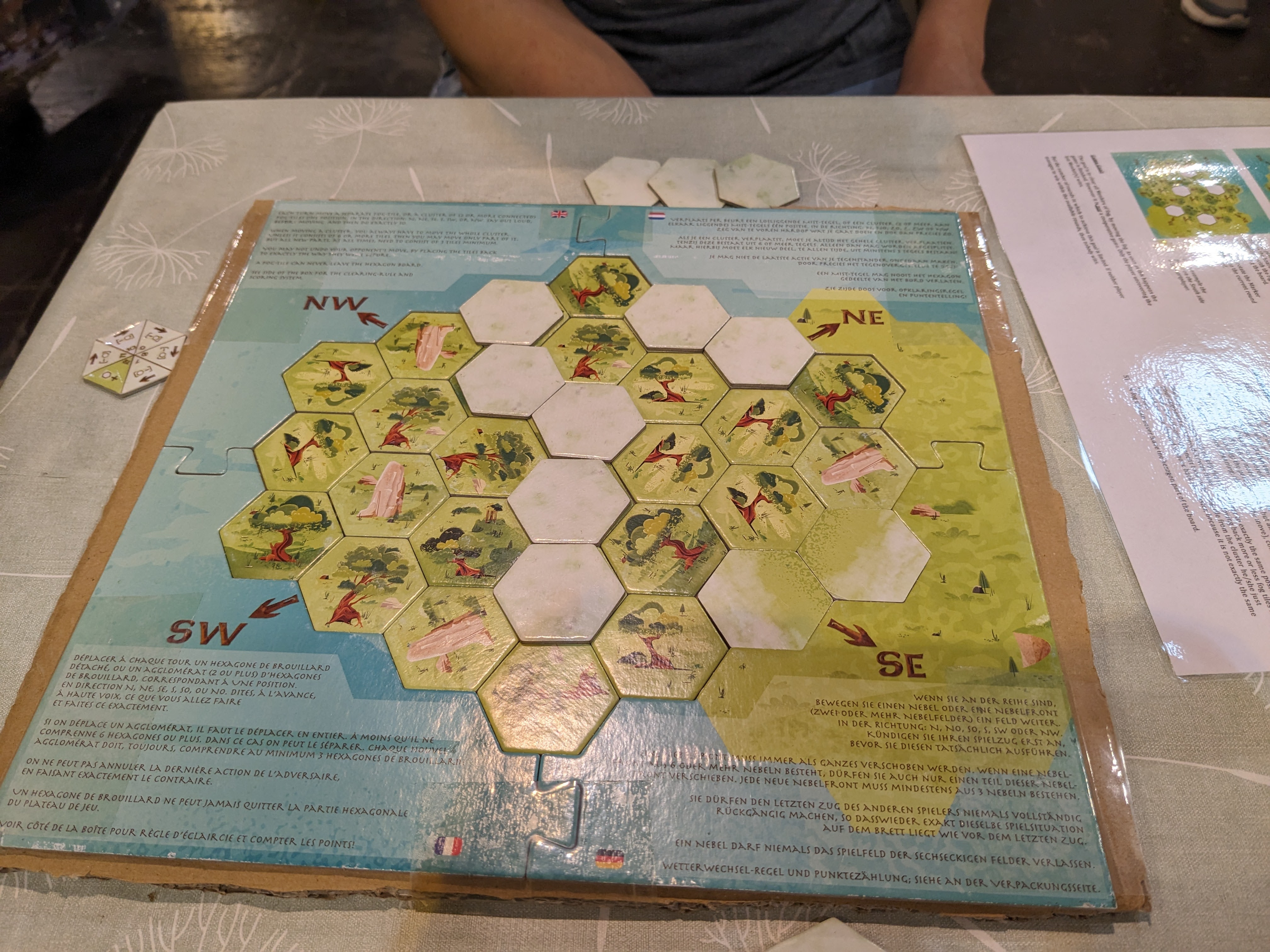
“Menhirs dans le brouillard” was a buy, and it was honestly half because of the title (which means “Menhirs in the fog”, which we both found hilarious) and quarter because of the people explaining the game (who were super friendly and passionate). And the game is actually interesting, even if it’s not our typical fare! You have an hex grid of forest tiles, in which a few menhirs are hidden. There’s initially some fog covering them, and there’s a game of adding fog, removing fog and moving fog so that you are the one to uncover the last menhir (or you’re preventing your adversary to uncover the last menhir).
Robo Factory
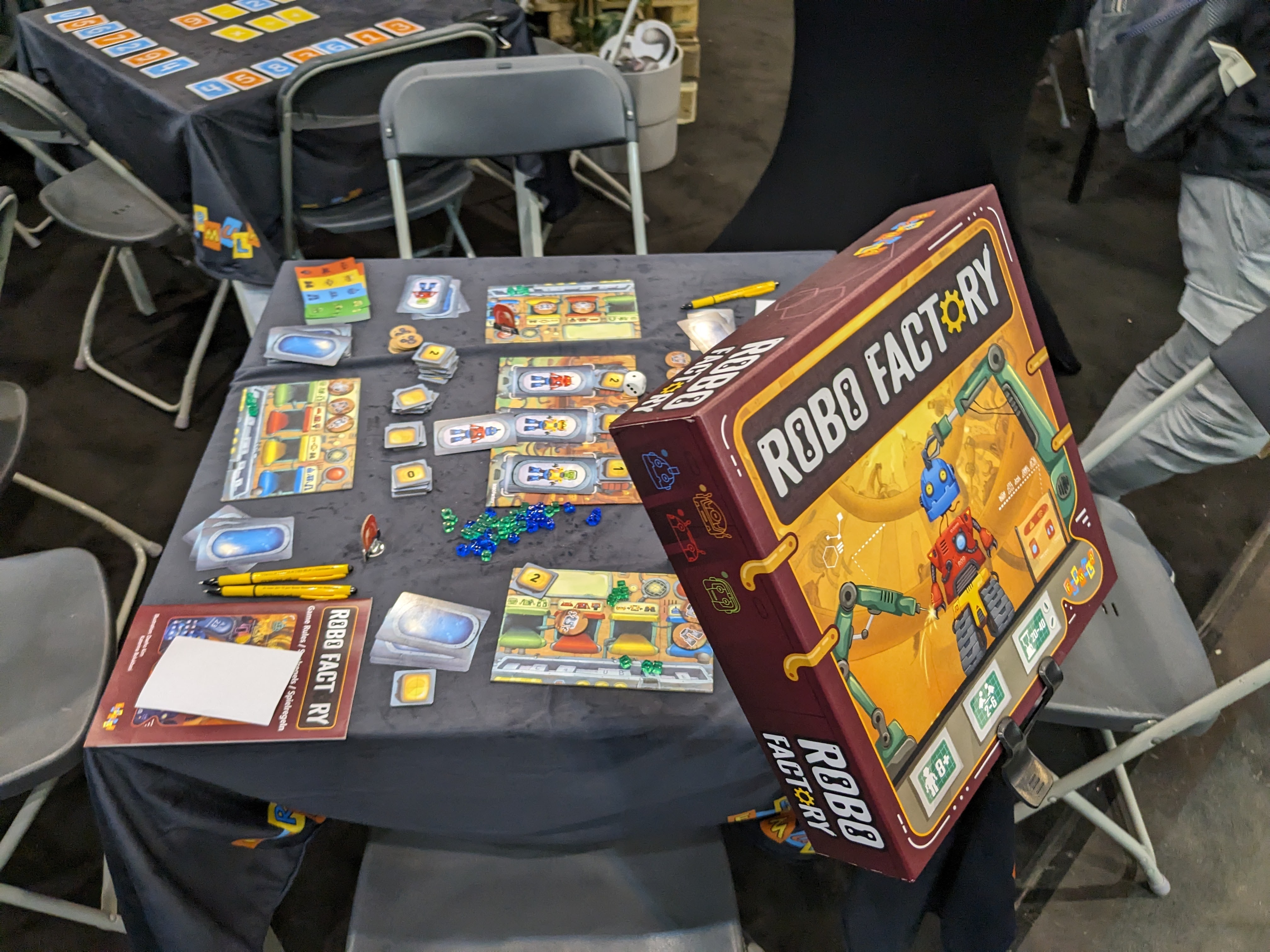
Robo factory is a deduction game where players try to match a secret combination of color elements to create a robot. It’s essentially a multi-player, simpler, version of MasterMind, with all the players playing at the same time, and we were not convinced.
Mind Up!
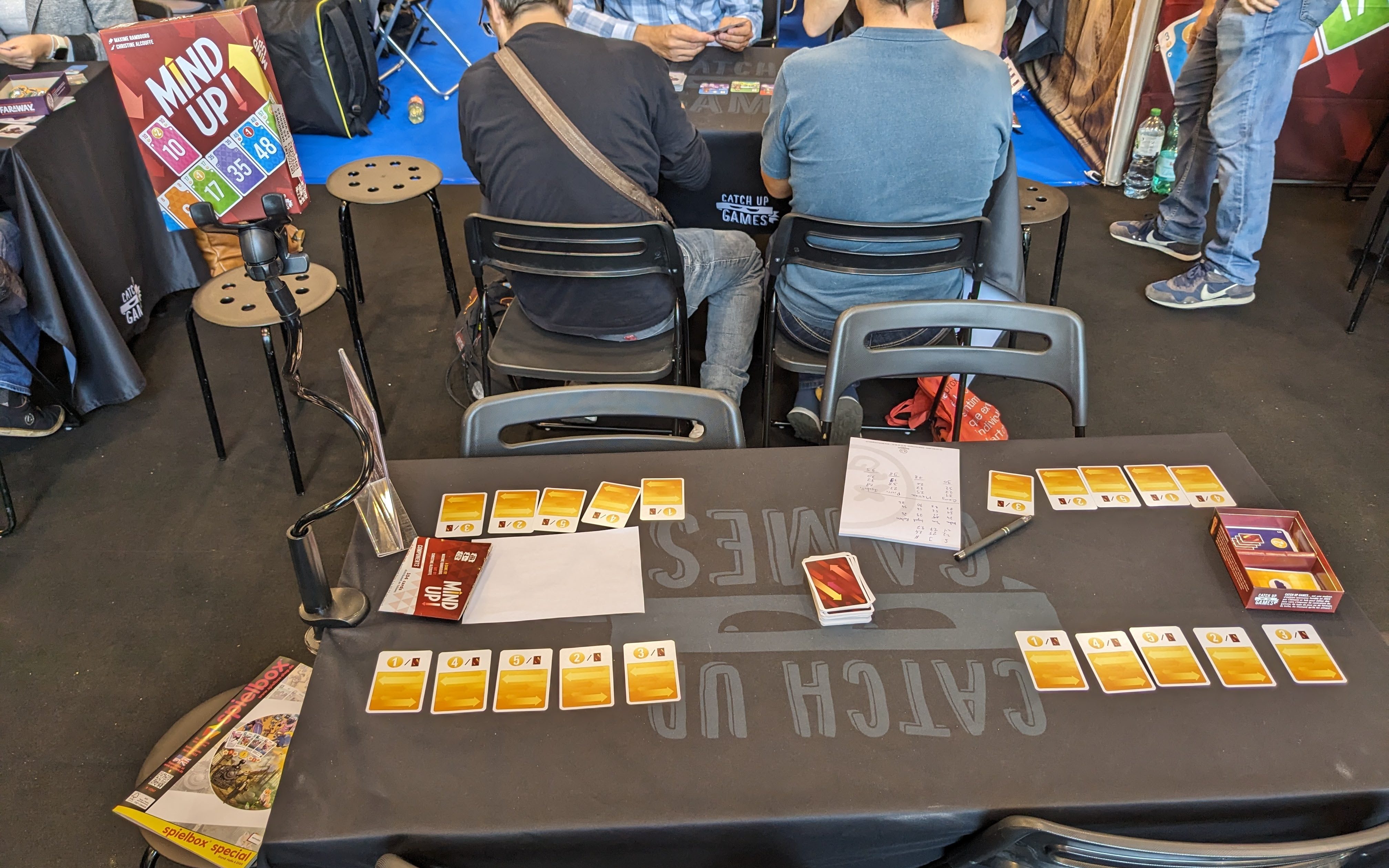
The explanation for Mind Up! started with “Do you know 6 Nimmt?”. And it is indeed very reminiscent 😉 Players play a card from their hand, which allows them to pick another card, depending on the order of their card in the overall sequence, which they then organize in piles according to the color. It feels like a welcome update to the concept of “trying to get the right position in a sequence of cards”, and we got a copy (the first of multiple “X copies of N colored cards with numbers” games we got this year 😀 ).
Nautilus Island
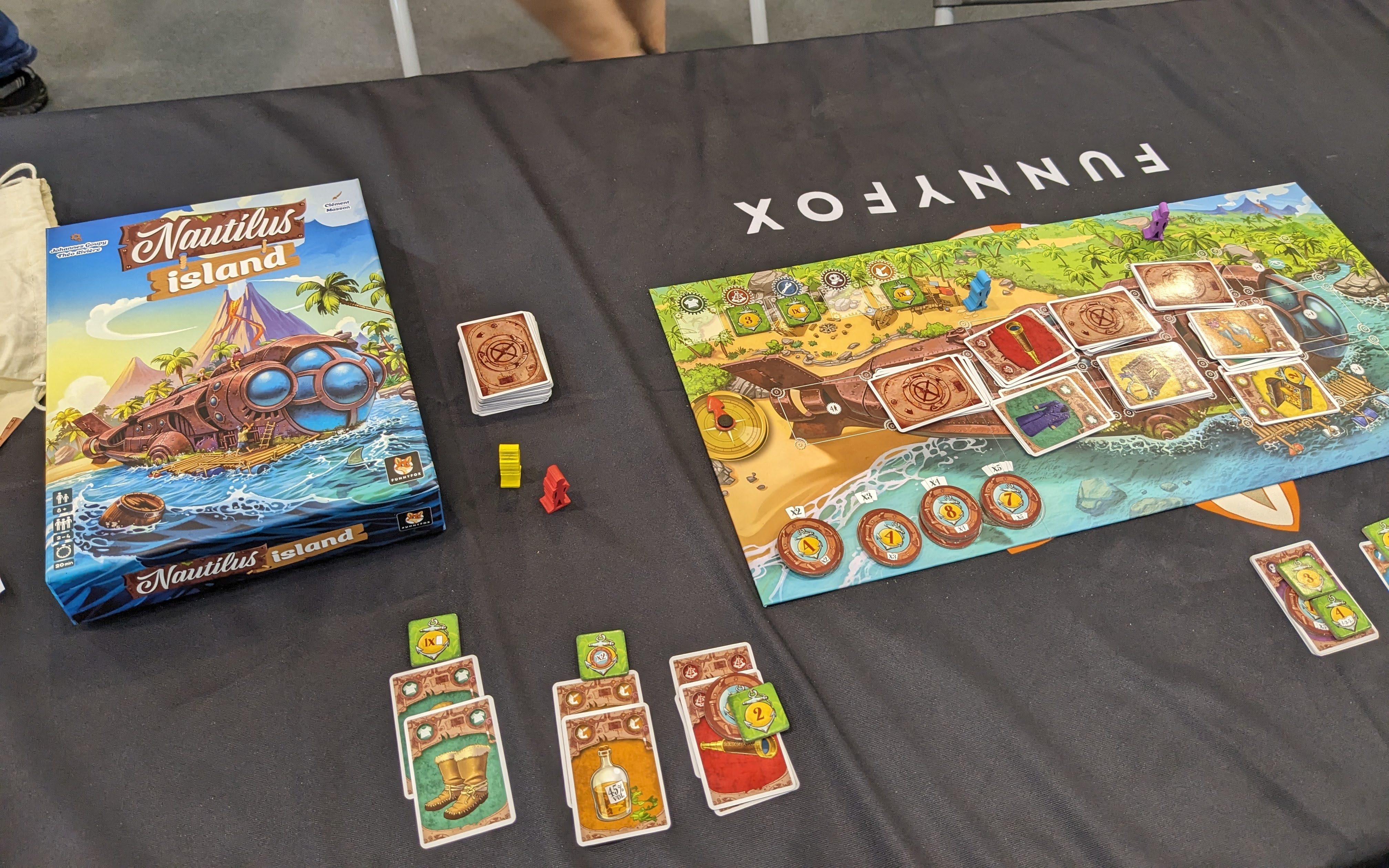
Nautilus Island is a set collecting game: you’re on a desert island with a crashed submarine and you’re trying to collect stuff to survive. It’s a pretty neat combination of set collection, race for bonuses, and push your luck, and I’d be happy to re-play it, but it didn’t feel special enough to warrant a buy.
Line It
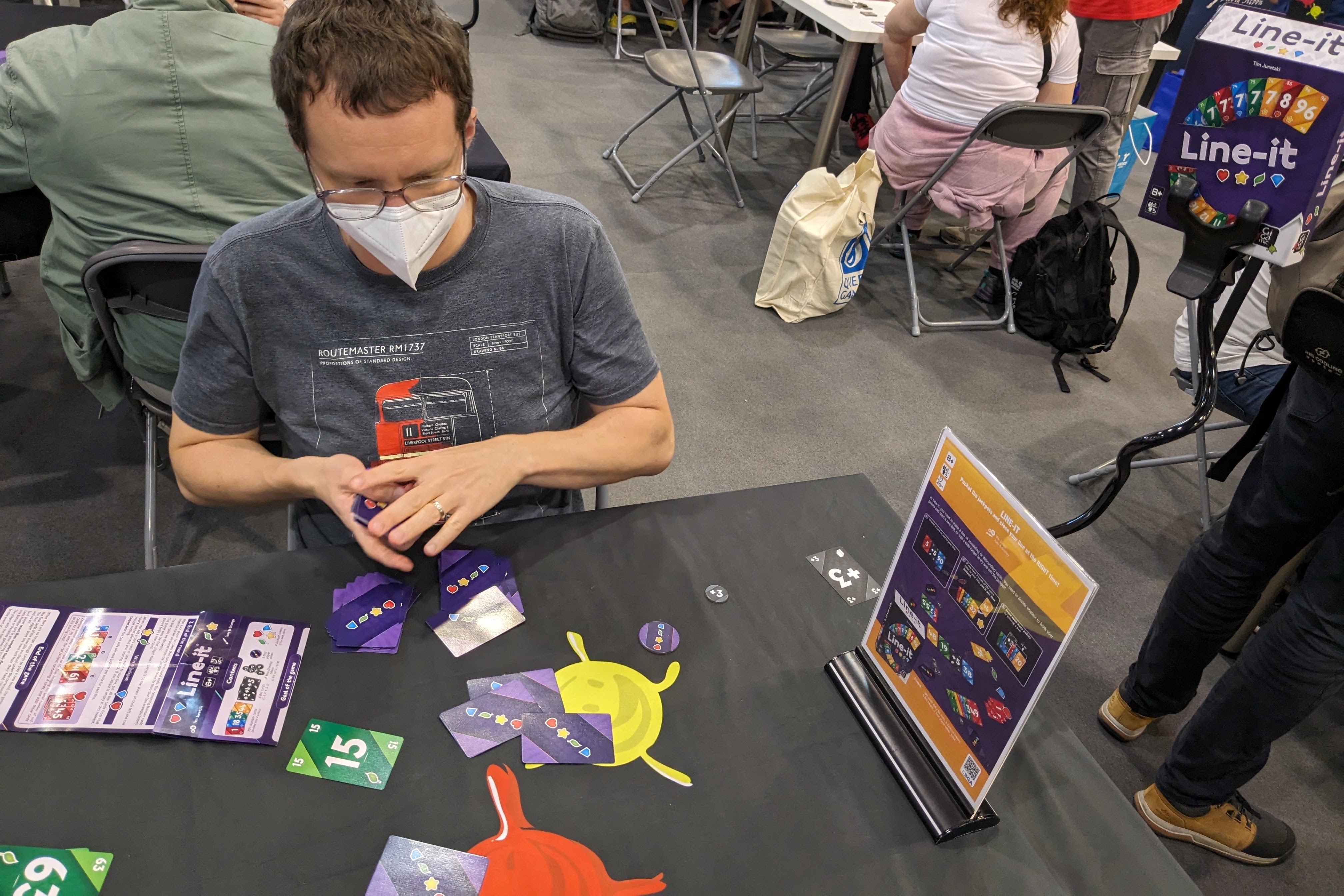
Line It is another “numbered cards with colors” game, where you build a line of value-increasing or value-decreasing cards in front of you, and try to time fetching “jackpots” that build up as a side effect. Considering our other buys, it’s possible that the only reason we didn’t get that one is because we had gotten Mind Up! half an hour before, despite the games not being that similar in the end.
Battle Fries
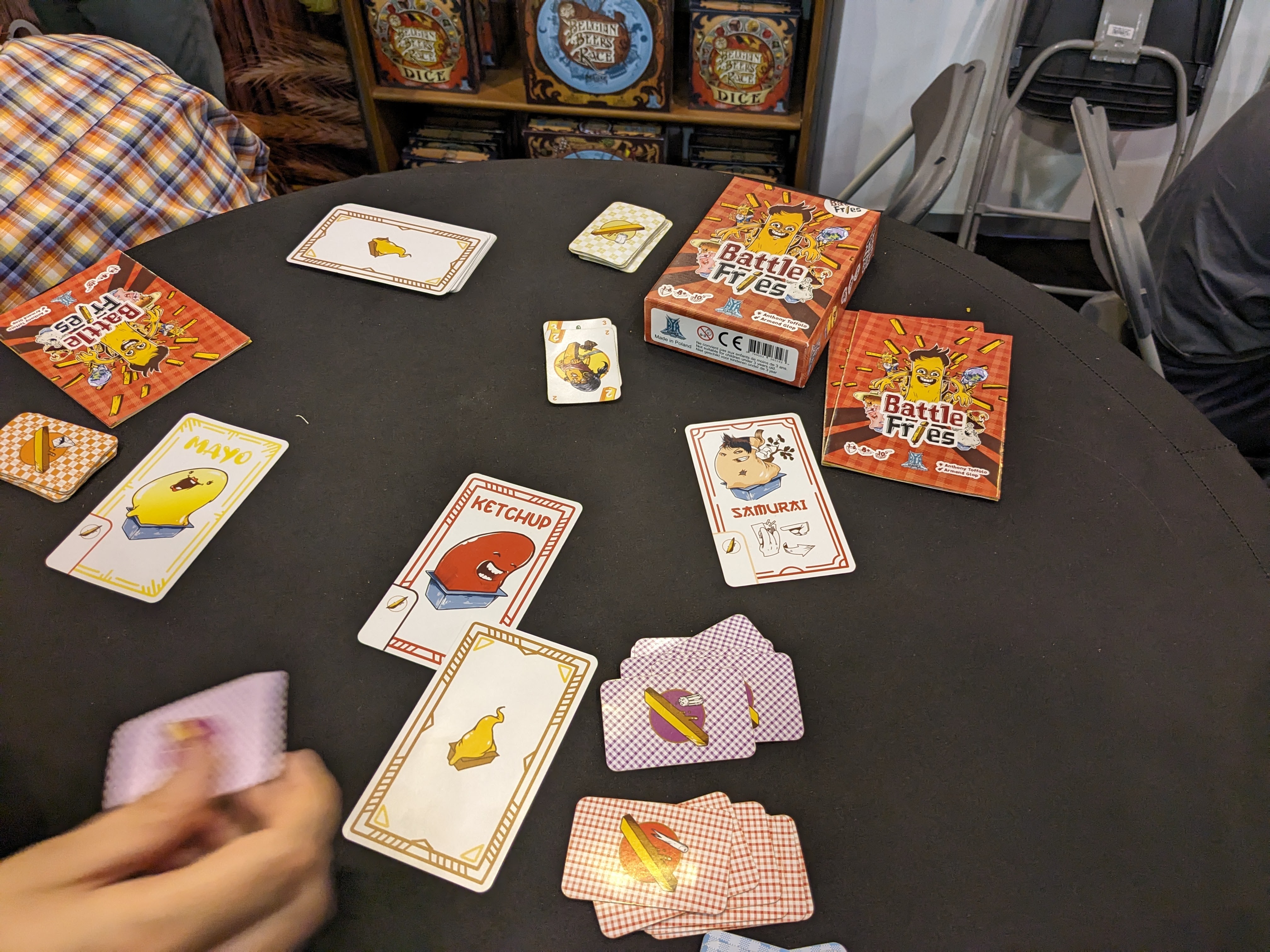
Battle Fries is a very silly card game where you try to dip your fries in various sauces… and preferably other sauces than your opponents, by yelling the name of the sauce all at the same time. The theme is hilarious, but we’re not much for yelling games 😀
Black Friday
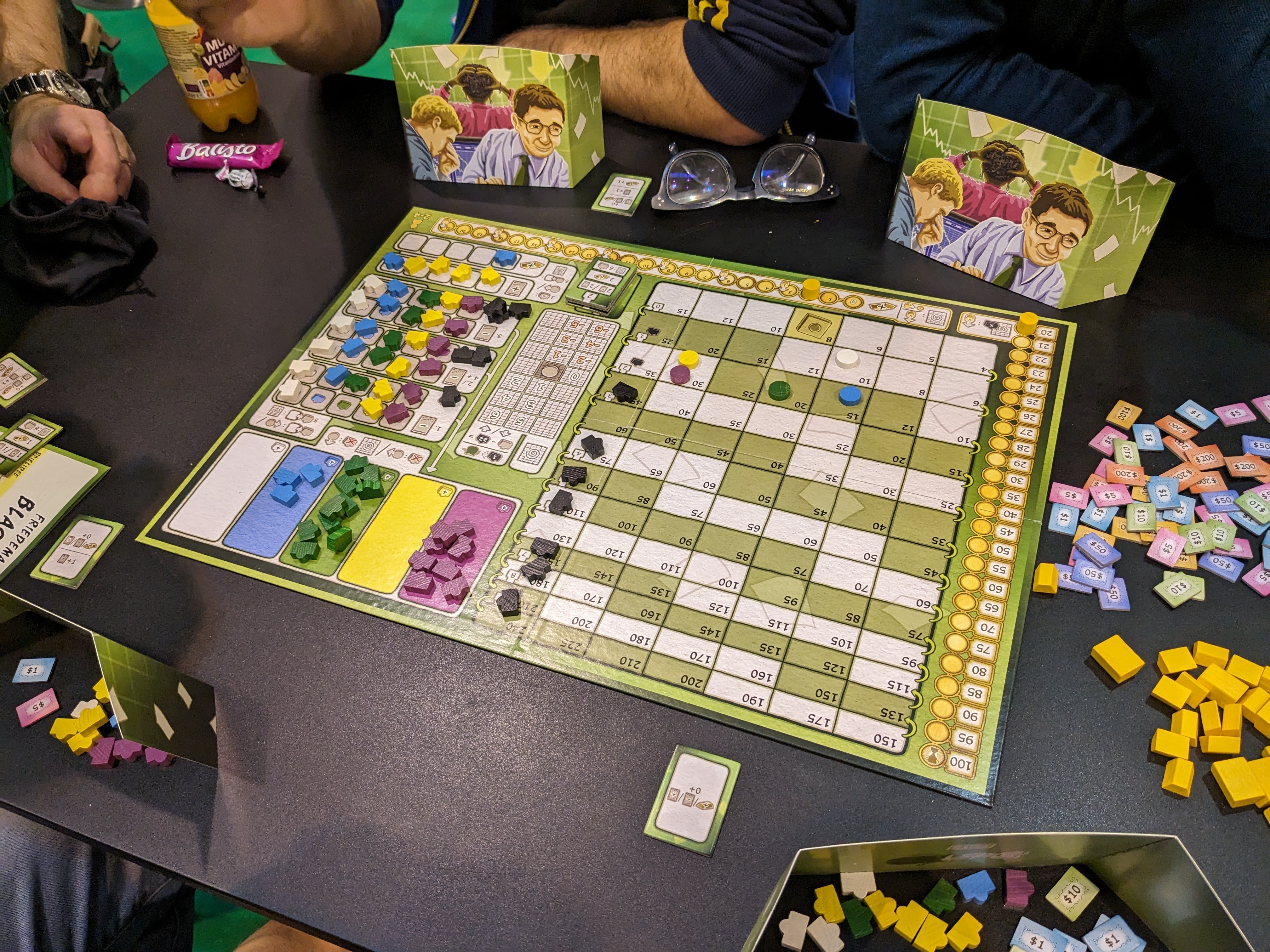
Black Friday is a market manipulation game: you’re trying to make the most money possible by timing your share buys and sells between the different market crashes. Interesting mechanics that do yield “large tendencies and small variations” around the share prices, but it felt a bit dry to be able to sell it on a game night.
Stamp Collection
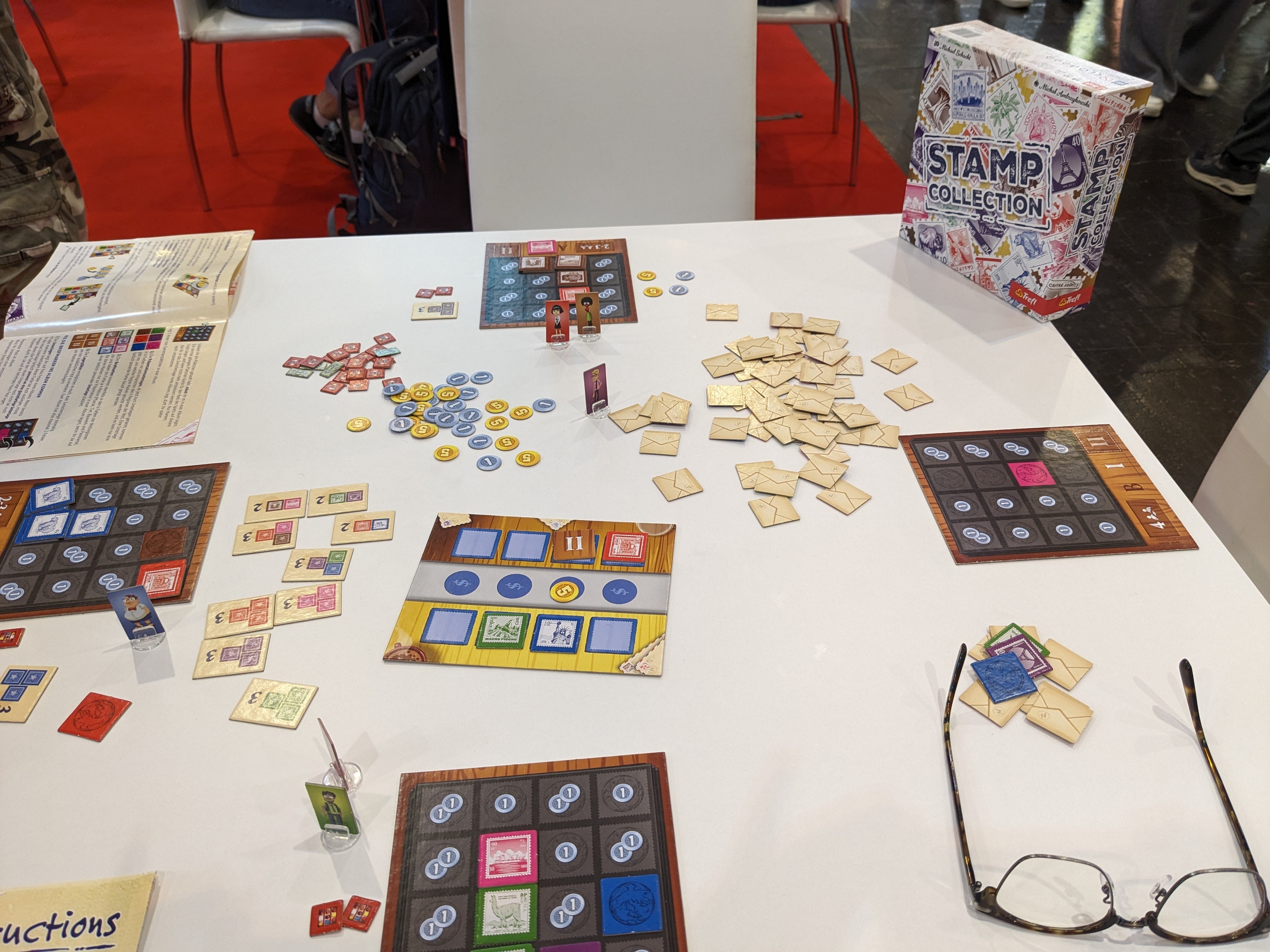
Stamp Collection is a reimplementation/re-theming of an older game called California, where the players try to make pretty stamp collections to attract fans that bring chocolate when they visit/appreciate said collection. I kind of liked it, and the theme was cute, but the component quality felt pretty low compared to modern standards.
Isle of Trains
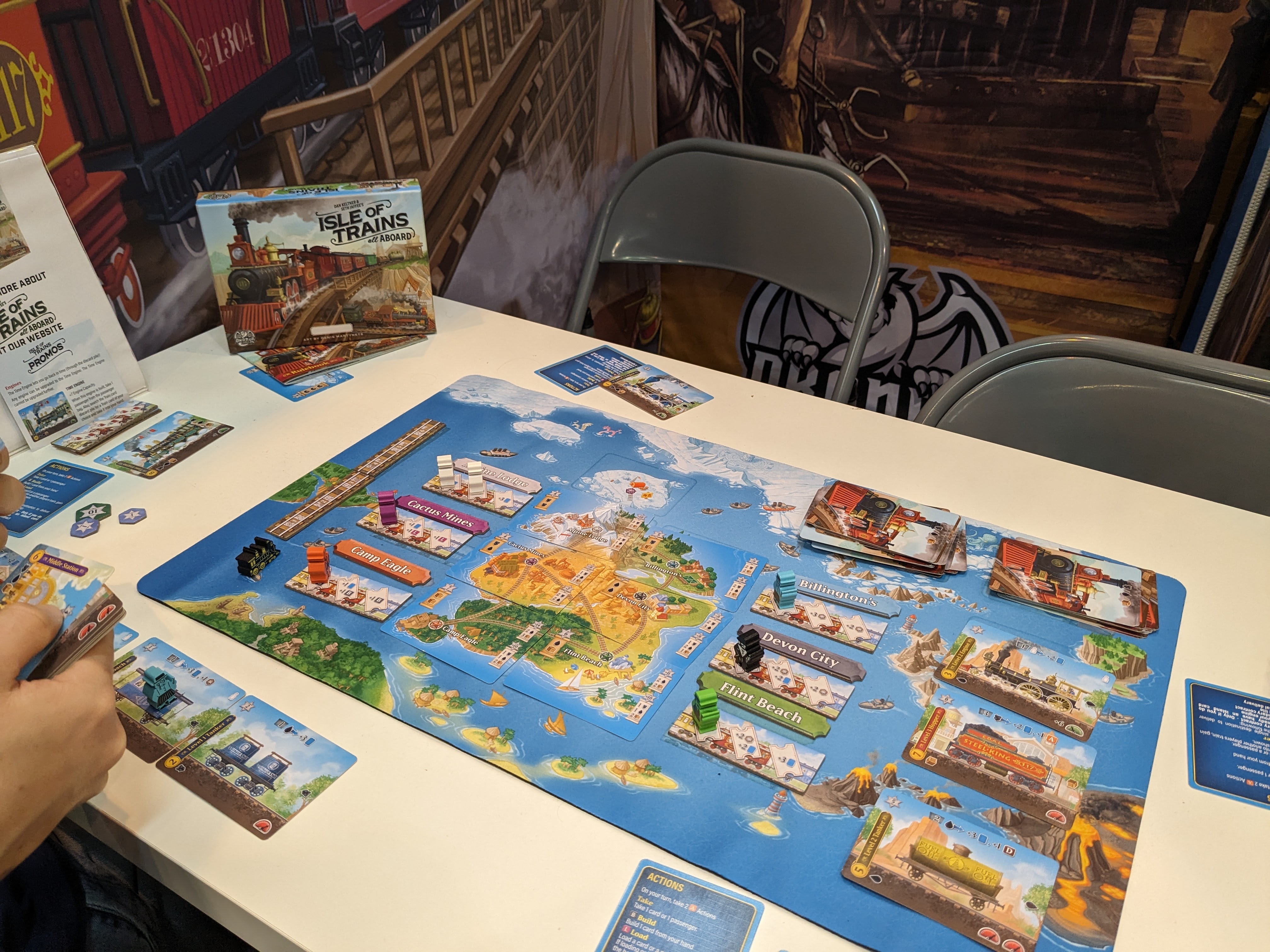
In Isle of Trains, you build a train to deliver goods and people to places. The twist is that the goods and people can be put there by your opponents, because you get bonuses and resources when you add things to your opponent’s train, but not to your own – making your train appealing is consequently a good idea! We both liked the game, which also had excellent iconography, but were a bit worried at having to check other player’s boards from across the table to be able to make decisions (checking what others players are doing are not necessarily our strong suit, and this requires a fairly detailed view of that).
Fit to Print
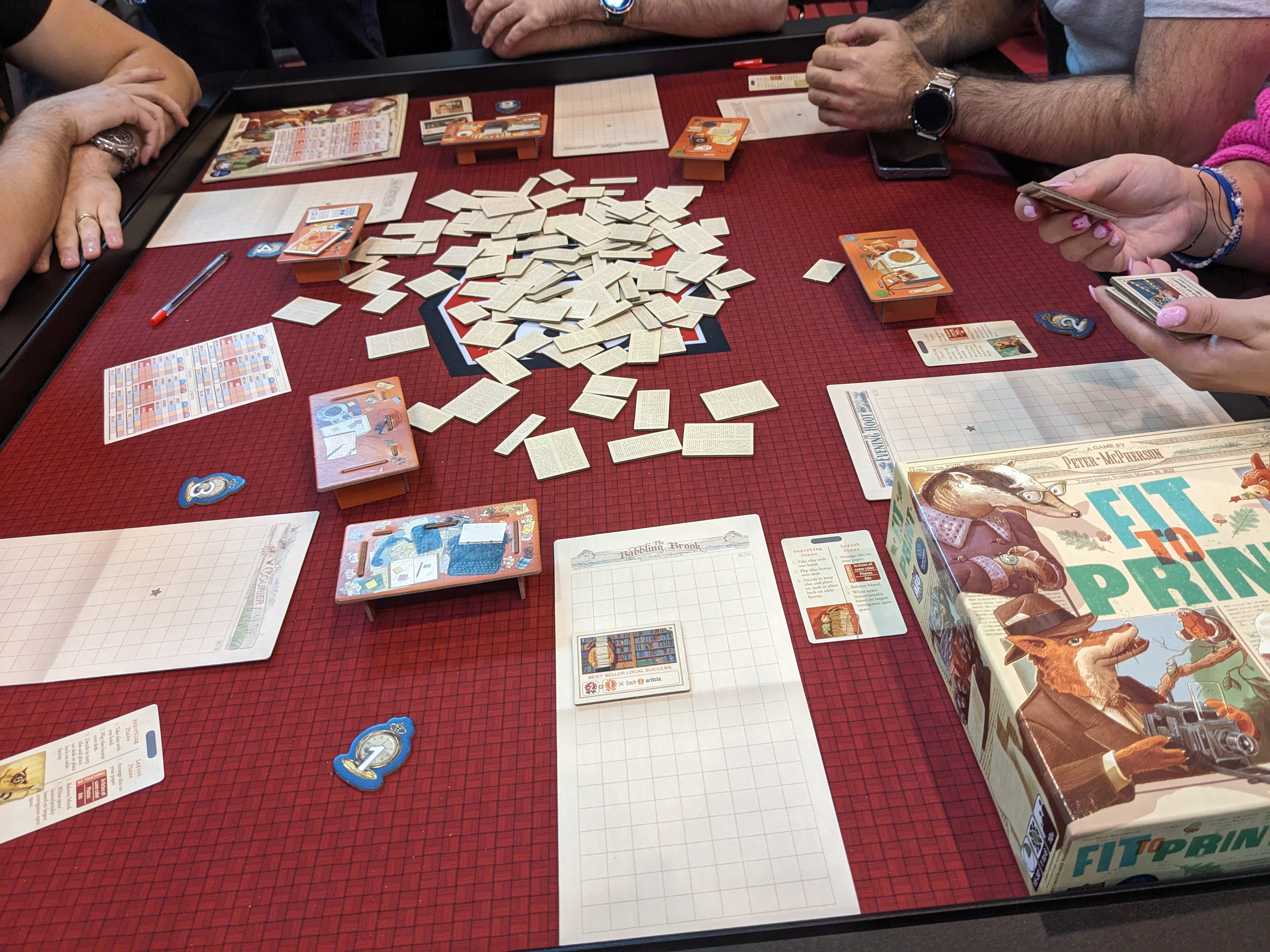
Fit to Print is very reminiscent of Galaxy Trucker, but instead of creating a ship, you create a journal layout, with a bunch of constraints. Also, you score directly without making your journal layout explode first. I kind of like the frenzy of ship building in Galaxy Trucker, but I was never convinced by the “race” second half of the game, so Fit to Print plays into that. Add to that an adorable “forest newspaper” theme, and that’s a box that went home with us.
Footprints
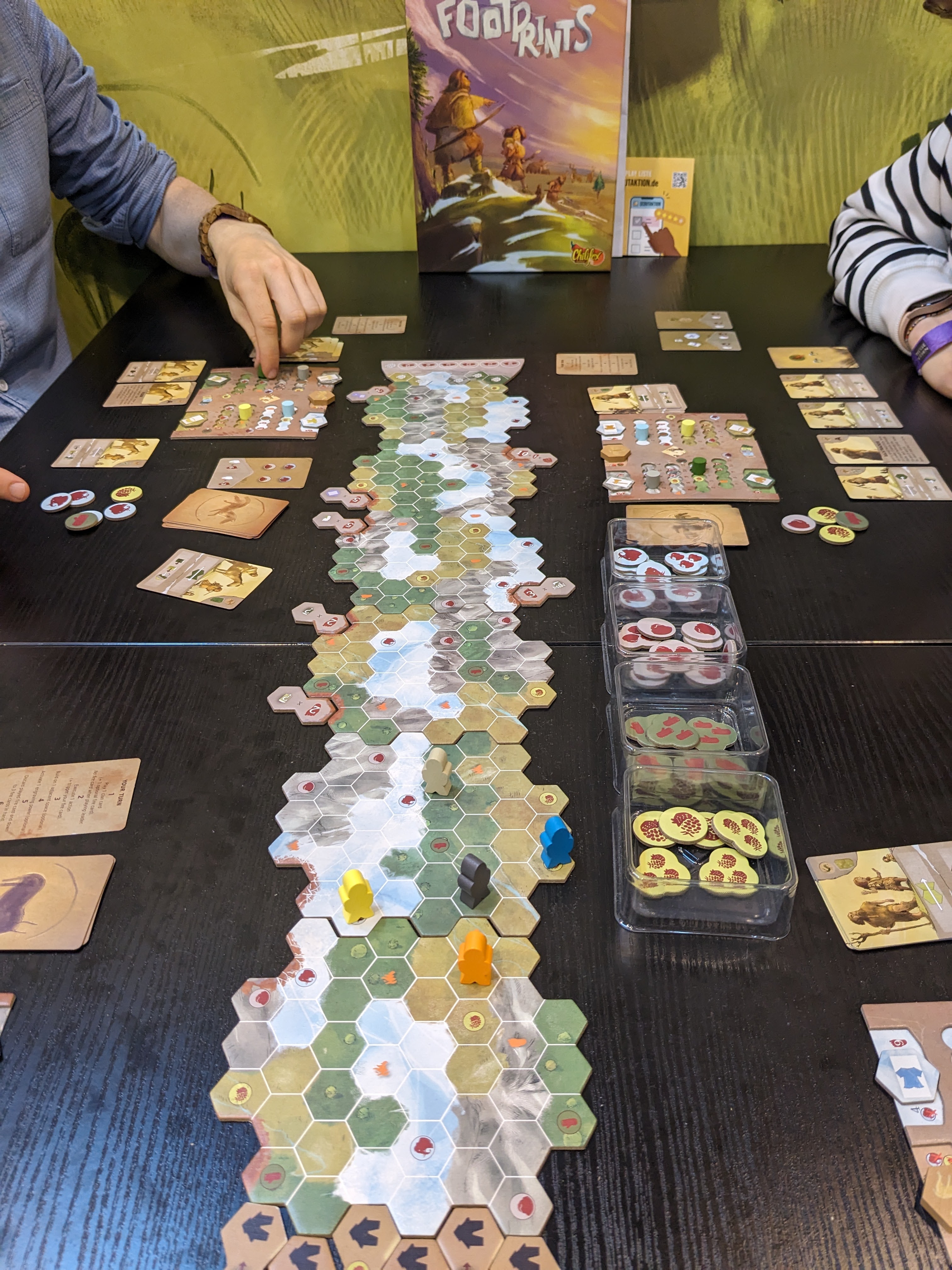
Footprints is probably the game I got most excited about while playing it. You’re playing as a clan of stone age people who move through the terrain, gathering resources and leaving footprints (and cave paintings) around. Each card you have can either move your pawn or increase the amount of movement you get in one or two terrain types, and you unlock more powers as you go. It was really enjoyable and we also got a box for home – good thing that we did, because it did sell out later during the Messe!
Color Flush
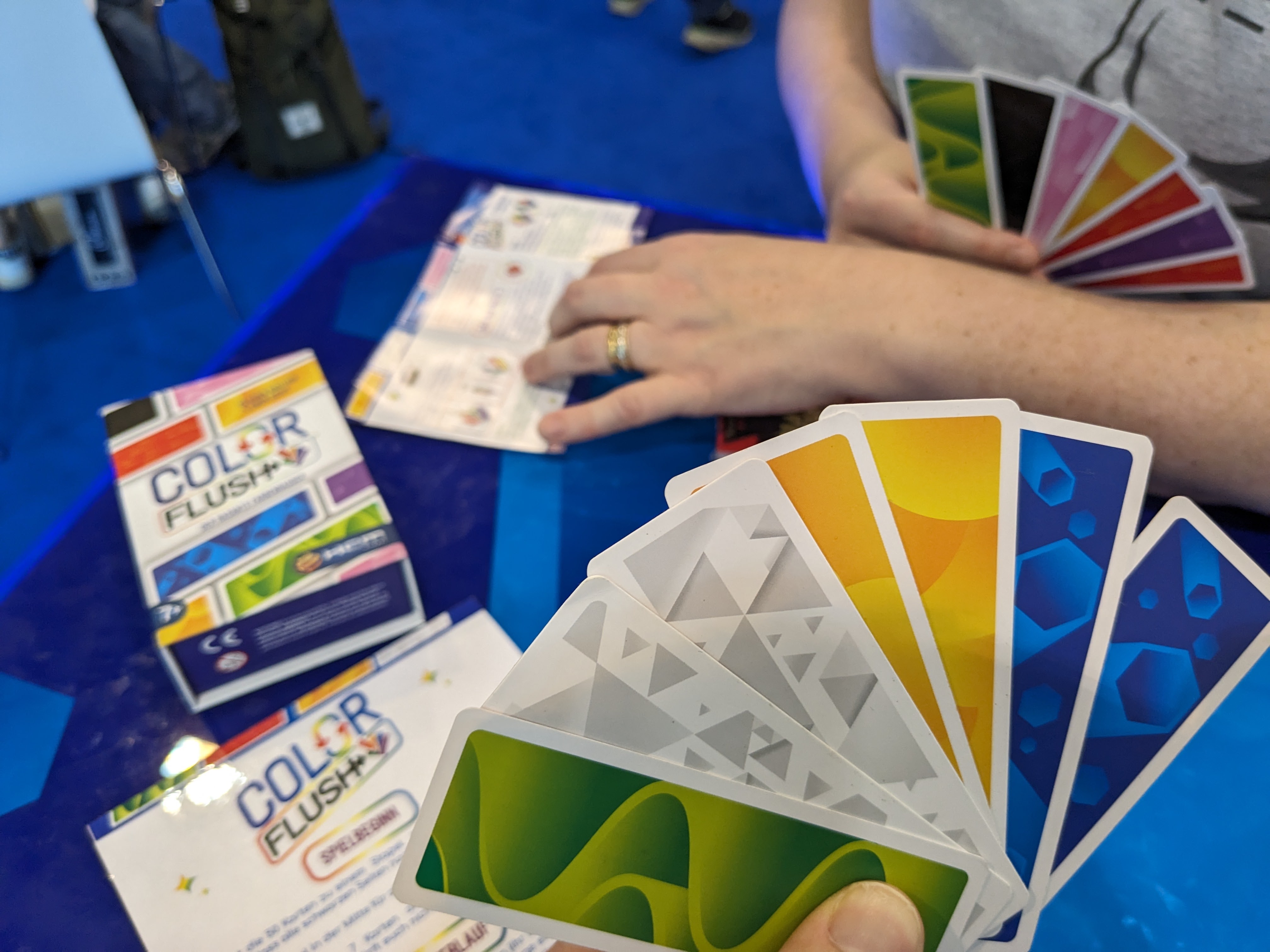
In Color Flush, players have colored cards that may or may not have the same color on both sides. They’re trying to get a hand in front of them that has only one color of cards, and they do that by picking cards, removing cards and turning cards. We explored this 3+-player game on our own with the German rule, and it felt like it could be fun, so we got a box; but a subsequent attempt at play proved disappointing. Possibly the buying mistake for this year :p
Sixto
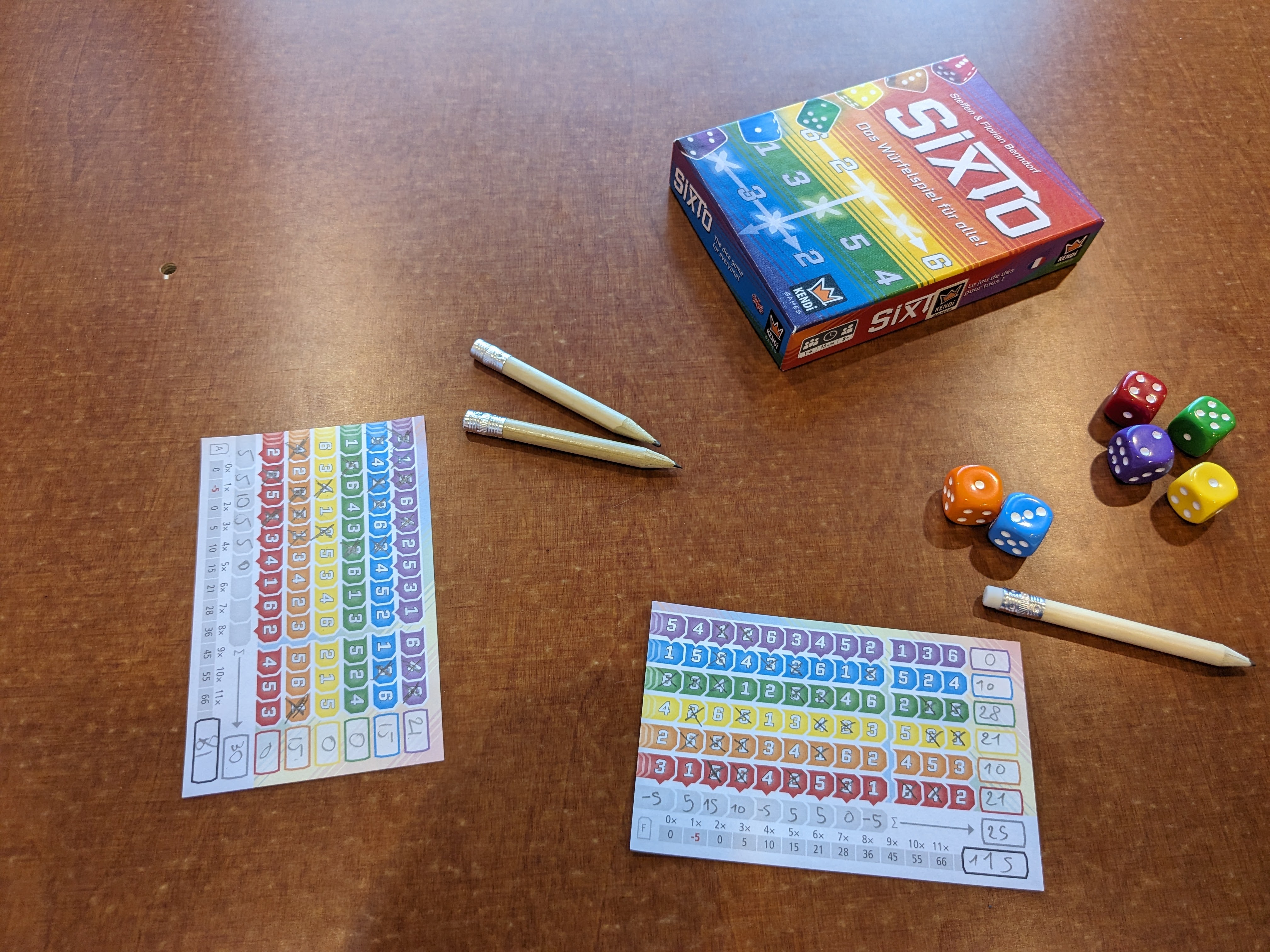
Sixto is a roll&write game where you decide, on each roll, whether you want to cross the cell corresponding to a number and a color on your sheet. Crossing a cell prevents you from crossing cells to the left of it; scores depend on the number of crossed cells on each row and each column (and can be negative if there’s only a single cell crossed on a given line!). Could probably replace Yahtzee for most use cases, but we don’t play Yahtzee much 😉
Whale Street
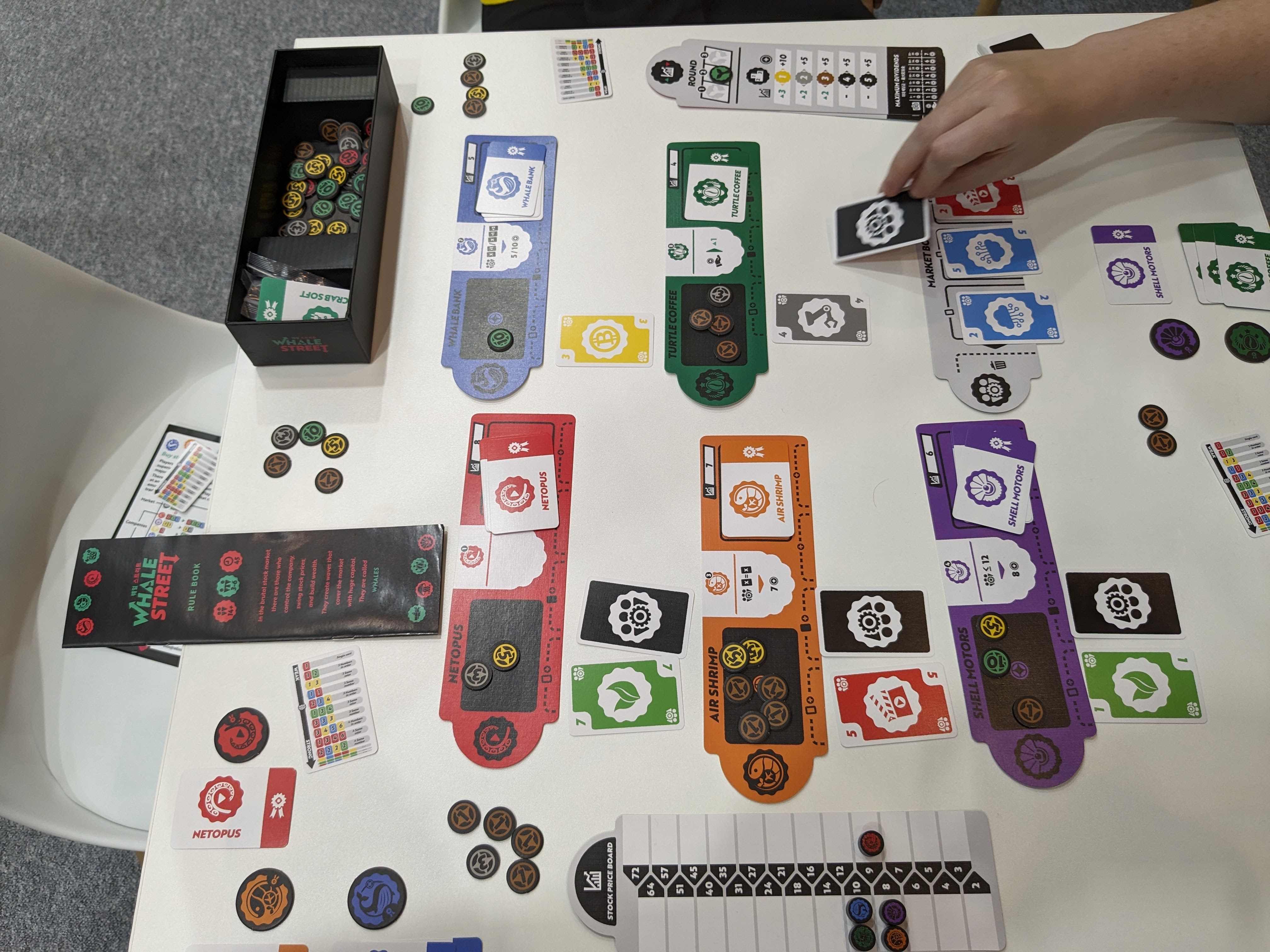
Whale Street is a stock exchange game where you try to invest your and your companies monies wisely (in order to maximize your final profit), while trying to be the “best operated company”. Honestly kind of neat, and clicked well together; playing it during the demo only the two of us may have removed a bit from the desired feeling of the game (as it was, we probably weren’t competitive enough with each other!), which may have been more fun otherwise.
Trio
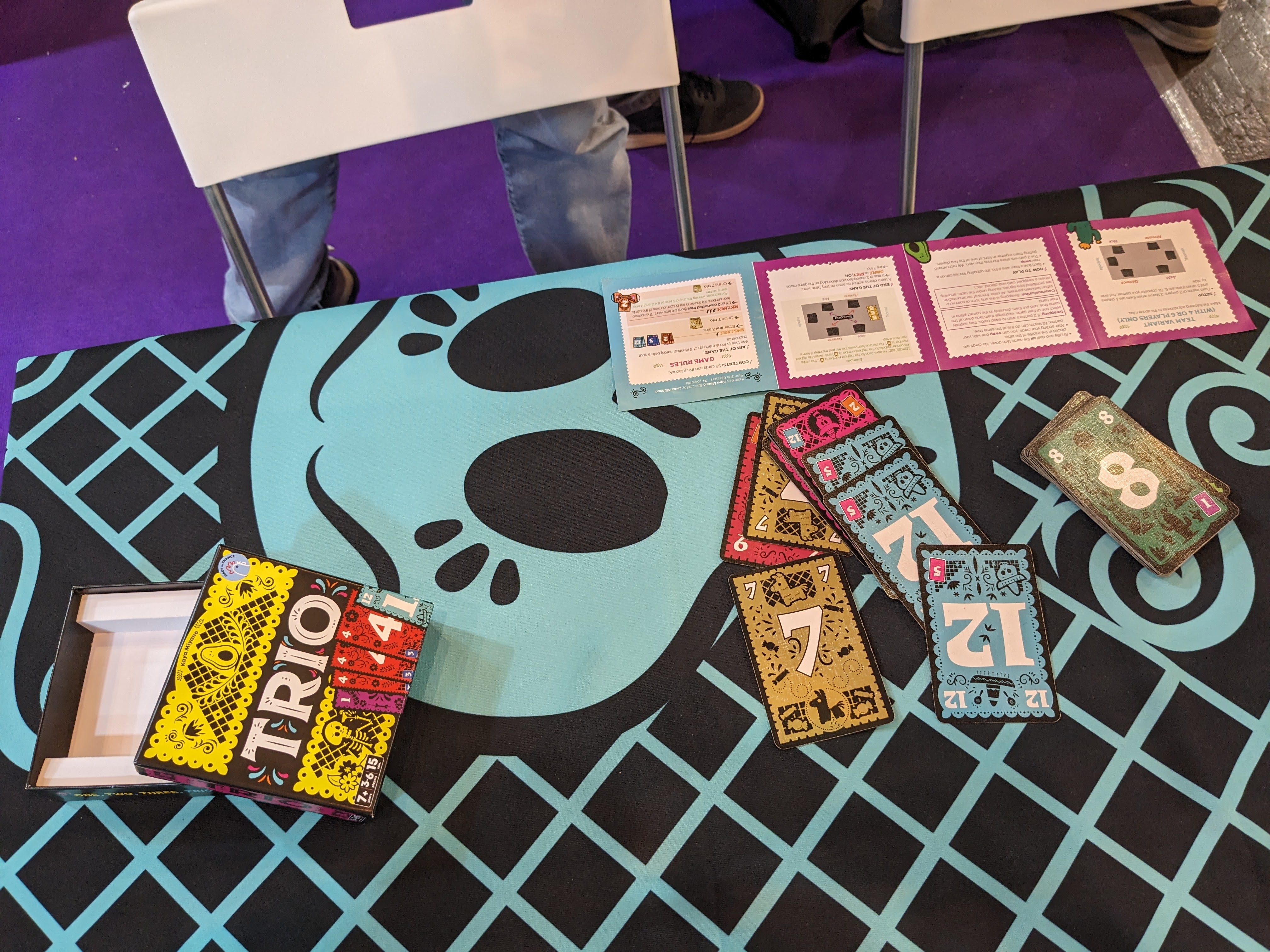
Trio was a “colored number card game”, so obviously we had to give it a try 😉 Cards are split between players and a third deck that gets laid faced down on the table. Players are trying to create three triples of identical cards by asking their opponents for their lowest or highest card, playing their own lowest or highest card, or flipping a card from the middle. requires quite some memory, but we had more than a few good laughs, it’s quick to play and… well, fun – so that’s another deck of numbered colored cards in the collection 😉
Bites
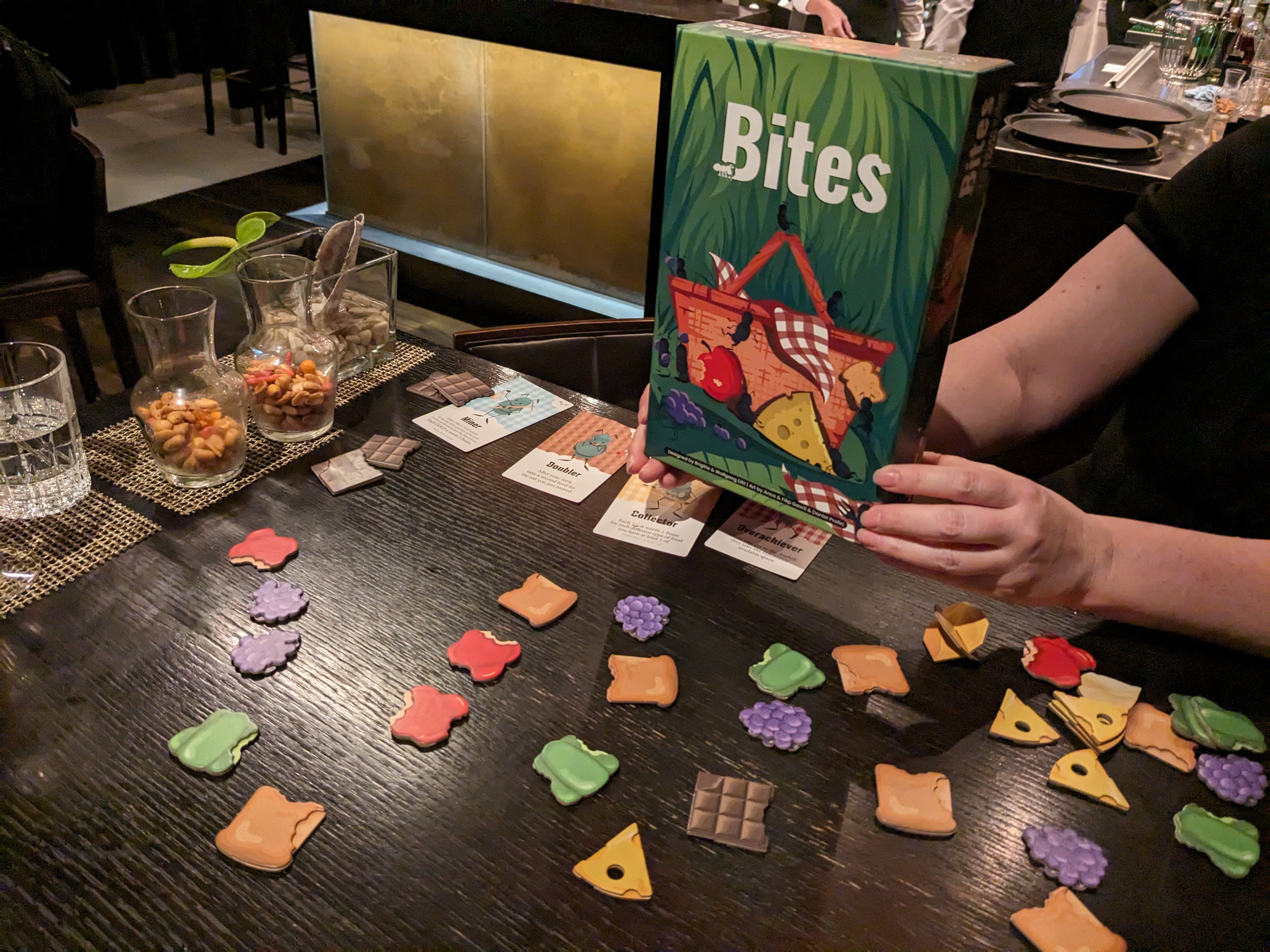
Bites has an unfortunate title for French-speaking gamers, but a cute theme where ants are trying to gobble picnic leftovers. All players control all the ants, and can get a piece of food on each round; the order in which the ants arrive at the end of the path determine which food is worth how many points. Modifier cards for each game round up the box. It’s well-designed and a fun casual game; we played it in the evening at the hotel bar and not during the Messe itself, so we didn’t get a copy then 😉
On The Road
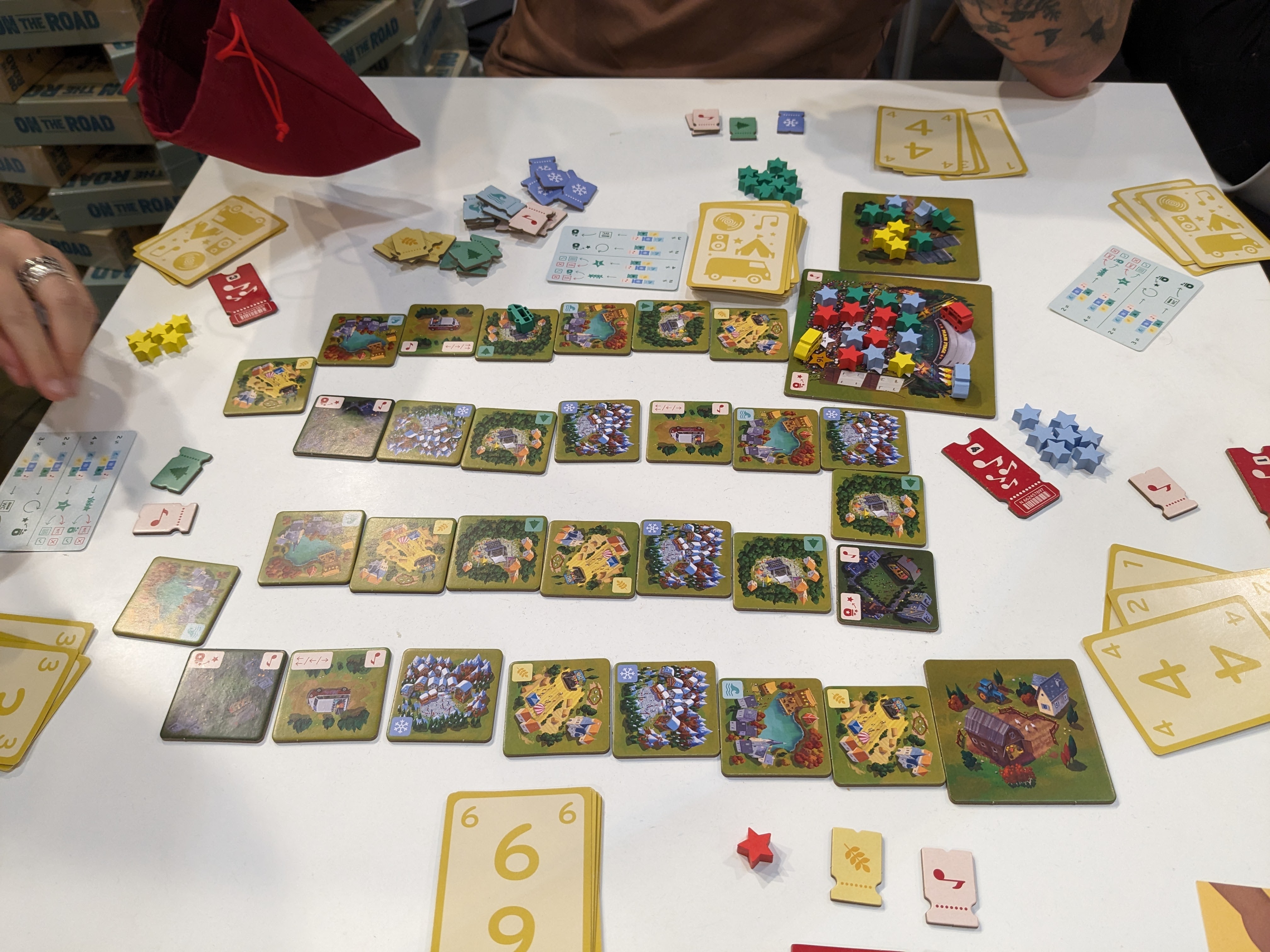
On the Road lets players take the role of a group on their road to success, from their grandma’s farm to a large festival. They collect tickets that gives them fans which should eventually attend the festival… if you’re lucky, that is. Kind of nice, very cute components (the band vans are adorable), but it didn’t quite click enough for it to be a buy.
Garden Guests
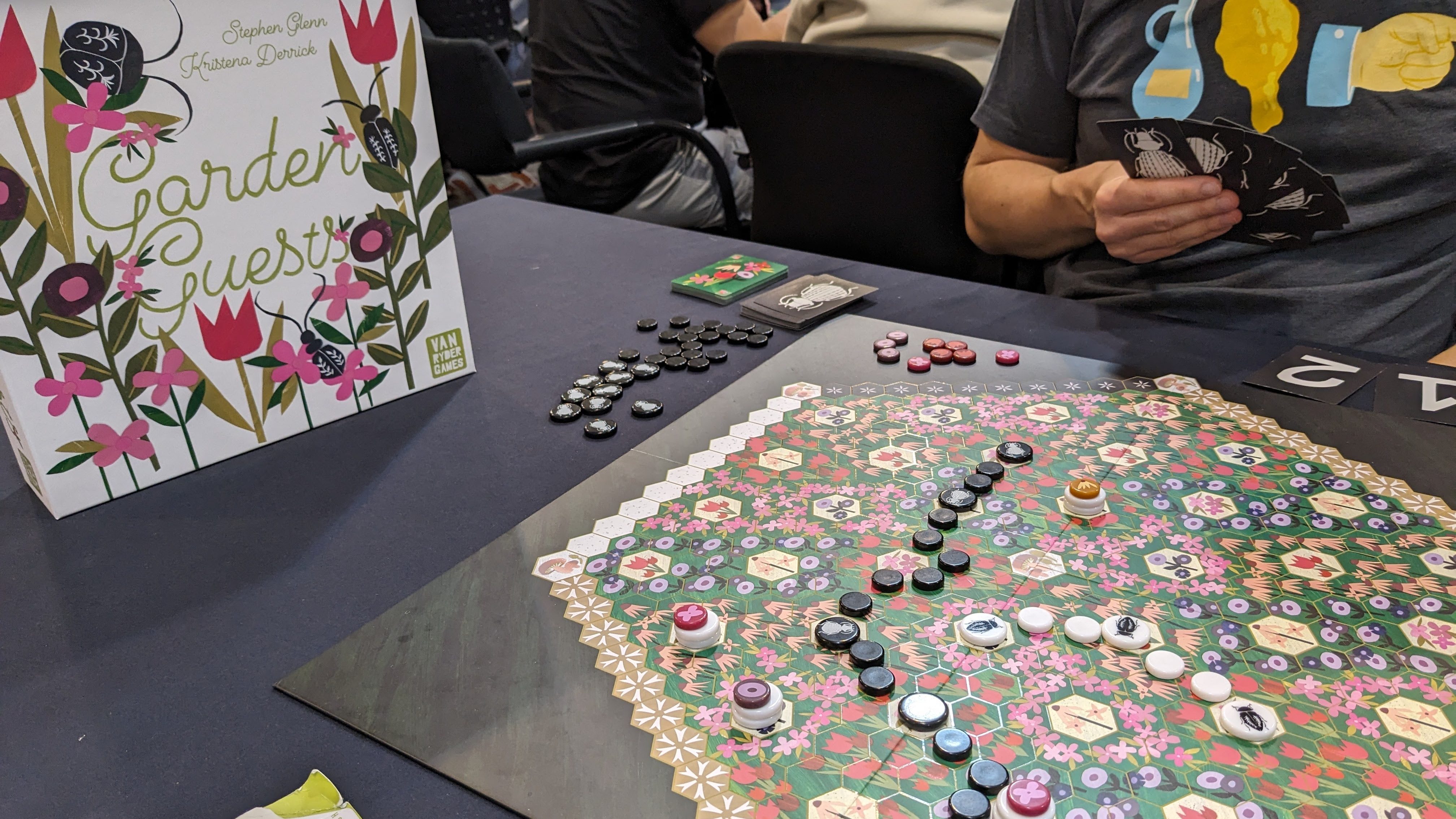
Garden Guests is a distant cousin of Hex: players (or teams of players) want to connect one side of the hexagon to the other with their tokens. For that, they can build bases, and then build paths connecting these bases, depending on the cards they have in their hand. Lovely components, but too abstract for our usual fare. I’m a bit curious about the team play, though (players of different teams play alternatively, are not allowed to communicate but can pass cards between each other).
Sunrise Lane
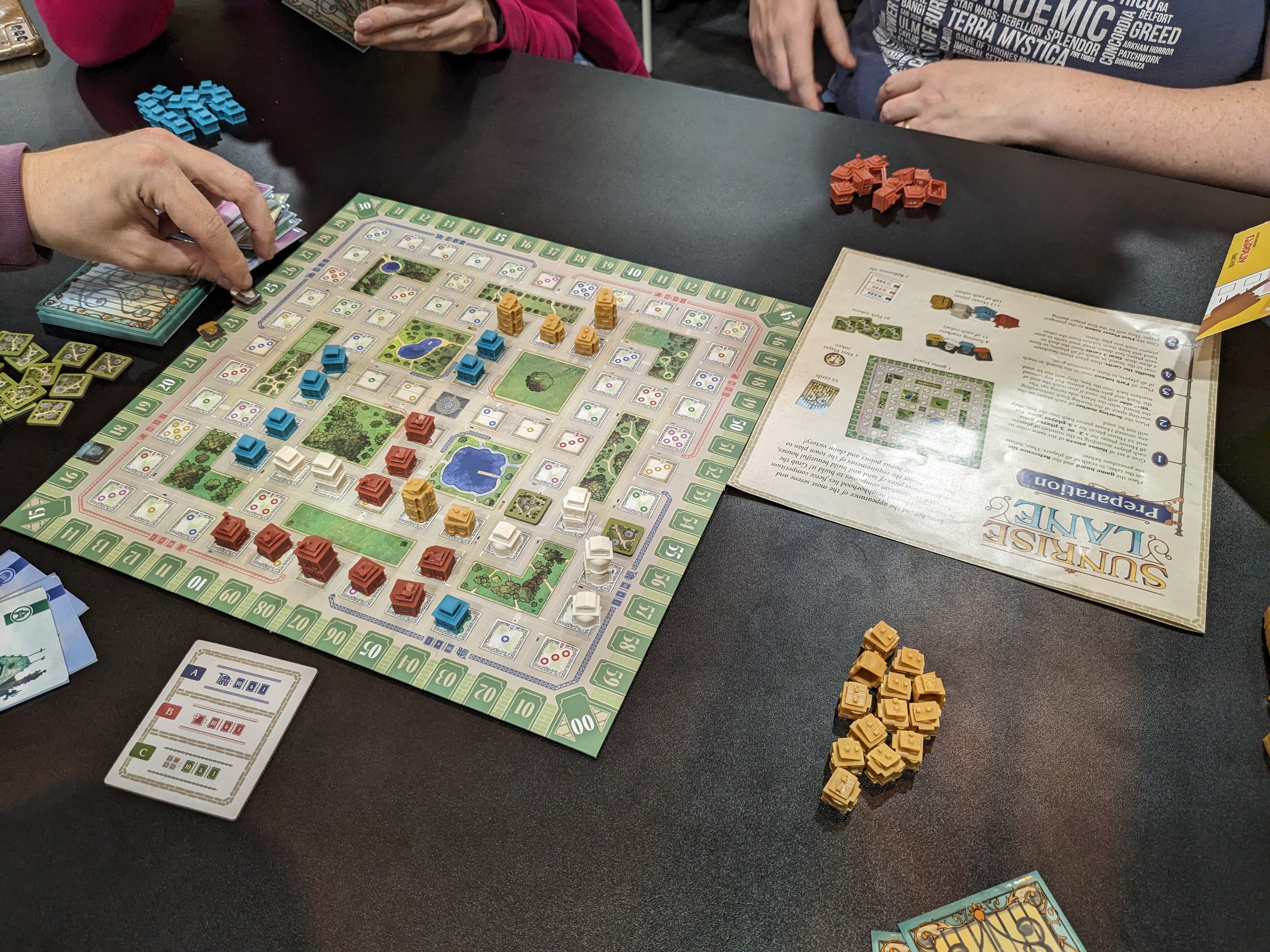
In Sunrise Lane, you build houses of different levels on marked spots to get points depending on the height of the buildings and the exact spot where you put them. You can continue building adjacently in a chain as long as you have the cards to do so. It felt more abstract that it looked, which is not a surprise as we learnt later that it was a reimplementation of Rondo, except on a square grid.
After Us
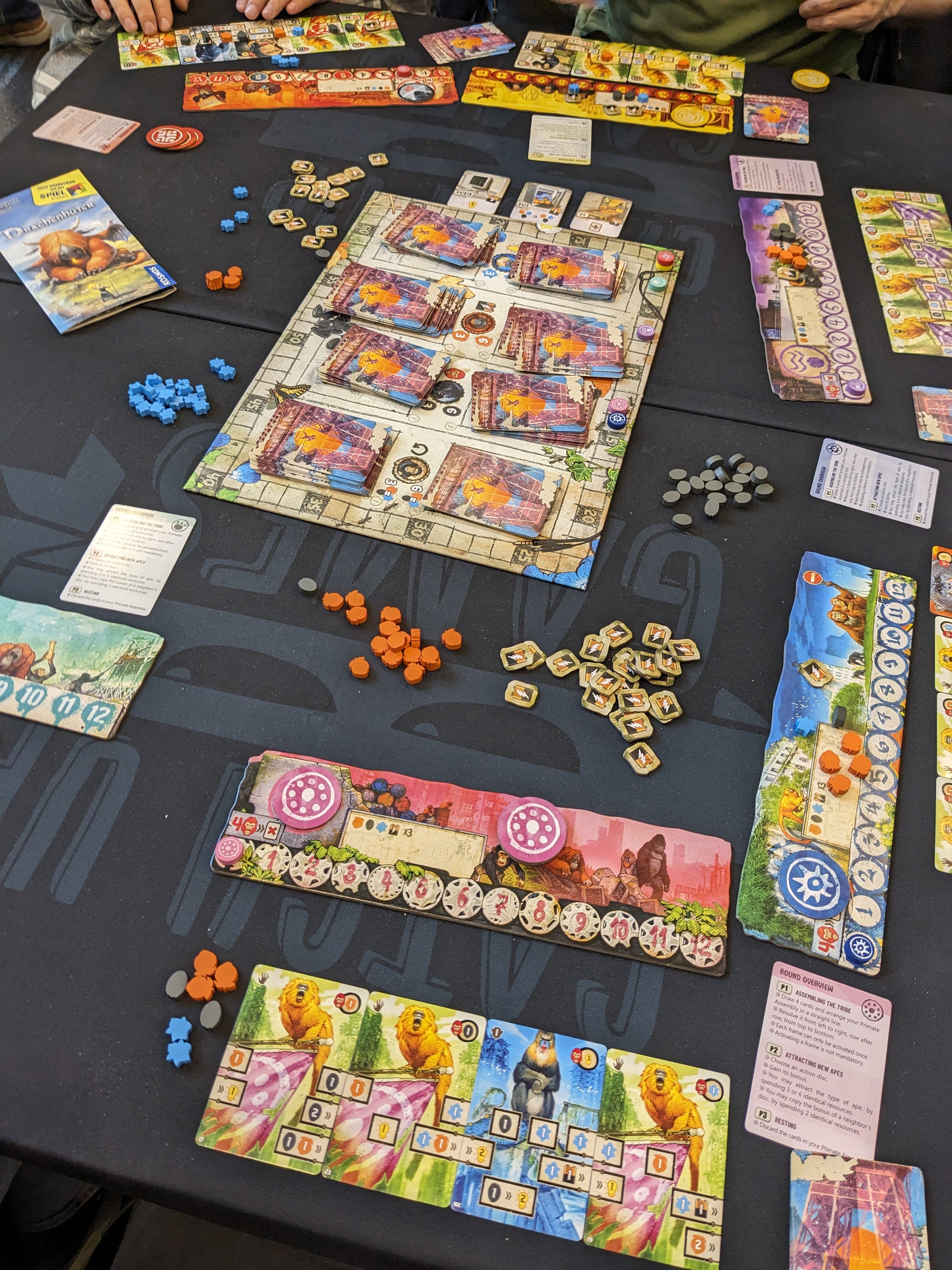
In After Us, players are trying to recruit a band of primates to be the first to evolve to intelligence. The primates cards typically give you some actions or half-actions that can be combined with other half-actions from other cards, allowing you to build resources to get more better faster stronger primates. I liked it a lot, so we got a copy; other players at the table bemoaned the lack of interaction, which is a fair question (but not one that particularly bothers us.)
Apocalipsocks
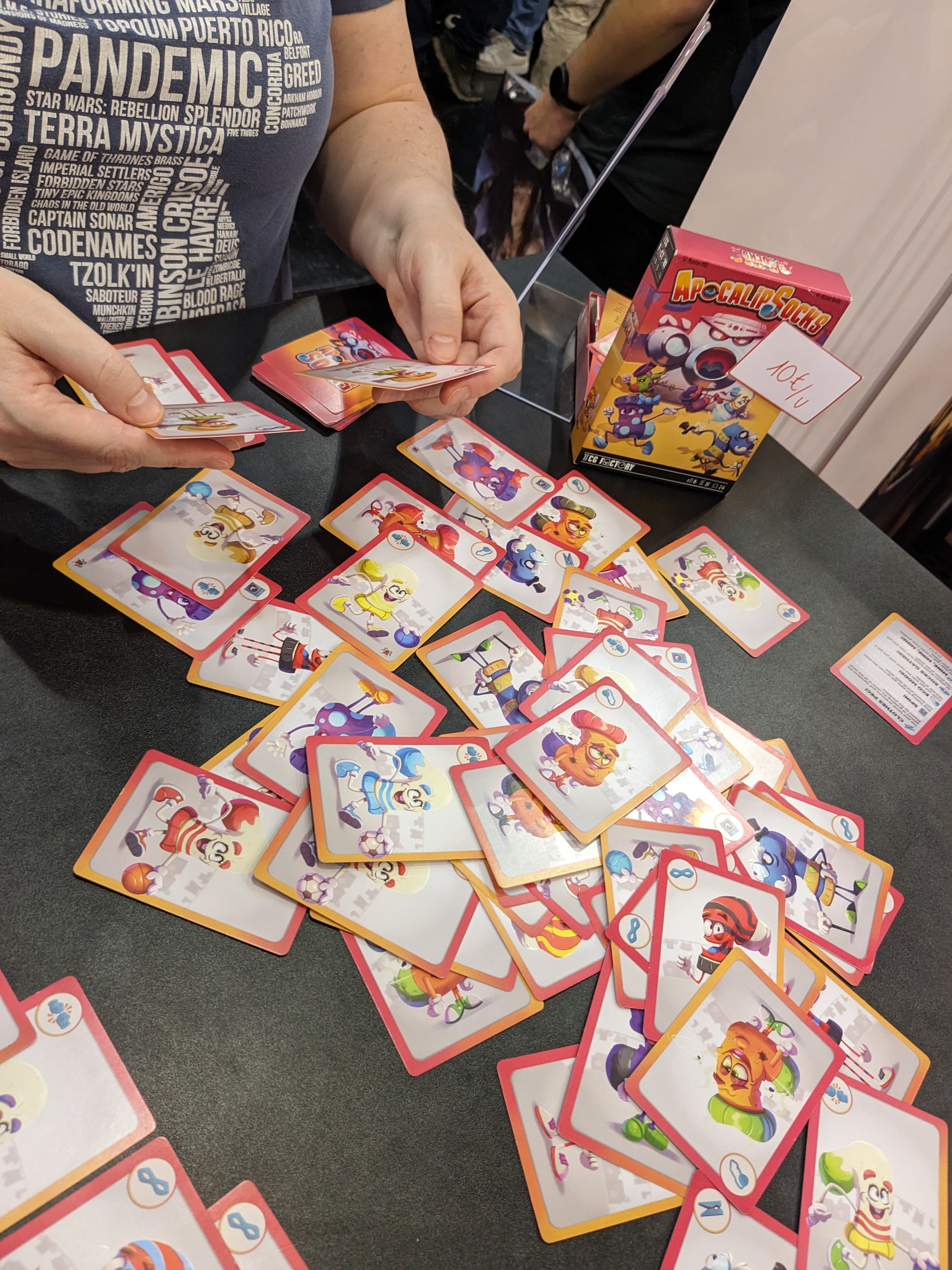
In Apocalipsocks, you try to pair similar-looking socks into identical pairs of socks and, when you do that, your opponents get to do something silly like turning on themselves or playing with one eye closed. It probably works for its audience, but that’s not us 😉 The cards are neat and the details to take care of are fun!
Rome In A Day
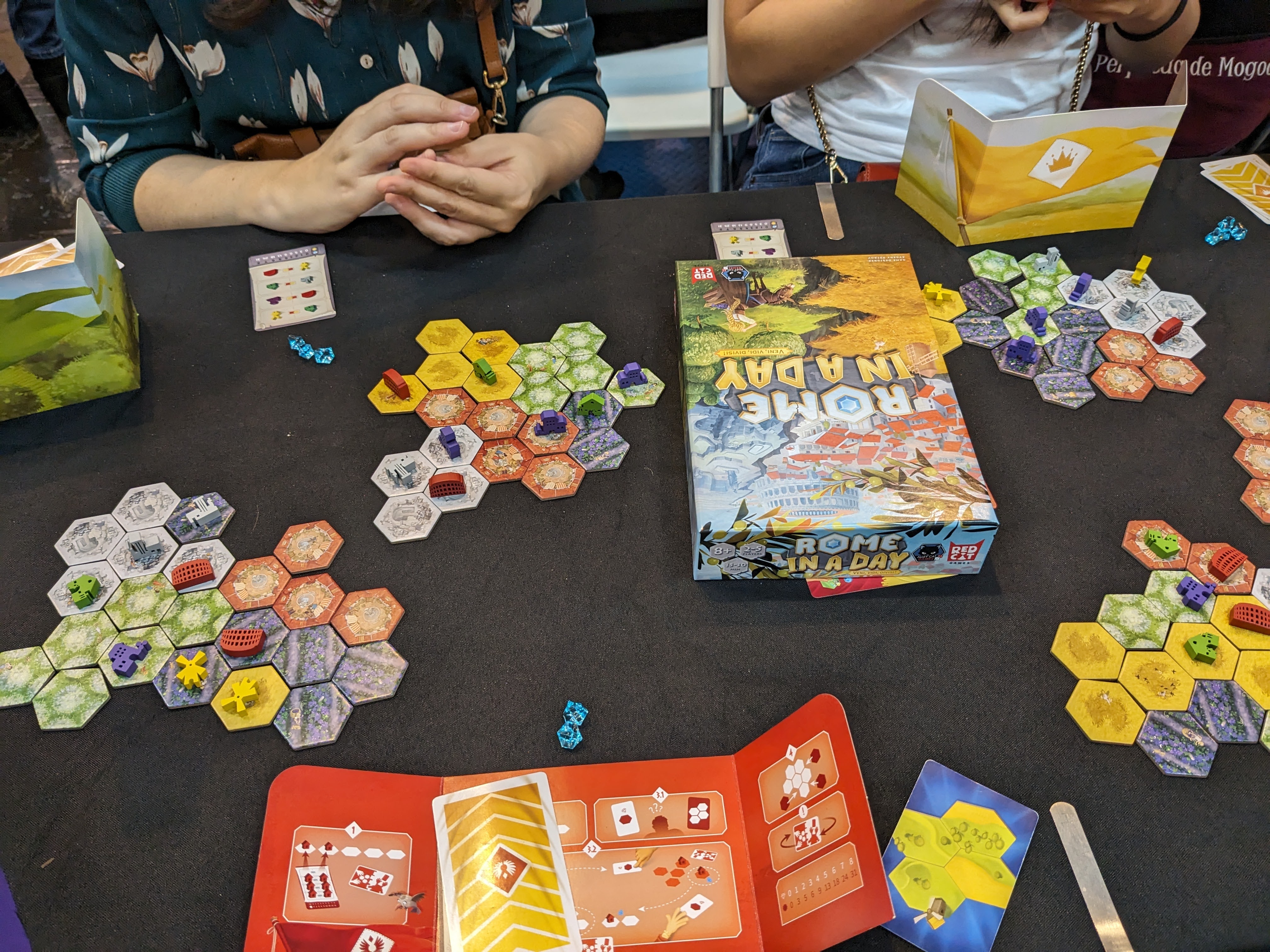
Rome In A Day is pretty similar to The Great Split, which we liked a lot last year: you split tiles behind a screen in two groups, and your neighbor player decides which group of tiles they want to add to their board. Compared to The Great Split, though, it felt like there was a bit more strategy involved in choosing groupings, because the other player’s boards are much more visible/readable; the “getting points” part of it also requires a bit more thinking. Long story short, we got a copy of this one.
Belgian Beers Race Dice
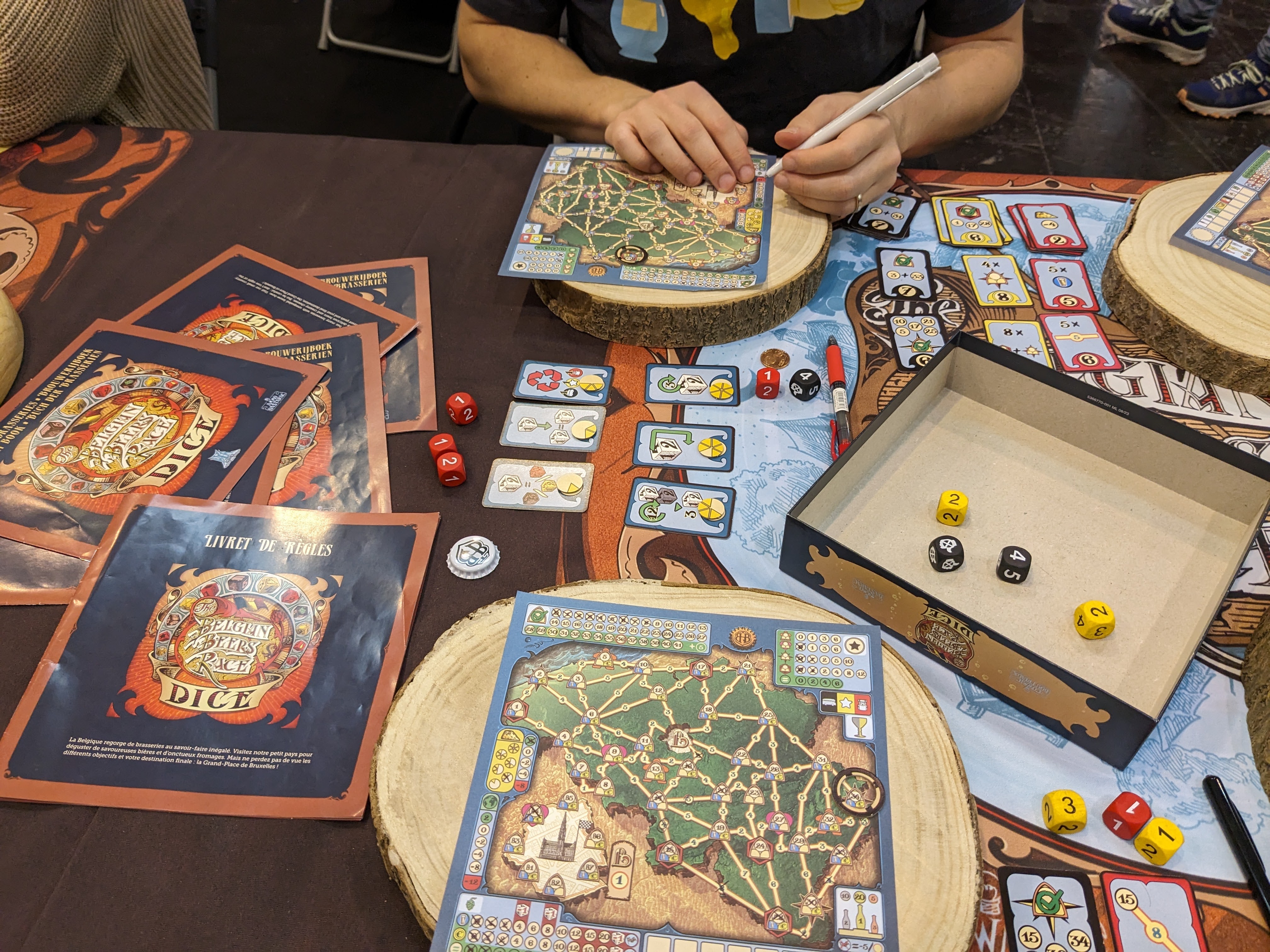
Belgian Beers Race Dice is a roll&write version of Belgian Beers Race. The theme is similar: trying to visit as many breweries as possible while filling in objectives, not get too drunk, and come back to Brussels early enough. The marking sheet makes it kind of hard to follow what’s happening, and it’s quite easy to forget to cross something, which is a bit sad, because the rest of the game feels like a decent roll&write.
Moon River
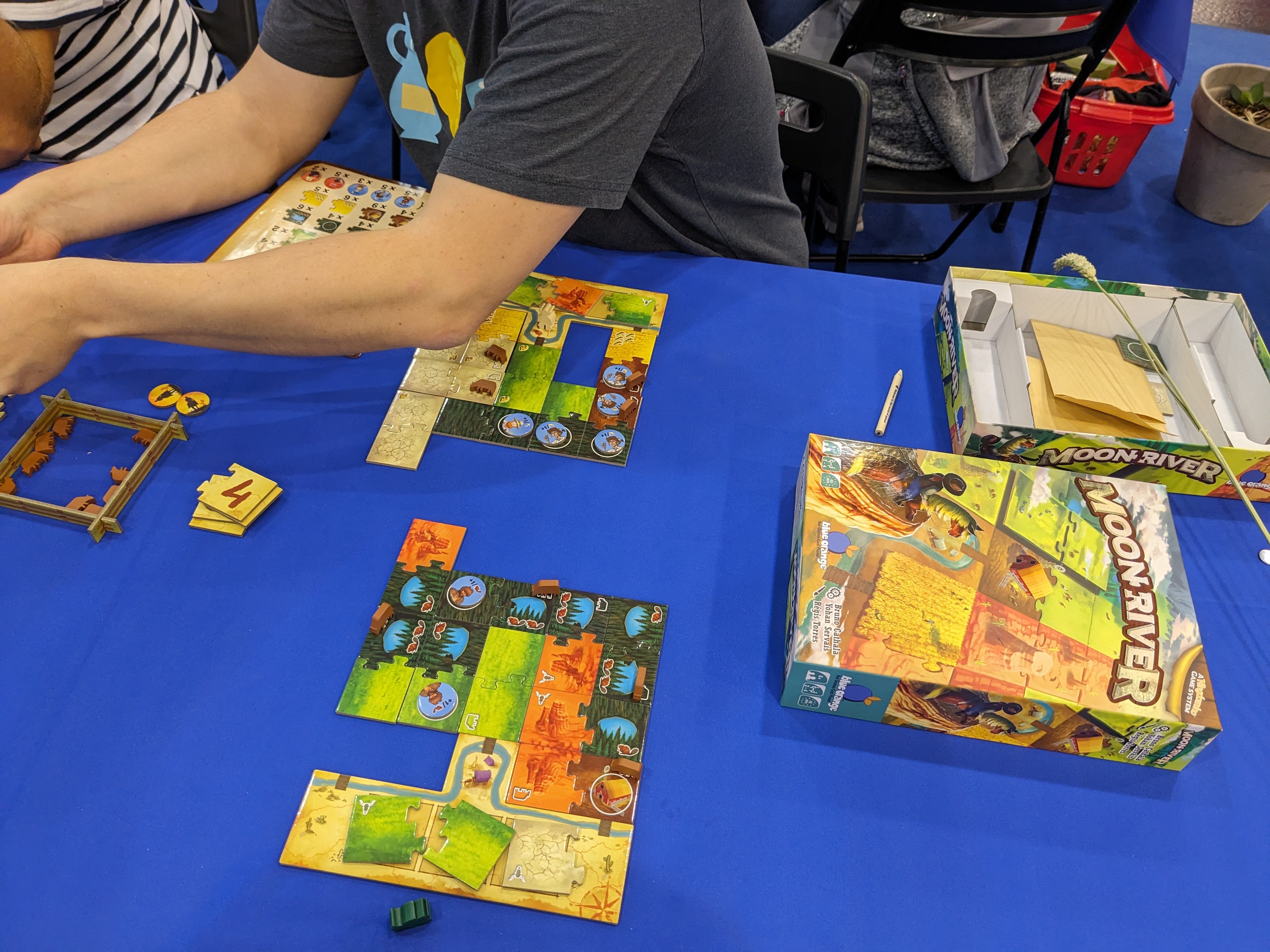
Moon River is a clear riff on Kingdomino, but where players get to build their own dominoes. Also, there’s cows. Kingdomino still has my heart, but I liked this specific take (while I was not necessarily convinced by other variants of it), which felt different enough and enjoyable enough to get a box for that “I’d play Kingdomino, but I’d like something just a tiny bit more complex” mood 😀 (yes, it’s a pretty specific mood.)
Dorfromantik
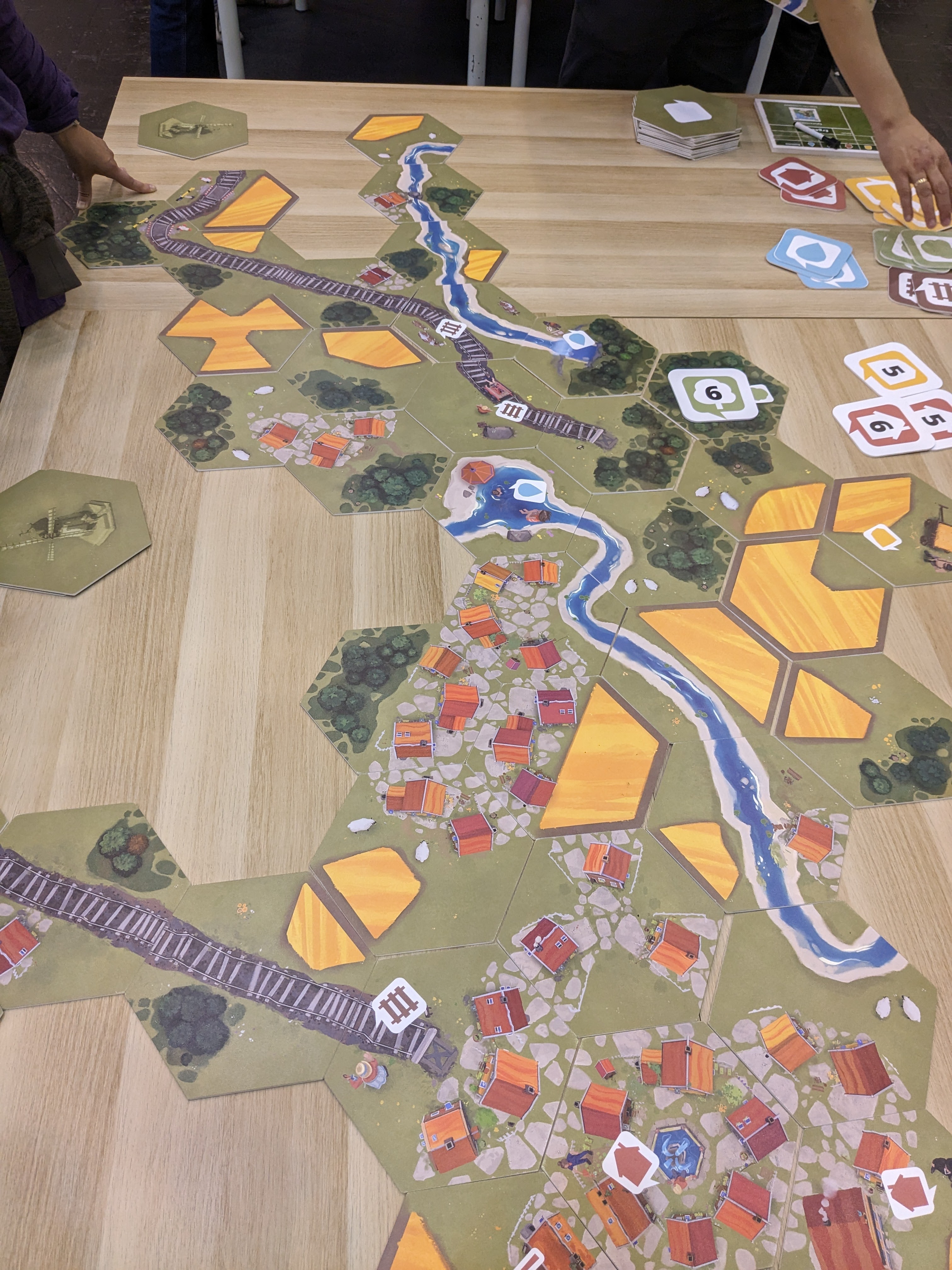
Dorfromantik is a cooperative game, adapted from the video game of the same name. I love the video game, I was excited to see the board game adaptation, then a bit skeptical because it didn’t sound that fun, then it got the Spiel des Jahres award, then I watched it played and was still not convinced, and then I played it myself… and it was super fun. We got a copy, I’m not sure how/with whom we’re going to play the campaign (you get to “unlock” more tiles depending on your score :)) but… worst case I’ll play solo 😛 The above picture is a giant version of it – the box version has much smaller tiles! (Which is a good thing for my table estate.)
Deep Dive
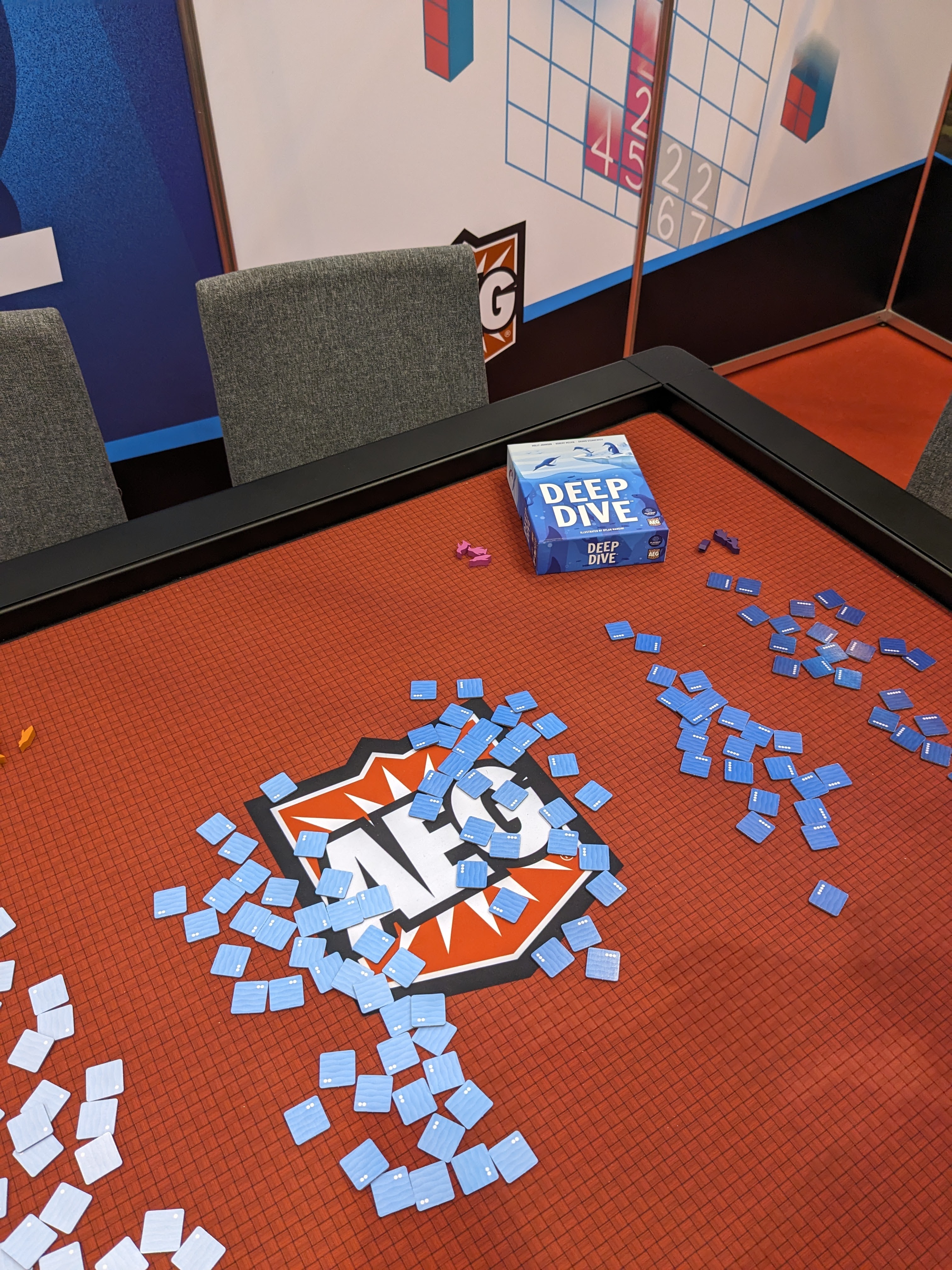
In Deep Dive, you have a colony of penguins looking for food. The deeper you go, the better the fish – but the higher the chance of getting trapped by a predator (No worries, though, you’ll get back eventually!). It’s a pretty fun push-your-luck game, it plays 6, we know who may appreciate that one, so that was a buy.
ArcheOlogic
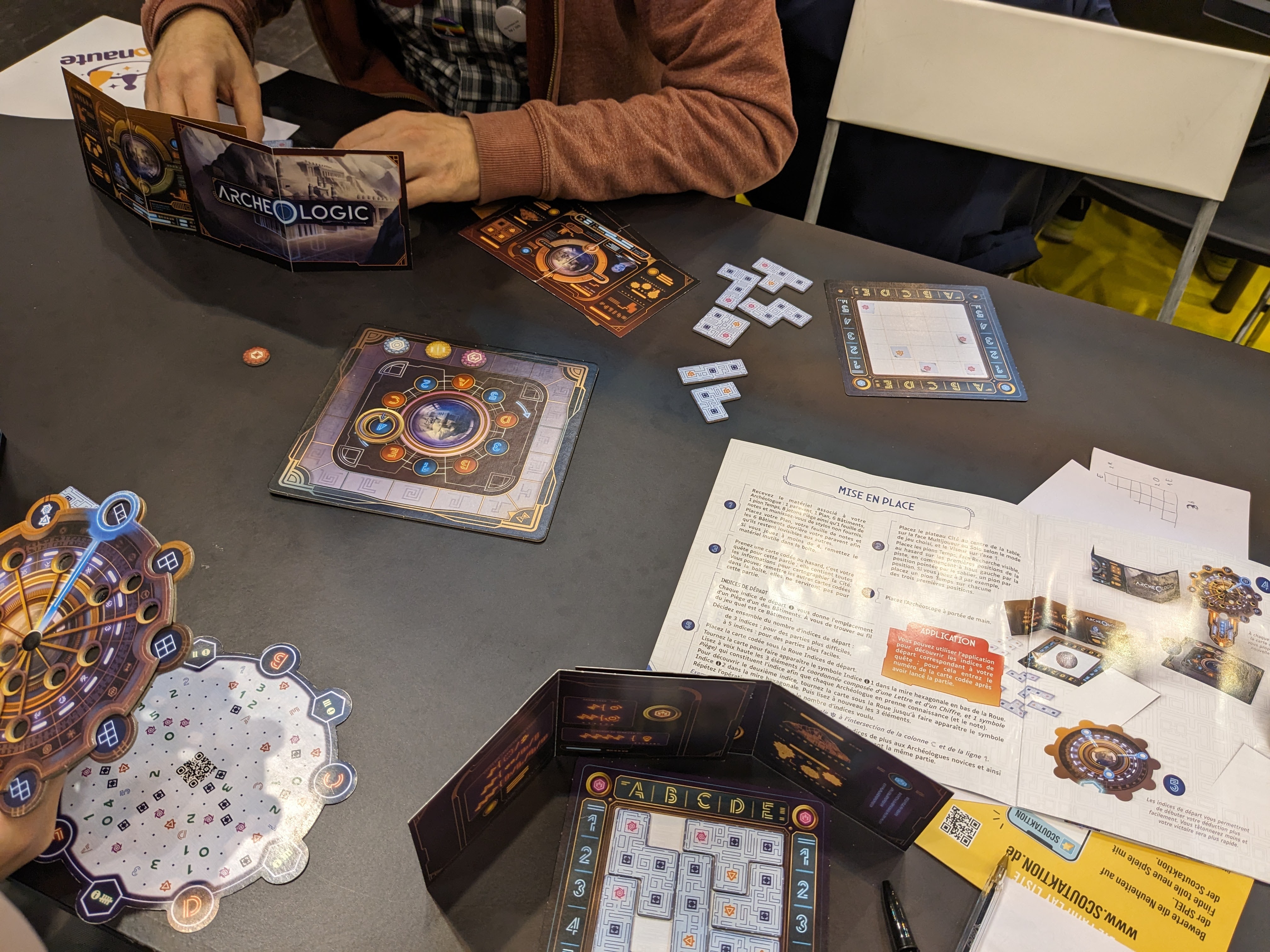
ArcheOlogic is a puzzle game that uses the same kind of mechanic as Turing Machine, but to make players guess the layout of an ancient temple. You get to ask questions such as “what are the parts of this piece that are on column C” or “how many empty spaces is there on line 2”, with various associated costs, and the “most efficient” player normally wins the game. It’s well-designed and actually far more accessible than it looks, but we feared not having the audience for it to be played multiple times.
Mytikas
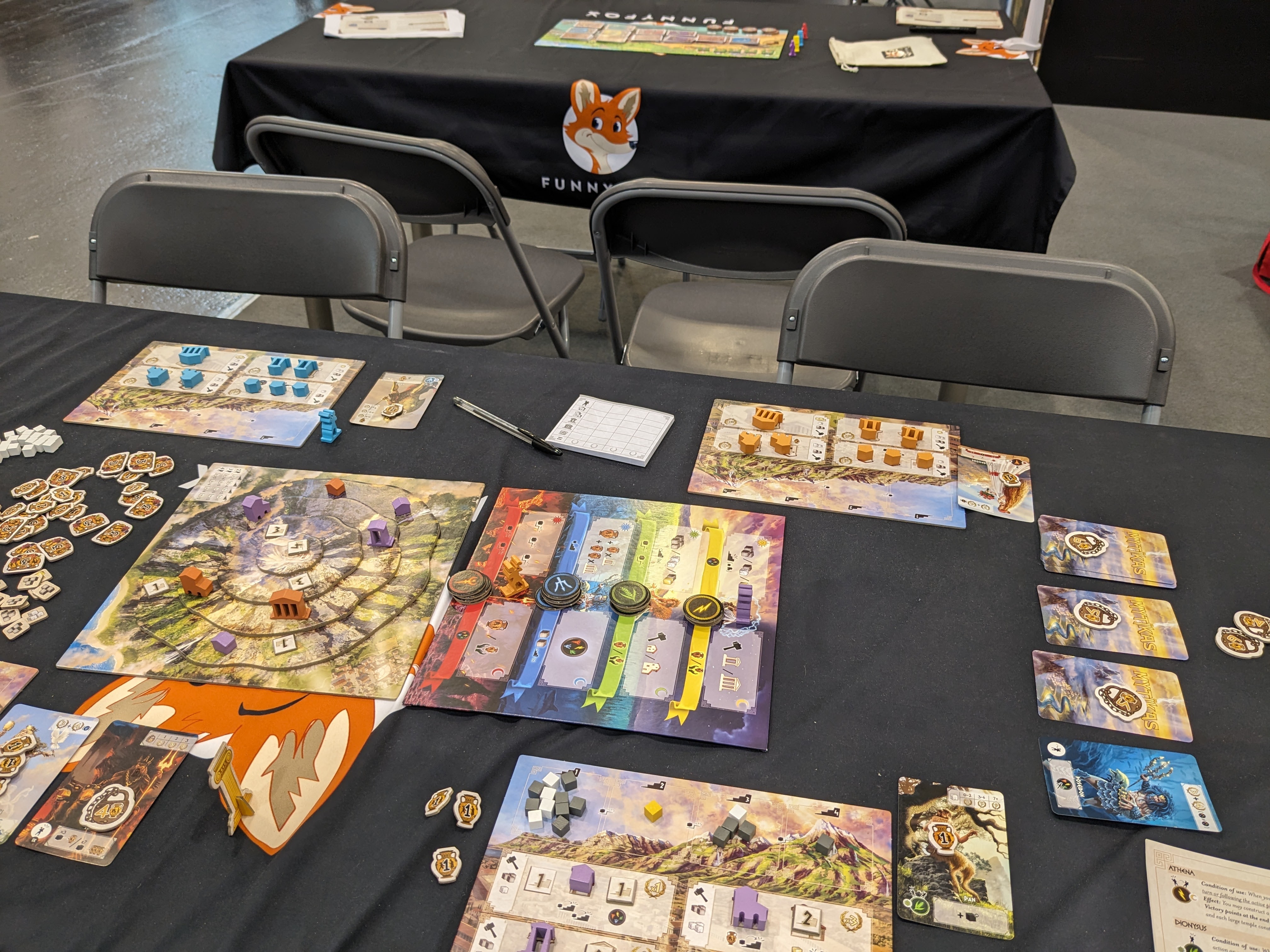
In Mytikas, players try to build houses and temples on the Mount Olympus, while trying to gain the favors of the gods. It’s a resource-managing game, with light worker placement, and generally pleasant, but (for us) not enthusiastically so.
 Balise's Blog